
This module is designed to increase capability by providing knowledge about the importance of exercise.
Module 5 - For health professionals
This module is designed to guide exercise health professionals in supporting their clients with Parkinson’s disease to use this website.
This module will not teach you how to prescribe exercise for people with Parkinson’s disease. If you would like to learn about Parkinson’s disease and exercise prescription, please ensure this is in your scope of practice (eg, you are a qualified physiotherapist or exercise physiologist) and undertake additional training. The resources at the end of this module will help you to get started.
This website is designed to assist people with Parkinson’s disease to increase their exercise self-management skills, enabling them to start and continue exercising over the long term. This exercise self-management program aims to increase exercise self-efficacy (a person’s belief they can exercise and confidence to overcome barriers).
To maximise the benefits of the website, it is recommended that people with Parkinson’s disease work with an exercise health professional who can provide health coaching and advice as they complete the modules.
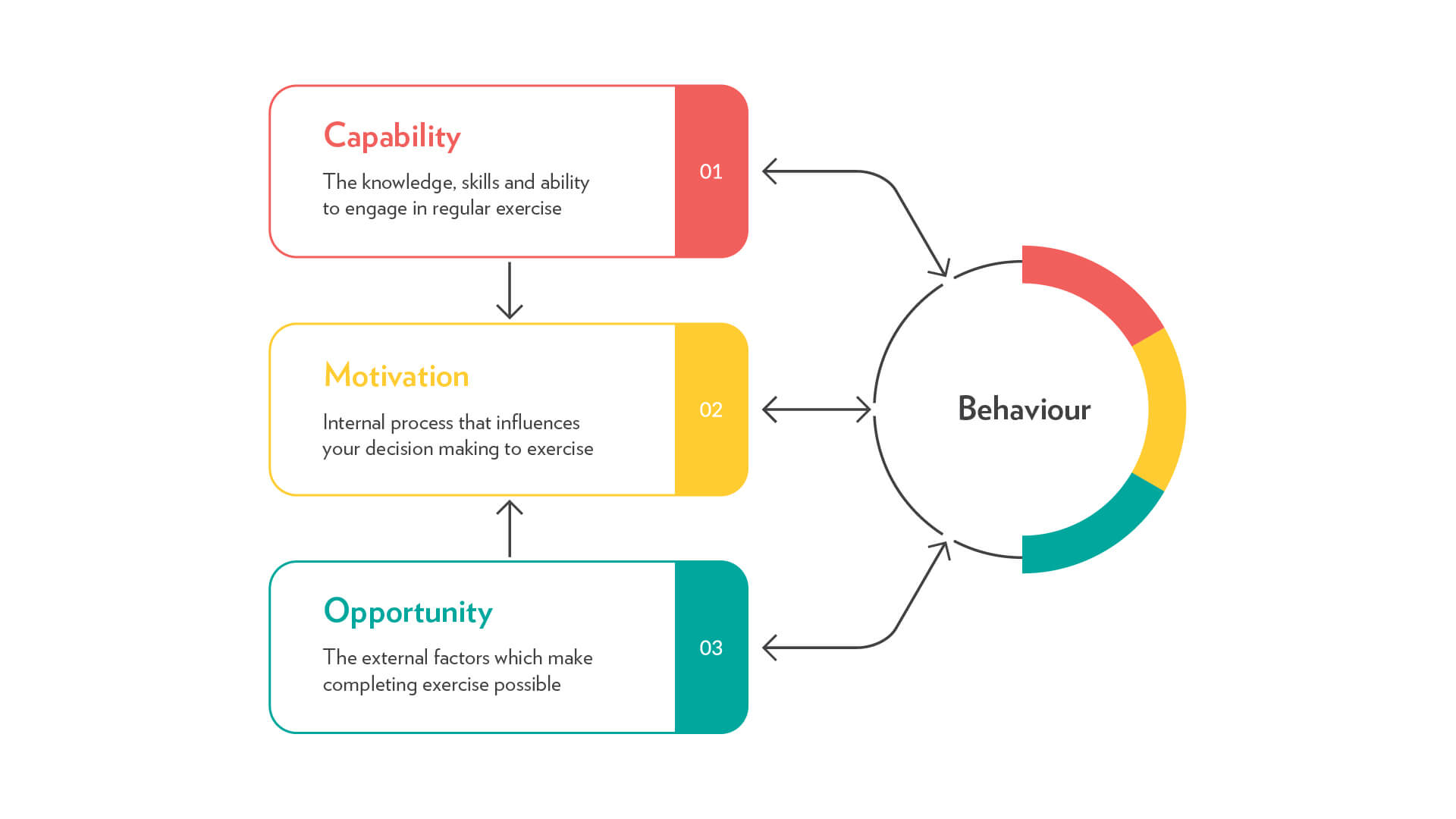
The COM-B model of behaviour change is used as a framework throughout this website.
You need to address all three aspects capability, opportunity and motivation to enable a person with Parkinson's to change behaviour and to start exercising.
The knowledge skills and abilities to engage in regular exercise.
COM-B Model Capability
Capability encompasses both the psychological (knowledge) and physical skills. Does the person with Parkinson’s know how to exercise? Do they have the physical skills to exercise?
Increasing capability assists in increasing exercise self-efficacy, a person’s belief they can exercise and their confidence to overcome barriers. The research shows that people with Parkinson’s disease who have higher self-efficacy are more likely to engage in and continue with exercise.
There are many ways as an exercise health professional you can assist a person with Parkinson’s to increase their capability. Some ideas include;
- Prescribing a tailored exercise program so they know what to do and the exercises are at the appropriate level for their physical skills.
- Adapting and modifying the exercise program as a person's ability changes
- Teaching people how to exercise safely, thereby increasing knowledge and confidence.
- Discussing potential barriers to exercise and developing strategies to overcome these.
- Assisting with goal setting and development of action plans.
- Monitoring progress over time – people with Parkinson’s disease highly value feedback on their performance.
The external factors which make completing exercise possible.
COM-B Model Opportunity
Opportunity encompasses both the physical opportunity and the social opportunity (cultural norms and social cues). Exercise health professionals can directly provide opportunities for exercise, connect people with exercise opportunities and assist in identifying exercise opportunities.
Physical opportunities to consider;
- Location of exercise, e.g home, a gym, in a clinic, in the community such as a beach, local park or neighbourhood
- Supervision, e.g. from a therapist, exercise trainer, family or friends
- Equipment, e.g. what equipment is available?
- Online options
Social opportunities to consider;
- Support available to exercise including health professionals, family and friends
- Exercising in a group
- Exercising with other people with Parkinson’s disease
Internal process that influence your decision making to exercise.
COM-B Model Motivation
Motivation refers to the internal process which influences decision-making and behaviours and involves both reflective (making plans and evaluations) and automatic (desires and impulses) mechanisms. Motivation is unique to everyone.
It is important to understand a person’s motivation for exercise: “Why are they exercising?”. Motivation may change over time and health professionals can assist with increasing and maintaining motivation.
The following table lists things which have been identified to increase people with Parkinson’s motivation to exercise and strategies exercise health professionals can implement.
| Things which increase motivation | Strategies for health professionals |
|---|---|
| Doing something enjoyable | Identify and prescribe exercises that people enjoy and are interesting |
| Supervision and feedback | Provide regular feedback on their performance Identify ways people can self-monitor their performance Encourage exercise to become a habit - something is better than nothing |
| Understanding the benefits of ecxercise | Educate people on the benefits of exercise |
| Exercising with others | Provide group classes Identify opportunities to exercise with others |
There are four modules to be completed by people with Parkinson’s disease. They do not need to be completed in order. Discover how to support people with Parkinson's disease to use those modules.
Module 2: Getting started
Designed to assist people who are not currently exercising but want to start. The module asks a series of questions which will help people with Parkinson’s disease identify the right exercise for them and outline the key considerations to exercise safely.

Module 3: Maintaining and sustaining exercise
Designed to assist people with Parkinson’s disease in identifying barriers to long-term exercise, developing strategies to overcome these barriers and outlining when and where to seek help.

Module 4: Factoring in your fall risk
This module allows people with Parkinson’s disease to determine their risk of falls over the next 6 months and understand how to approach exercise given their fall risk.

- Start a conversation about the importance of exercise.
- Clarify the person’s understanding of the benefits of exercise and the recommendations for exercise for people with Parkinson’s disease.
- Discuss the person’s motivation for exercise.
- Discuss and assist the person to develop exercise goals.
- Discuss and assist the person to develop a plan to exercise.
- Does the plan address the aspects regarding capability?
- Do they need a Parkinson’s specific program?
- What types of exercise will they do?
- Who will support them to exercise?
- How will they exercise safely?
- Does the plan address the aspects regarding opportunity?
- Where, when and who will they exercise with?
- Does the plan address the aspects regarding capability?
- Discuss how the person with Parkinson’s disease is monitoring their exercise.
- Discuss the strategies they have identified to overcome barriers.
- Clarify if the person knows when to get help and from whom.
- Ensure the person with Parkinson’s disease understands their fall risk and the implications for when they are exercising.
John is 55 years old and has recently been diagnosed with Parkinson’s disease. He had been an active individual throughout his life, engaging in regular jogging and going to the gym. However, over the past decade, he gradually stopped exercising due to work commitments and family responsibilities. He has heard that exercise is important for people with Parkinson’s disease, but he doesn’t know where to start.
Things to consider and how this can be assisted by modules;
- What is John’s understanding of the benefits of exercise for people with Parkinson’s?
- What is John’s “Why” for exercising?
- How can you assist John in recognising his capabilities and identifying opportunities for exercise?
- Based on John’s motivation for exercising, his goals and opportunities for exercise, can you assist John in writing an exercise plan?
- Complete Module 2: Getting started
- Help John to complete the goal setting and exercise plan worksheet - discuss the plan with John
Remember it is important to focus on developing John’s self-management skills. If you want assistance with how to start the conversation with John look at the Moving Medicine website.
Sarah is a 72-year-old retired librarian who was diagnosed with Parkinson’s disease 10 years ago. After her diagnosis, she was going for a brisk morning walk three times a week and practising yoga at home using an app twice a week. Recently Sarah has noticed she has stopped exercising as she gets frustrated because her morning walks turned into slow shuffles, and she is unable to maintain her balance with her yoga poses.
Things to consider and how this can be assisted by modules;
- What is Sarah’s motivation for exercising and who can support her to continue exercising?
- Ask Sarah to complete Module 2: Getting started
- What is Sarah’s fall risk, and does she need to be supervised when exercising?
- Help Sarah to complete Module 4 “Factoring in your fall risk”
- Does Sarah need a new exercise program to be prescribed for her which considers her current physical capabilities?
- How can you assist Sarah in identifying different opportunities for exercise which she might be interested in trying or enjoying to do?
- Can you assist Sarah in writing an exercise plan?
- Complete Module 2: Getting started
- Help Sarah to complete the goal setting and exercise plan worksheet
- What barriers might Sarah experience when returning to exercise?
- Ask Sarah to complete Module 3 Maintaining and sustaining exercise
Remember it is important to focus on developing Sarah’s self-management skills. If you want assistance with how to start the conversation with Sarah look at the Moving Medicine website.
The American Parkinson’s Foundation has these recommendations for exercise:
- Start by doing small amounts and gradually increase the frequency, time and intensity.
- Aim to build up to 150 minutes of moderate to vigorous exercise per week, which includes a combination of:
- moderate to vigorous aerobic exercise 3 days a week for at least 30 minutes
- strength training for all major muscle groups 2 to 3 days per week
- balance, agility and multitasking training (e.g dance, Tai Chi) 2 to 3 days per week
- stretching exercises at least 2 to 3 days per week, but aiming for daily.
How do we have conversations about physical activity and exercise?
This is a great resource for a step-by-step guide to having physical activity conversations in practice.
Benefits of exercise
- Osborne et al, Physical therapist management of Parkinson disease: a clinical practice guideline from the American Physical Therapy Association. Phys Ther 2022; 102(4)
- Exercise is Medicine factsheet on PD for health professionals
COM-B Model of behaviour change
- The behaviour change wheel: A new method for characterising and designing behaviour change interventions
- Summary of the COM-B
Online exercise programs
Contact us
Please contact Dr Allyson Flynn for more information or feedback about the program.