Please contact Dr Allyson Flynn for more information or feedback about the program.
Module 2: Getting started
/
/
/
/
Module 2: Getting started
After completing this module, you will be able to:
- identify the right exercise for you
- outline the key considerations to exercise safely.
It is important to find the right exercise for you. The best exercise is the one which you will complete.
Performing exercise regularly gives you the most benefit. Exercising consistently supports long-term health improvements and helps to better manage your Parkinson’s, improves quality of life, and overall well-being.
You will be more motivated to perform exercise which you find enjoyable and meaningful. This exercise is most likely to be effective and to be continued in the long term.
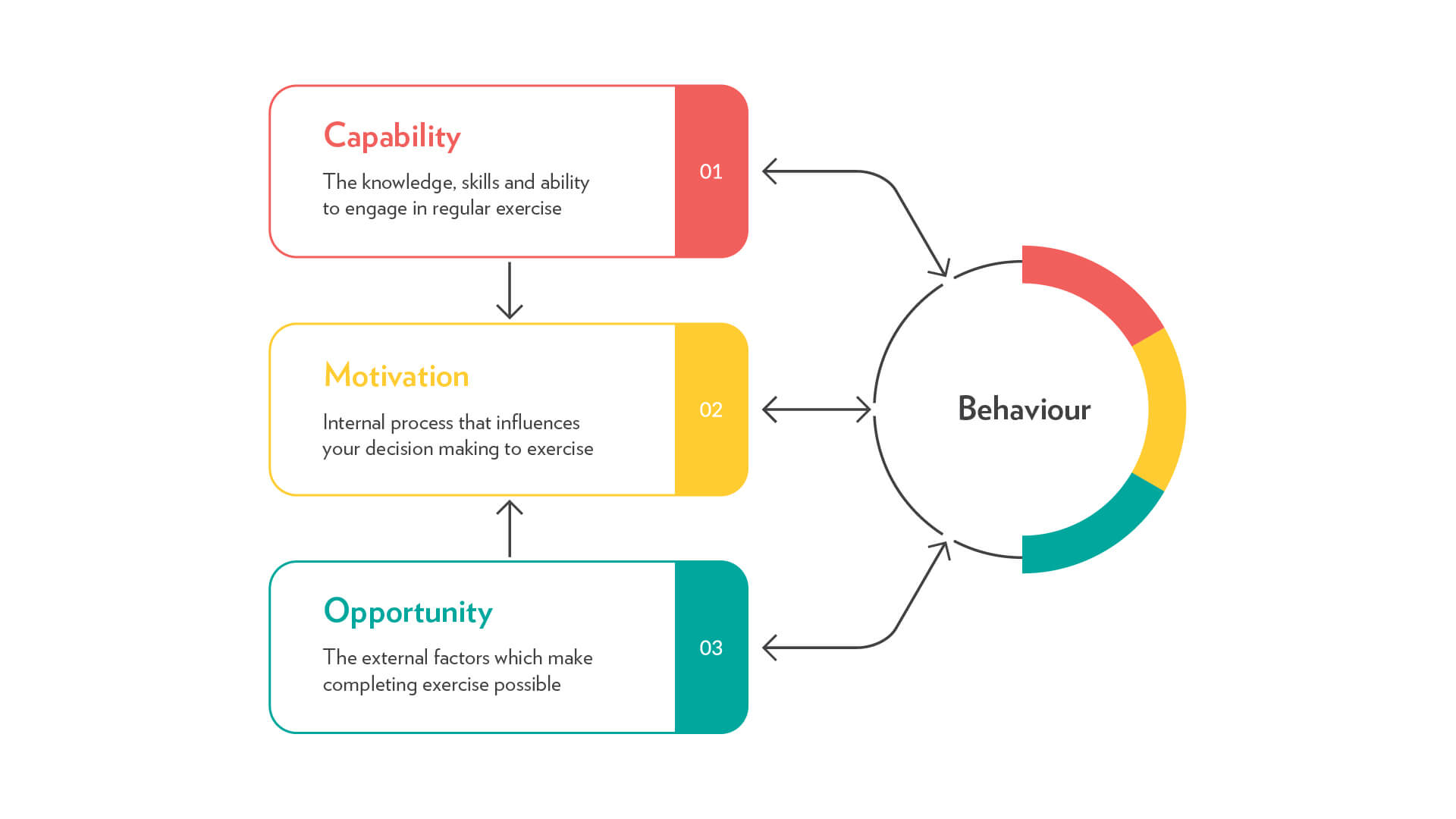
When thinking about starting to exercise it can be helpful to use the COM-B model of behaviour change as a guide.
You need to address all three aspects of capability, motivation and opportunity to enable a person with Parkinson's to change behaviour and to start exercising.
Yes!
It is recommended that people with Parkinson’s disease see a physiotherapist or exercise physiologist who can prescribe a program which is tailored to their individual needs, considering their symptoms, disease stage, fall risk, goals and preferences.
Your symptoms and stage of the disease will impact the exercise you do. Exercise should be commenced as soon as possible after diagnosis - though it is never too late to start.
As your disease progresses over time, your exercise program will need to be reviewed and updated to meet your changing needs and maintain your safety.
There is no evidence that one specific type of exercise is best for people with Parkinson’s disease. Programs should aim to include a variety of types of exercise. Different types of exercise include:
- Aerobic exercise: Exercise that increases your heart rate and breathing, such as brisk walking and cycling.
- Strength training: Exercise that targets and strengthens your muscles by working against resistance, such as weights, elastic bands or body weight.
- Balance, agility and multi-tasking exercise: Exercise that focuses on improving your balance, agility, mobility and reducing the risk of falls. Examples of this type of exercise are stepping in different directions, shifting your weight, and multitasking (doing two or more things at once). This includes specific balance exercises and activities such as dance or Tai Chi.
- Stretching exercises: Exercise aimed at improving joint range of motion, and muscle length.
- Mobility exercise: Exercise that improves your walking.
- Functional exercise: Task-specific practice of everyday activities, such as standing up, sitting down, and reaching.
Practice what you want to improve. For example, if you want to be stronger, you need to do strengthening exercise. Some exercises can help you achieve more than one goal. For example, walking can help you walk better and improve your fitness.
If possible engaging in higher-intensity exercise (where you are breathing heavily and can only speak a few words at a time) is recommended as higher-intensity exercise can lead to improvements in your fitness, mobility and overall physical performance, enhancing your ability to perform daily activities and potentially slowing down the progression of the disease.
The evidence shows that people with Parkinson’s benefit from having people support them to exercise. Support is especially important for providing motivation for people with Parkinson’s disease who have not undertaken regular exercise before.
A range of people can support you to exercise including a Physiotherapist or Exercise Physiologist, care partners, family and friends.
Having your exercise program prescribed by a Physiotherapist or Exercise Physiologist with experience working with people with Parkinson’s disease will ensure the exercise you complete is targeted to your needs, is realistic, achievable and effective. It will ensure the exercise is optimal, acceptable and adapted as your needs change.
Physiotherapists and Exercise Physiologists can also provide support through regular monitoring, giving feedback on your performance of the exercises and providing physical assistance if required. Receiving feedback assists people to continue exercising in the long term.
Care partners, family and friends can provide support in multiple ways including:
- practical support such as driving you to an exercise class
- increasing your motivation by exercising with you
- keeping you accountable to your goal.
Goal setting is important for initiating and maintaining your exercise habits. Goals will vary for each person and will be influenced by factors such as your symptoms, disease severity, other health conditions and living arrangements.
Before setting your goal, think about why you want to exercise.
When setting a goal, it is important to consider the following concepts (SMART goal):
- Specific: What, Why, How
- Measurable: How will you know if you have achieved your goal?
- Achievable: realistic for you to achieve. Are you willing and able to do what it takes to make it happen?
- Relevant: Something that matters to you.
- Time frame: How long will it take to achieve the goal?
The type of exercise you choose needs to match your goals. Here are some examples of goals which follow the SMART concepts:
- in the next 2 months to increase the speed of my walking so I can keep up with my friends when walking around the shops
- to attend a weekly Parkinson’s exercise class for 10 weeks.
The following might look like a goal, but they do not follow the SMART concept:
- start going to the Parkinson’s dance classes
- do my strengthening exercises every day.
Have a go setting a goal for your exercise – developing a goal and making an action plan form will help.
- Consider if you need someone there when you exercise. There could be some exercises which you can do safely on your own, while others might require supervision to be performed safely. Having someone present might allow you to practice more challenging exercises.
- Start slowly and build up – doing something is better than nothing.
- Stop exercising and seek medical advice if you feel chest tightness, chest pain, lightheaded, or nauseous.
- Make sure you replace your fluids by having a drink of water during or after exercise, especially on hot days.
It is important to understand what motivates you to exercise.
Motivation refers to the internal process which influences decision-making and behaviours. It involves both reflective (making plans and evaluations) and automatic (desires and impulses) mechanisms. Motivation is unique to everyone.
Why is it that you want the benefits of exercise? Think of the big picture. Here are some examples;
- To be able to go on a holiday that involves lots of walking.
- To be able to play with your children or grandchildren.
- To gain a sense of control over my Parkinson’s disease.
- To help manage my stress.
Exercise can be performed in many locations including at home, a gym, in a clinic, or in your community; for example, at the beach, local park or neighbourhood. The evidence shows that no specific location is better than another.
The location of the exercise needs to be easily accessible, convenient and affordable for you. Exercising at a centre or gym provides increased opportunities for supervision, feedback, social interaction and access to equipment.
You may also consider online exercise programs if you prefer to exercise at home.
- Plan exercise so that it becomes part of your daily routine.
- Exercise when your Parkinson’s medications are working optimally, typically 45-60 minutes after your last dose.
- Exercise when you are least tired.
While you can exercise on your own there are some additional benefits to exercising in a group. Exercising in a group reduces social isolation, provides motivation and may help you to make exercise a long-term habit. Exercising in a group creates a sense of belonging, which can positively impact your mood, motivation and overall quality of life.
Consider if you want to exercise with other people who have Parkinson’s disease. Exercising with others who have Parkinson’s allows you to share experiences and learn from others. Some people can be inspired by other’s achievements, but some people in the early stages of the disease can find it uncomfortable as they observe people with more advanced disease.
Have a goal, have a plan, have a go. A goal without a plan is just an idea.
If you haven’t already, take the time to answer the questions about finding the right exercise for you. This will help you to develop your plan for exercise.
Now you have a plan, Module 3 focuses on maintaining and sustaining exercise. Here is an example of an exercise plan;
| Week | Monday | Tuesday | Wednesday | Thursday | Friday | Saturday | Sunday |
|---|---|---|---|---|---|---|---|
| 1 | 9-9.30 am Walk |
1-2 pm Parkinson’s exercise class |
9-9.30 am Strength exercise at home |
3-4 pm Tai Chi |
9-9.30 am Walk |
||
| 2 | 9-9.30 am Walk |
1-2 pm Parkinson’s exercise class |
9-9.30 am Strength exercise at home |
3-4 pm Dance class |
9-9.30 am Walk |
Online exercise for people with Parkinson’s disease:
Finding an exercise program or exercise professional near you:
- Active and healthy ageing NSW (Australia) finding an exercise program near you
- Find a Physiotherapist - Australia
- Find an accredited Exercise Physiologist - Australia
Information about exercise:
- Parkinson’s UK – Physical activity and exercise
- Active and healthy ageing NSW (Australia) – How to get started and keep going
Goal setting and exercise plan