


Suzanne Lazaroo
23 September 2026: University of Canberra postdoctoral researcher Meng-Han Joseph Chung has received a boost for his research into amphibians’ immunity to the deadly chytrid fungus as they transform from tadpoles to frogs, thanks to receipt of the Max Day Environmental Science Fellowship Award from the Australian Academy of Science.
While the award was announced earlier this year, it was formally presented at Science at the Shine Dome 2026, the Academy’s flagship annual event.
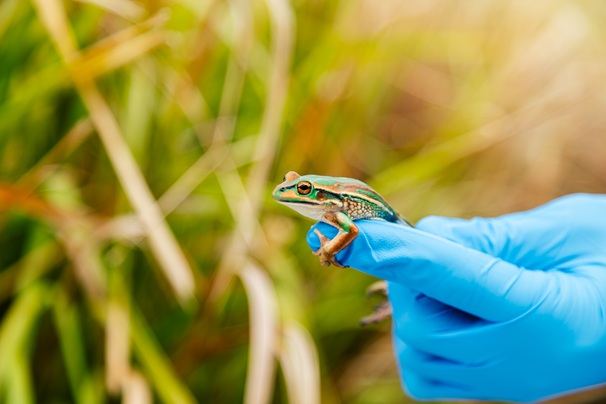
Under the Fellowship, Dr Chung will receive $20,000 over a two-year period; it will support his work on amphibian conservation, with a focus on the chytrid fungus which has devastated amphibian populations around the world, affecting over 500 frog species globally. The fungus damages skin containing the protein keratin, which blocks the amphibian ability to breathe and absorb water through their skin.
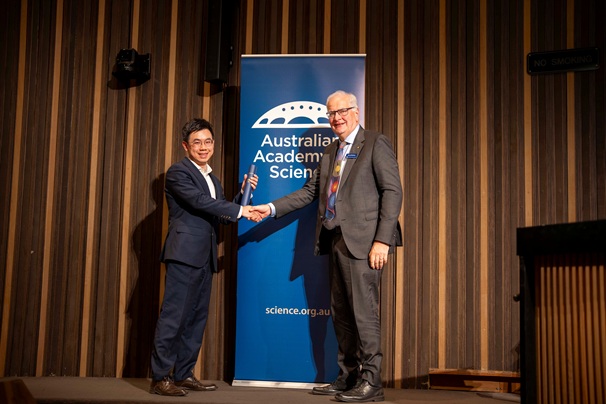
Dr Chung is a researcher with the Centre for Conservation Ecology and Genomics, his work forming part of a larger research group focusing on battling chytrid fungus with Associate Professor Simon Clulow and Professor Richard Duncan from the University’s Faculty of Science and Technology.
“This award will help me expand the scope of my research – and it’s a great motivator, to see that such longitudinal studies are valued,” Dr Chung said.
“I will be investigating whether vaccination can boost the immunity of tadpoles, and whether the enhanced immunity can carry on after they metamorphose into frogs. Metamorphosis is a particularly fascinating aspect, because amphibians are one of the few vertebrate groups undergoing this process.”
Dr Chung says that metamorphosis is a transformation that restructures body plans and immunity systems. When tadpoles are undergoing metamorphosis, their immune systems are often suppressed so that newly generated cells aren’t recognised as foreign invaders.
“Chytrid acts very differently between tadpoles and frogs, because the fungus attacks the parts of the skin that contain keratin. In frogs, that skin covers their entire bodies, but in tadpoles, it’s only around their mouths so the fungus doesn’t kill them at that stage.
“My study is designed to first understand how much a vaccine will help tadpoles, and then to track their immunity levels once they become frogs. I will also look at how vaccination will alter their growth, behaviour and reproductive success.”
Dr Chung grew up in Taiwan, where he pursued his undergraduate study.
“I’ve loved fish and aquatic animals since I was young, and I grew up wanting to study them – they became the focus of my undergraduate degree,” he said.
“My focus then was on exploring fish physiology, how they survive in seawater and freshwater by adjusting different enzyme activities in the gills. I also interned at a fish farm and a marine museum, to explore the topic further.”
After completing a PhD at the Australian National University (ANU), Dr Chung decided to pursue postdoctoral study at the University of Canberra in 2025, switching his focus twice over – from behavioural ecology to conservation, and from fish to amphibians.
“For my PhD, I was studying things like evolution and sexual selection among fish, and a lot of that was very theoretical – you couldn’t make real-life observations, you had to theorise how something would influence the next generation, or what offspring might evolve into over decades,” he said.
“Ultimately, I was interested in applied ecology, and trying to use my skills to make a tangible difference for animals. Once I learned about chytrid fungus, and what it was doing to amphibians around the world, I knew I had found my research focus.”


