


Suzanne Lazaroo
9 December 2025: The University of Canberra’s School of Information Technology and Systems (ITS) summited its Semester Two Capstone unit with a mini expo, showcasing its top projects combining innovation and real world impact.
Part of the Faculty of Science and Technology, the School of ITS runs the Capstone unit twice yearly – enabling undergraduate and postgraduate students to focus on semester-long projects, aimed at solving real world challenges.
The program is a valuable bridge for academia and industry, with each project sponsored by an industry partner or University academic.

"The program provides students with an opportunity to apply and refine their skills to tackle real world problems, create impact beyond the classroom, and prepare for their future workplaces," said Assistant Professor Richa Awasthy, one of the co-convenors of the program.
“The students work with a range of expert stakeholders, learning to negotiate scope, manage ambiguity, and experience the pace and expectations of industry. This gives them the confidence to step into professional roles with a clear understanding of how their skills can translate into business value.”
This semester, 315 students completed 78 projects. Of these, 42 projects were sponsored by industry – across federal and local government agencies, small and medium-sized private enterprises, sole traders and nonprofit organisations – and 36 were sponsored by University academics.

Taking the top spot for Best Project with their Wireless OTA Firmware Updates for Motorsport Sensors, Dharmi Khodidasbhai Gondaliya, Jeremy Ram, Hetanshi Nirav Shah and Yevin Nejith Silva chose to tackle an operational bottleneck in motorsports.
Their project utilised a wireless app to replace manual firmware updates to save time, reduce risk and improve race day performance.
“Their professionalism, strong documentation and delivery of a production-ready outcome distinguished them across all aspects of their assessment – presentation, poster and final delivery of their solution,” said project sponsor Shaun Crain, CEO and Tech Innovator at Team Plus.
He added that acting as a Capstone project sponsor was a great opportunity to pay it forward and help students get a career head start, while also boosting an organisation with new ideas and solutions.
For their polished, professional delivery and ability to translate technical findings into accessible insights, Daniel Hargraves, Jose Martinez Rocholl, Milos Vorkapic and Nour-El-Deen Younes scored the Best Presentation trophy.
Using computer vision data from simulated driving sessions, they set out to build a baseline system for the real-time detection of distraction in drivers – they convincingly highlighted the system’s value and future potential, but were also candid about the model’s limitations.

For the Best Poster win, Christopher Harrison, Blake Langtry, Holly Pulford and Alexander Zecevic presented on SmartGate, an AI-enabled wildlife protection system developed over several semesters with sponsor Dr Carlos Noschang Kuhn, Research Chair in Open Source Technologies at OpenSI.
To clearly communicate the complex conservation challenge, solution and environmental impact, the team went with strong visual, data-driven storytelling.
"One of the best parts of our program is seeing the transformation of the teams, from tentative at the start of semester to confident professionals by the end – our students present with real pride, and sponsors clearly value the insights and results that the teams bring," said Senior Lecturer Jeanette Cotterill, Capstone co-convenor.
Associate Professor Ahmed Imran, Capstone co-convenor, said that what stood out for him was how clearly the teams articulated the real world impact of their work – from wildlife protection to road safety technology, teams showed they understood both the technical challenge and the broader community and industry benefits.
“We have also seen impressive long-term continuity – projects like SmartGate and Wireless OTA Firmware Updates have been iteratively developed over multiple semesters, and the architecture, documentation and testing have strengthened as students built on earlier work and took it several steps further,” he said.
 This year, the Capstone program received global recognition when it won the 2025 Community Engagement Initiative of the Year award at the Global Triple E Awards held by the Accreditation Council for Entrepreneurial and Engaged Universities (ACEEU); it was also named a finalist at the Engagement Australia Excellence Awards for the second year running.
“Capstone students also made their mark by winning the ACT Australian Information Industry Association (AIIA) Award, with others named national finalists, while others again were finalists for the Innovation ACT Accelerator Pitch at CBRIN,” Dr Imran said.
“It’s our responsibility as educators to innovate teaching design and delivery to provide the best possible experience and learning outcome for students – but Capstone projects take impact a step further, inspiring change beyond the University, and making a difference for community at all levels.
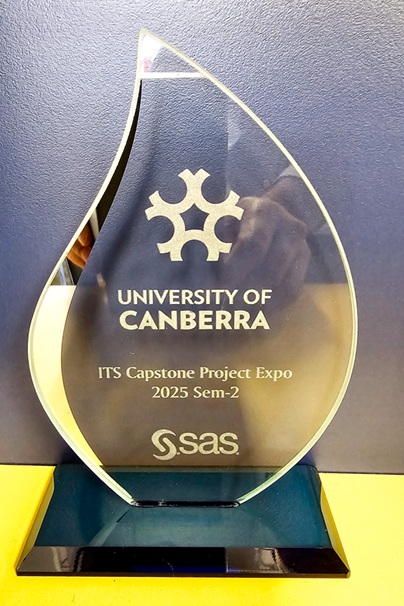
“It was particularly satisfying to see two Capstone alumni return to act as mentors for an SAS-sponsored project – and accept thanks on behalf of SAS, which generously sponsored the event trophies.”


