


Suzanne Lazaroo
12 December 2025: From conservation ecology, focused on the Canberra grassland earless dragon, smoky mouse and green and golden bell frog, to the monitoring of urban water in the ACT and surrounds and the nation-leading use of environmental DNA in biosecurity and conservation – the University of Canberra’s Institute for Applied Ecology (IAE) celebrates a remarkable 20 years of impactful research this year.
Situated within the Faculty of Science and Technology, the IAE comprises two specialised research centres – the Centre for Conservation Ecology and Genetics (CCEG, led by Centenary Professor Richard Duncan) and the Centre for Applied Water Science (CAWS, led by Co-Directors Research Fellow Will Higgisson and Associate Professor Ben Kefford).
Its roots actually reach back to 1989, when a group of like-minded researchers came together to form the Applied Ecology Research Group – Distinguished Professor Arthur Georges (Director, and later, Foundational Director, of the IAE), Adjunct Associate Professor David Williams (Vegetation Management), Dr John Harris (Ecology), Emeritus Professor Jim Hone (Wildlife Management), Emeritus Professor John Dearn (Genetics), Emeritus Professor George Cho (Spatial Analysis), Dr Owen Cartledge (Plant Biology) and 11 Masters research students.
Their mission? To generate research that would grow and improve understanding of the environment, in order to enhance and support decision-making around sustainable development and the management of natural resources.
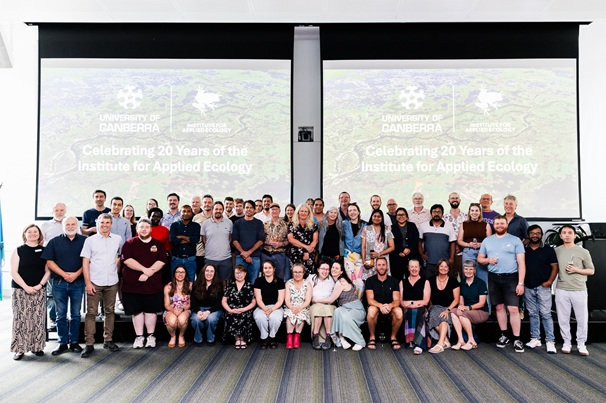
“As its name suggests, the IAE was formed with a mission to undertake high quality, practical, applied research, which would make a tangible impact to what we know about the world around us, so that knowledge could be used as an evidence base for best practice in development and resource management,” said Professor Janine Deakin, Executive Dean of the Faculty of Science and Technology.
The IAE has certainly delivered on that original purpose – and beyond. To fulfill its mission, members built strong relationships with government, industry and community partners – a move that enabled research to not only underlie policy and process, but to be embedded in the everyday.
“The IAE has attracted $58 million in cumulative research funding, published hundreds of papers, and graduated and inspired hundreds of undergraduate and postgraduate students, some who have stayed with UC, and others who have moved all over the world,” said Associate Dean, Research, Professor Fiona Dyer.
The Institute marked the double decade milestone with a two-day celebration this week, kicking off with the annual Krebs Lecture on Tuesday. Conceptualised by former IAE Director Professor Stephen Sarre, the lecture series debuted in 2011, and was named after Charles Krebs, one of the world's foremost ecologists and the IAE’s Thinker in Residence.
The 2025 lecture was headlined by Professor Sarah Legge from Charles Darwin University, who spoke on the work undertaken by Indigenous Traditional Owners and rangers in the Great Sandy Desert in WA, as they integrate contemporary science with cultural governance and priority setting in fire management.
The next day saw IAE members gather for a celebration event at the Ann Harding Conference Centre.
It was a day to celebrate the Institute as a whole, and its many remarkable achievements and research areas in wildlife genetics and genomics, conservation ecology, water science, environmental DNA, and environmental chemistry and ecotoxicology.
Professor Dyer said that the work of the IAE has never been more needed or relevant.
“Looking forward, the issues we face in ecology across Australia and the world continue to require our research,” she said.
“Our climate continues to change, species continue to become endangered or are driven to extinction. Meanwhile, human populations continue to grow.
There’s a fundamental need for the science, and the long-term partnerships that we have developed – and continue to grow – and there is an increasing need for the passionate, committed and inspired students we continue to train.
“That has always been our focus and identity here at the IAE – the applied focus of our collective work, and the pathways we create for future scientists and researchers.”
Institute for Applied Ecology alumni are making a difference all over the world – in conjunction with the IAE's 20th anniversary, read some of their memories and well wishes on UnCover.


