


Mike Verzosa
27 November 2026: Charting a path to help students and the broader community to avoid being victims of misinformation online was the goal of teacher-librarians, researchers, and policymakers who gathered at the University of Canberra last week for the Pathways to Democratic Information Resilience symposium.
Hosted by the Faculty of Education, the News and Media Research Centre (N&MRC) and the Centre for Deliberative Democracy, the symposium launched UCMETHOD, a handbook and online resource aimed at improving the discernment and verification skills of students.
With participants that included presidents of state and national school library associations, as well as representatives from the Australian Electoral Commission (AEC), the National Film and Sound Archive (NFSA) and the Australian Curriculum, Assessment and Reporting Authority (ACARA), symposium convenor Professor Mathieu O’Neil said the two-day event served to exchange ideas, collect feedback about UCMETHOD and two draft policy briefs, as well as work towards the next steps.
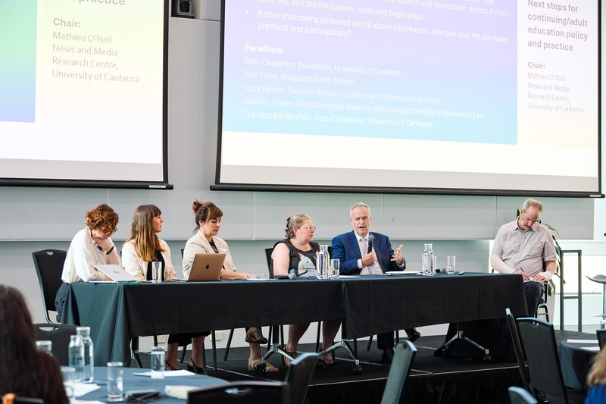
“Everybody’s interested in the same thing – how do we make resources like this work better, so people have the tools to avoid being misled – and this forum is a catalyst for that because of the interdisciplinary discussions and engagement of the people in this room,” Professor O’Neil said.
In a final collaborative session, participants agreed to identify six key issues currently faced by educators and the public, in order to produce a collective document for education ministers and other policymakers, following the federal Minister for Education’s recent announcement that a new teaching and learning commission was to be established.
The symposium builds on the work Professor O'Neil has been developing with teachers and teacher-librarians since 2022, thanks to the ACT Education Directorate–UC Affiliated Schools Research Program. The methods that emerged from the implementations in ACT schools and senior colleges, as well as from two iterations at the University, are now being implemented in 15 New South Wales schools in partnership with the School Library Association of NSW.
Central to the program is ‘lateral reading’, which teaches students to look beyond one source, open another tab and check what others say about it, rather than analysing only the first source in depth. Professor O’Neil said this approach suits low-quality online environments, where students need to be quick.
“Lateral reading is basically thinking like a fact checker. Instead of engaging 'vertically’, in depth, with questionable or low-quality content, we encourage fact checking elsewhere,” he said.
“If the claim or source is found to be reliable, students can engage further. If it is not, they should move on.”
Among the highlights of the symposium were two keynote presentations by Professor Jutta Haider from the Swedish School of Library and Information Science, and Dr Kay Oddone from Charles Sturt University, who analysed information resilience and the factors that impact it from their different perspectives.
Professor O’Neil said his goal was to see the methods used in more schools and shared with parents and the broader community, and that the strong turnout at the symposium was proof of the momentum the project has built.
“There was a great diversity of voices in this room, and they were all really engaged, so I think it shows the credibility we’ve built and everyone’s willingness to work together in the future.”
Image by Chris Walsh.


