


Mike Verzosa
23 November 2026: A coffee table made from sewn aluminium and leather. An arcade claw machine transformed into a take on the great Australian dream. Wall art that changes the viewer’s perspective when it’s rotated. These were some of the University of Canberra student works showcased at Miko Designs in Fyshwick, as part of Break//Make, a collaboration between the University’s Faculty of Arts and Design and the Canberra design studio.
The project was part of the Craft + Design Canberra Festival and the centrepiece of Design Industry Studio, a new unit that brings together students from across the faculty’s design disciplines to work on collaborative projects. This semester, students from visual communication design, industrial design, interaction design, game development and digital media worked on Break//Make: UC X Miko.
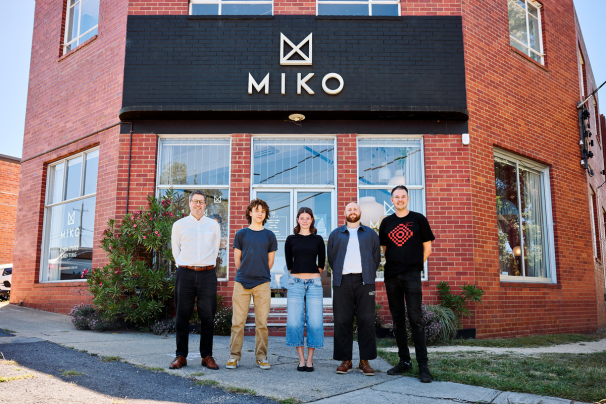
Unit convener and Bachelor of Design Program Director Dr Ben Ennis Butler said planning for the project began about a year ago, when he sat down with UC alumnus and Miko Designs owner and manager Stuart Finlayson to design the brief. Later, another UC alumnus and local industrial designer Tom Skeehan joined the unit as tutor.
“The idea was to treat the showroom floor as an experimental space but also to create objects that would sit comfortably in someone’s home, rather than just looking like concept art,” Dr Ennis Butler said.
“It was a really unique opportunity for the students to work with someone from industry and then place their work within an established studio in Canberra.”
Among the students who participated in Break//Make were Oscar Senden and Jonathan Charlton, both in the second year of their Industrial Design studies. Their project, SEAM, explores sewn aluminium and leather as a means for furniture construction. Together they created a coffee table and a lamp, revealing new possibilities through the reinterpretation of established processes.
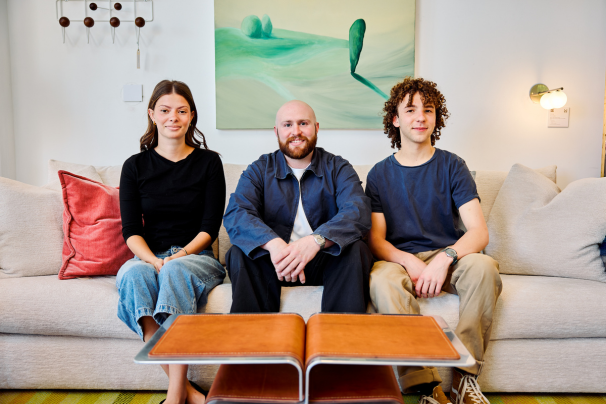
“We wanted to explore traditional techniques through a modern lens which led to sewing metal, and then from there, we looked at designing a family of products that would fit under the same umbrella,” Mr Senden said.
“Oscar took on the coffee table, and I created the lamp as a supplementary product and we worked together to ensure that both products shared the same design language and would sit well together in a space,” Mr Charlton said.
The pair visited the Miko Designs showroom several times to research the existing stock and ensure that their work would belong both aesthetically and functionally.
Mr Senden said the table went through a series of designs before the final concept and shape was settled. Once the form was produced, more than 30 hours of hand-sewing followed.
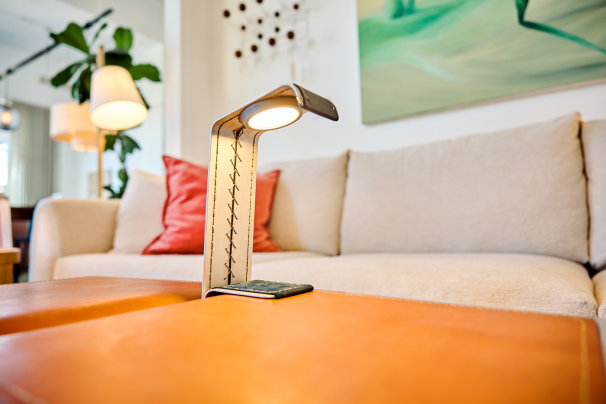
Designing the lamp, Mr Charlton said, meant matching the curves and simplicity of the table without having the table on hand for reference.
“At first, I kept on overcomplicating things. I found myself constantly having to bring it back to the simplest form, and the simplest form ended up being the most elegant.”
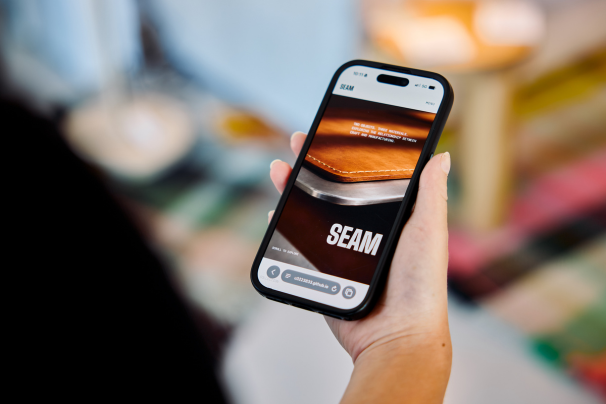
To bring the collection online, third-year Bachelor of Interaction Design student Grace Scott-Graham joined the team as the User Interface (UI) and User Experience (UX) designer and developed a website to present the furniture collection.
Ms Scott-Graham, who is based in Melbourne and has been studying the Bachelor of Design online, saw a unique opportunity to collaborate with students from another discipline.
“I contacted them because I thought their concept was really cool. Before they started, I had no idea about furniture, like how to make anything, so I've learnt a lot about industrial design,” said Ms Scott-Graham.
“Seeing the lamps, table and website displayed together at the exhibition is such a highlight. The collection feels complete,” she said.
Even though this is the second project Miko Designs has partnered with the University. Mr Finlayson, said he continues to be inspired by the students’ creativity and how they approach a brief.
“This coffee table set is such a beautiful one-off piece and it’s almost retail ready,” he said.
“You have a variety of design disciplines all collaborating and providing different perspectives and skills which is what made all the responses and pieces so good.”
Dr Ennis Butler, who also taught Mr Finlayson at the University many years ago, said industry partnerships like this are vital as they expose students to the broader ecosystem of what’s possible out of their degrees.
“When we talk about design, it’s not just about products. You might be building a brand for a local business, designing the user experience of an app, shaping how people access government services, working in a games studio or creating video and motion work for a festival,” he said.
“This project allowed students to work within the skill sets that they’re learning in their studies but also push themselves away from the standard approach to design. Stuart handed us his showroom and let us experiment within that space – and our students have really made the most of it.”
Images by Tyler Cherry.


