


Fleta Page
23 July 2026: Nearly one in five Australian women already navigating the trials and tribulations and dos and don’ts of pregnancy will receive a diagnosis of Gestational Diabetes Mellitus (GDM).
The experience can be overwhelming: blood glucose monitoring four times a day, diet tracking – and for some, insulin injections – become the norm.
University of Canberra researchers have now released an evidence-based app to help women manage their GDM, and are seeking users to participate in a feedback study.
Co-designed by specialists in GDM research, women with lived experience of GDM, endocrinologists, diabetes educators, and other allied health professionals, the app – somewhat suggestively named “SugarMumma” – brings together all aspects of diabetes management.
Dr Cathy Knight-Agarwal, Senior Lecturer in Nutrition and Dietetics at the Faculty of Health, is one of the researchers in UC’s Brighter Beginnings team. With a PhD in gestational weight management and extensive clinical experience in diabetes management, she led the development of the app and is conducting the study.
She said mobile apps have been shown to be a useful resource for women with Type 1 diabetes and could successfully contribute to GDM management.
“There are apps that just look at blood glucose level control, apps that just look at diet. What we have done is integrated all aspects of lifestyle, as well as medical management, into the one app,” she explained.
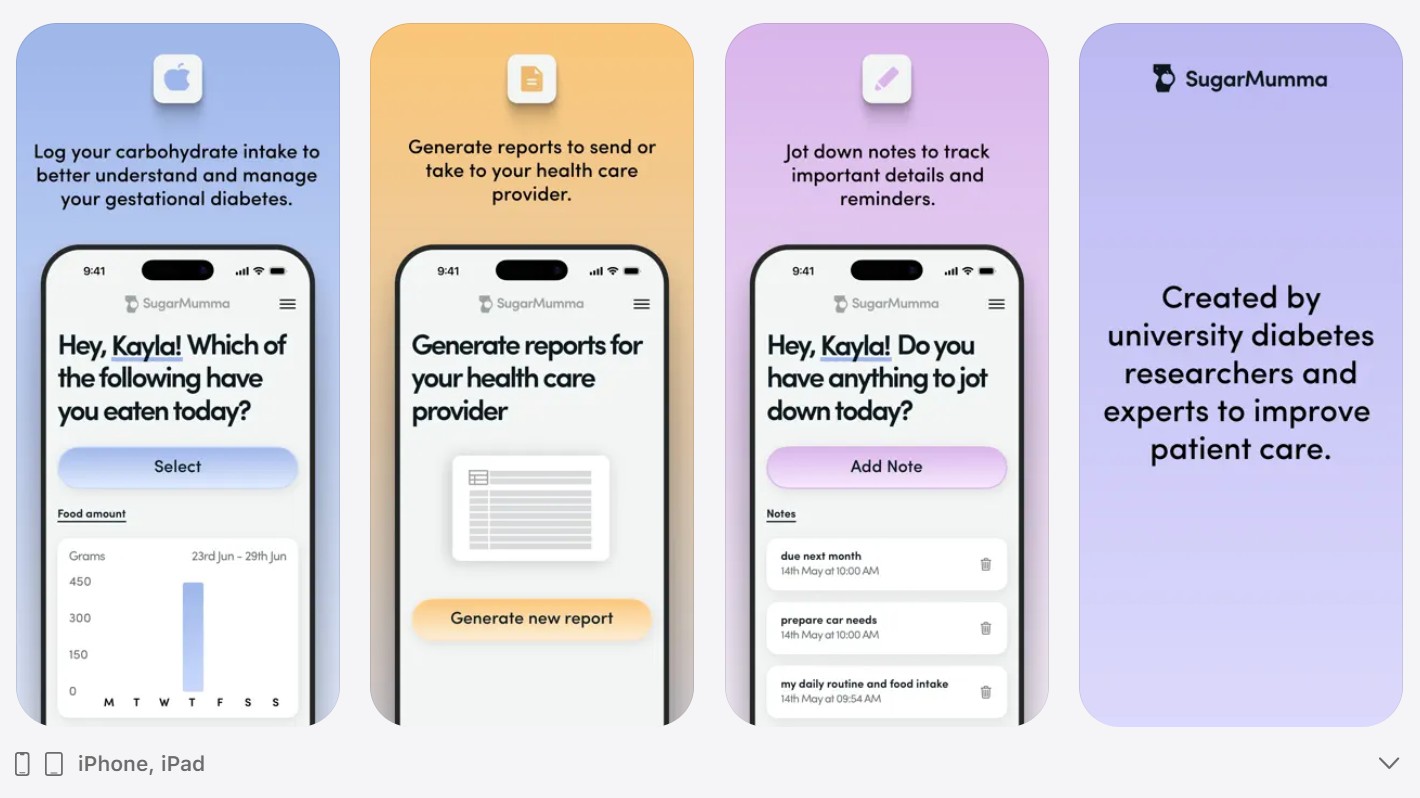
The app can be used to log blood glucose levels, weight and insulin doses, as well as diet – breaking it down by food groups – and activity.
Crucially, it also has functionality to run reports for healthcare providers, and in the future has potential to integrate with digital health records.
“With the information it collects, it is easy for doctors and diabetes educators to see what the blood glucose levels have been doing, and then look at the dietary and activity impact – and by also including a graphing function, it will demonstrate very holistically all the things that are relevant not only to managing a pregnancy, but also managing good glycaemic control,” Dr Knight-Agarwal said.
Bori Kim is one of the 18 per cent of pregnant women diagnosed with GDM, which she discovered at 26 weeks gestation through a routine oral glucose tolerance test.
“It was very unexpected news,” she recalls, but she took a get-on-with-it approach to prevent the serious complications that can arise for mum and bub if GDM is not managed properly.
Through Canberra Health Services, she was referred to an education session about GDM, then a one-on-one session with a dietitian.
She was already regularly exercising, walking a new puppy twice a day, but had to make adjustments to her diet – the main one being swapping white rice, her primary carbohydrate, for multigrain rice, which has kept her blood sugars under control.
Her biggest challenge came not from diet, but the stress of having to move house coupled with the deadline of an impending birth.
“After we moved to the new place, my glucose levels stabilised,” she said.
Now 35 weeks pregnant, she recently started using the SugarMumma app at the recommendation of her University of Canberra student midwife. She has found it easy to use, but is mainly using the blood glucose logging function, which she finds more convenient than a pen and paper logbook while out and about.
The app has been tailored to the Australian context, including blood glucose levels based on Australian recommendations, which differ from country to country, as well as Australian recommendations for diet and physical activity.
Dr Knight-Agarwal said the benefits of the app – and participating in the study – may be greatest for women in rural and remote areas, who have challenges when it comes to getting comprehensive education and support.
“With usual care, women may or may not get to see a dietitian, one-on-one. It is best practice, but there are lots of limitations within the public health system. By joining our research project, women will have a one-on-one online consultation with a dietitian, who will go through the app and explain the features comprehensively,” she said.
The researchers are looking for at least 50 women to join their study and help improve the app, before they work towards integrating it within ACT Health’s systems.
The app is free to download through Google Play or Apple, but to join the study, contact cathy.knight-agarwal@canberra.edu.au.


