Ann Harding Conference Centre
Building 24, University of Canberra ACT 2601
June 23 to 27, 2025
Centre for Deliberative Democracy and Global Governance, University of Zurich (UZH)
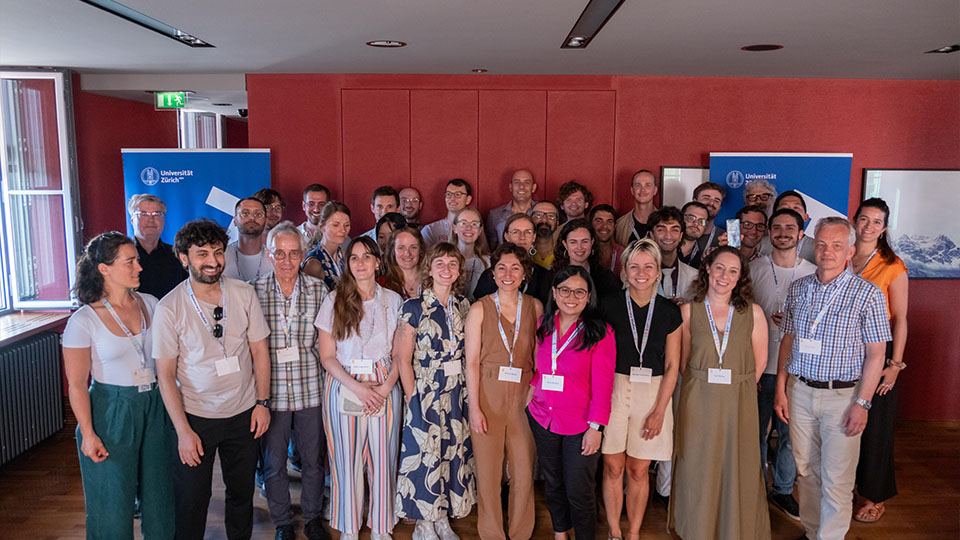
The 7th Deliberative Democracy Summer School was hosted by the University of Zurich (UZH) for the first time from June 23 to 27, 2025 — previously held at the University of Canberra (UC; four times) and Åbo Academy in Finland (twice). Bringing together 50 scholars from 14 countries who gathered to present and discuss their work on issues at the intersection of inequality and deliberative democracy. In response to the growing interest, participation was expanded beyond postgraduate students to include scholars seeking to deepen their knowledge of the field and interact with leading scholars, who provided feedback and mentorship. The delivery of the event was a shared effort between the Centre for Deliberative Democracy (CDD) at the University of Canberra and the Centre for Democracy (CFD) at the University of Zurich, marking a growing relationship between the two institutions.
The summer school began in the afternoon on Day 1 with an opening by Daniel Kubler from CFD as chair of the organising committee, followed by a keynote speech by Cristina Lafont from Northwestern University, who critically assessed how certain forms of minipublics aimed at directly influencing policy without including the wider public risks negatively impacting political equality (moderated by Hannah Werner). Later, a roundtable continued the conversation, with Céline Colombo (Office for Participation, Canton of Zurich), John Gastil (Penn State University), André Bächtiger (University of Stuttgart); and Fabian Reidinger (State Ministry Baden-Württemberg) — with a lively discussion about the relevance, utility and design of minipublic deliberation moderated by Daniel Kubler.
The association between the University of Zurich and University of Canberra was formally recognised at the event with the signing of a memorandum of understanding for future cooperation by the Dean of the Faculty of Arts and the Social Sciences (UZH), Prof Katharina Michaelowa, along with Prof Daniel Kubler (CFD, UZH) and Prof Simon Niemeyer (CDDGG, UC) to promote further academic exchange and joint research development. The agreement is particularly timely. The Swiss government has recently mandated the University of Zurich to develop research collaborations with Australia as part of the South Pacific Region, with specific initiatives being announced shortly.
From left to right: Prof. Katharina Michaelowa (UZH), Prof. Simon Niemeyer (UC), and Prof. Daniel Kübler (UZH)
Keynote speeches kicked off each of the following four days of the summer school, with CDD’s own John Dryzek starting Day 2 (Tuesday) by explaining how deliberative democracy is fundamental to achieving justice. On Day 3, Thamy Pogrebinschi (WZB Berlin) discussed the pragmatic role that minipublics play as a means to addressing inequality in South America, rather than as an end. The issue of social identities, inequality, and democratic decision-making was the theme of Edana Beauvais’ talk on Day 4, Thursday, where she considered the implications of complex and overlapping identities for deliberative design. Jean-Benoît Pilet (Université Libre de Bruxelles) rounded out the keynote presentations with the latest findings on how Europeans evaluate the growing practice of commissioning deliberative minipublics, with public support varying depending on familiarity and background conditions, such as attitudes toward politicians and evaluations of citizens’ capabilities.
In the afternoons, participants presented their papers in two parallel sessions with themes including Environmental Justice, Polarisation, Representation, Institutional design, marginalisation, theories of inclusion, impacts, artificial intelligence and deliberation.
In addition to consummate organisation marked by Swiss-level precision, other factors contributing to the success of the summer school were the participants' commitment to the task of renewing and strengthening democracy, the impressive questions, and the quality of the discussion. The University of Zurich has indicated that they would again like to host the event, with the University of Canberra due to host next before the event returns to Europe.
The 7th Deliberative Democracy Summer School was hosted by the University of Zurich (UZH) for the first time from June 23 to 27, 2025 — previously held at the University of Canberra (UC; four times) and Åbo Academy in Finland (twice). Bringing together 50 scholars from 14 countries who gathered to present and discuss their work on issues at the intersection of inequality and deliberative democracy. In response to the growing interest, participation was expanded beyond postgraduate students to include scholars seeking to deepen their knowledge of the field and interact with leading scholars, who provided feedback and mentorship. The delivery of the event was a shared effort between the Centre for Deliberative Democracy (CDD) at the University of Canberra and the Centre for Democracy (CFD) at the University of Zurich, marking a growing relationship between the two institutions.
The summer school began in the afternoon on Day 1 with an opening by Daniel Kubler from CFD as chair of the organising committee, followed by a keynote speech by Cristina Lafont from Northwestern University, who critically assessed how certain forms of minipublics aimed at directly influencing policy without including the wider public risks negatively impacting political equality (moderated by Hannah Werner). Later, a roundtable continued the conversation, with Céline Colombo (Office for Participation, Canton of Zurich), John Gastil (Penn State University), André Bächtiger (University of Stuttgart); and Fabian Reidinger (State Ministry Baden-Württemberg) — with a lively discussion about the relevance, utility and design of minipublic deliberation moderated by Daniel Kubler.
The association between the University of Zurich and University of Canberra was formally recognised at the event with the signing of a memorandum of understanding for future cooperation by the Dean of the Faculty of Arts and the Social Sciences (UZH), Prof Katharina Michaelowa, along with Prof Daniel Kubler (CFD, UZH) and Prof Simon Niemeyer (CDDGG, UC) to promote further academic exchange and joint research development. The agreement is particularly timely. The Swiss government has recently mandated the University of Zurich to develop research collaborations with Australia as part of the South Pacific Region, with specific initiatives being announced shortly.
Keynote speeches kicked off each of the following four days of the summer school, with CDD’s own John Dryzek starting Day 2 (Tuesday) by explaining how deliberative democracy is fundamental to achieving justice. On Day 3, Thamy Pogrebinschi (WZB Berlin) discussed the pragmatic role that minipublics play as a means to addressing inequality in South America, rather than as an end. The issue of social identities, inequality, and democratic decision-making was the theme of Edana Beauvais’ talk on Day 4, Thursday, where she considered the implications of complex and overlapping identities for deliberative design. Jean-Benoît Pilet (Université Libre de Bruxelles) rounded out the keynote presentations with the latest findings on how Europeans evaluate the growing practice of commissioning deliberative minipublics, with public support varying depending on familiarity and background conditions, such as attitudes toward politicians and evaluations of citizens’ capabilities.
In the afternoons, participants presented their papers in two parallel sessions with themes including Environmental Justice, Polarisation, Representation, Institutional design, marginalisation, theories of inclusion, impacts, artificial intelligence and deliberation.
In addition to consummate organisation marked by Swiss-level precision, other factors contributing to the success of the summer school were the participants' commitment to the task of renewing and strengthening democracy, the impressive questions, and the quality of the discussion. The University of Zurich has indicated that they would again like to host the event, with the University of Canberra due to host next before the event returns to Europe.