<iframe src="https://www.googletagmanager.com/ns.html?id=GTM-PRQLQP" height="0" width="0" style="display:none;visibility:hidden">
Accommodation Guarantee Other housing options Resolving disputes
About UC
Library facilities
Research equipment
UC account
Skip navigation
University of Canberra logo University of Canberra home page
Future students
Future students
Find a course
  • Find a course
  • Study at UC
  • Browse study areas
  • Online courses
  • UC College
  • International
  • Life and living at UC
  • Student support
  • Entry requirements and pathways
  • Scholarships
  • Australian Indigenous students
  • Apply
  • Start at UC
  • Talk to us
  • Careers advisors and agents
Research
Research
Discover more
  • About UC research
  • Research Plan 2024 - 2028
  • Research impact
  • Life of a CBRn
  • Research centres and institutes
  • Contribute to research
  • Graduate Research School
  • Research news
  • Contact us
Give
Give
Discover more
  • Student Support Appeal 2026
  • Funds you can support
  • How to give
  • Impact of giving
  • Contact us
On campus
On campus
Discover more
  • Campus tours
  • UC Collections
  • Facilities
  • Campus Master Plan
  • Venue hire
  • Campus cafes and shops
  • Childcare
  • Health and support
  • Transport
  • Parking
  • Adobe Creative Campus
  • Sport at UC
  • Security
  • Lost and found property
  • Safe community
  • Report an incident
About UC
About UC
Discover more
  • University strategy
  • Senior management
  • Faculties
  • Campus locations
  • Educational partners
  • Graduation
  • Office of Indigenous Leadership
  • Academic integrity
  • Sustainability
  • Media and communication
  • Governance
  • Policy and legislation
  • Learning at UC
  • Learning and Teaching
  • Student Equity and Participation
  • Equity and diversity
  • Work at UC
  • Key dates
  • Contact University of Canberra
  • Safe community
  • Report an incident
  • Students
  • Staff
  • Alumni
  • Library
  • Maps
  • Safety & Support
Safety & Support
  • Students
  • Staff
  • Alumni
  • Library
  • Maps
  • Safety & Support
UC Open Day Fest - For future students, families, and the whole community. Saturday 12 September, 10am to 3pm
UC Open Day Fest - Saturday 12 September, 10am to 3pm

UC Open Day Fest

Sat 12 Sept, 10am–3pm

REGISTER NOW

Master of Nutrition and Dietetics

Fuel a rewarding career.

Enquire Apply
Home
/
Future students
/
Study at UC
/
About our courses
/
Master of Nutrition and Dietetics

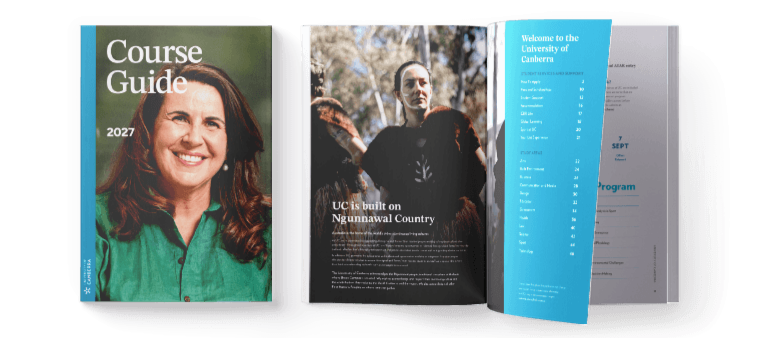
Download course brochure

Discover everything you need to know about the Master of Nutrition and Dietetics at UC.
It seems something went wrong with your submission. Please email study@canberra.edu.au to receive your course guide.
landingpage
https://www.canberra.edu.au/future-students/study-at-uc/about-our-courses/master-of-nutrition-and-dietetics/thank-you

Study Nutrition and Dietetics

Support healthier communities through nutrition

Learn how to turn nutrition science into practical, evidence-based care that supports people across different life stages, health needs and communities with UC's Master of Nutrition and Dietetics.

In this postgraduate degree, you'll build on existing knowledge and develop the clinical, communication and research skills needed to work confidently as a dietitian and make nutrition matter. Study dietetics and explore how nutrition connects to health and disease, and learn how to communicate that knowledge in ways that are clear, useful and relevant in community first healthcare.

Combine research and practice

Research and practice come together throughout the course, helping you understand not only what the evidence says, but how to use it to support people. Alongside a research project in an area of nutrition that matters to you, you'll complete up to 24 weeks of professional placement and an additional four-week internship. These experiences will help you build confidence, make informed decisions and turn knowledge into care that is grounded in people's needs.

Graduate as a qualified Dietitian

Accredited by Dietitians Australia, this course gives you the knowledge and practical experience needed to graduate as a qualified Dietitian, so you'll graduate ready to support people's health with nutrition.


Study level

Postgraduate

Delivery mode

On campus

Course unit cost

Commonwealth Supported Places available to domestic students.

Study duration

2 years, full-time

Intake dates

Semester one, 15 February 2027

Want to know more?

Schedule a call with our friendly team to learn more about the Master of Nutrition and Dietetics.

1800 864 226 Book a consult
Primary school teacher in classroom

Course highlights


Build advanced knowledge of nutrition across clinical, community and public health settings.


Complete up to 24 weeks of workplace learning in real industry environments.


Plan and deliver a research project in an area that matters to you.


Learn to clearly communicate complex nutrition information to different audiences.


Graduate as an Accredited Dietitian with Dietitians Australia.


Undertake research ensuring your learning reflects current evidence and up-to-date theory and practice.

UC’s Master of Nutrition and Dietetics is a program grounded in hands-on learning. Our academics are current researchers, so the learning comes from real-life expertise. Our students are connected from day one with real communities and a focus on inclusion."

   
Dr. Ekavi Georgousopoulou
Discipline Lead in Nutrition and Dietetics

UC’s Master of Nutrition and Dietetics is a program grounded in hands-on learning. Our academics are current researchers, so the learning comes from real-life expertise. Our students are connected from day one with real communities and a focus on inclusion."

   
Dr. Ekavi Georgousopoulou
Discipline Lead in Nutrition and Dietetics

Nutrition and Dietetics course details

The Master of Nutrition and Dietetics postgraduate degree is structured to give you a clear, practical understanding of nutrition and dietetics from the ground up. You’ll study a mix of clinical, community and research-focused units, building your knowledge step by step and applying it in practice as you go.

Your core units include:

  • Clinical Dietetics 1
  • Clinical Dietetics 2
  • Community and Public Health Nutrition
  • Counselling and Communication for Dietitians
  • Food Service Management
  • Research Project in Health
  • Nutrition and Dietetics Practicum Part A
  • Nutrition and Dietetics Practicum Part B
  • Research Planning or Epidemiology and Principles of Research

Across these units, you’ll learn how to assess nutrition needs, deliver evidence-based care and communicate clearly with different groups. You’ll also apply research skills to a project that reflects your interests.

In your second year, the focus shifts to professional practice. You’ll spend extended time on placement, where you’ll build confidence and start working like a dietitian in real settings.

Learn more

With a Master of Nutrition and Dietetics from UC, you can work as an Accredited Practising Dietitian in areas such as:

  • Hospitals
  • Community health
  • Private practice
  • Government
  • The food industry
  • Media and education
  • Research.

This qualification is accredited by Dietitians Australia (DA) and recognised globally, giving you flexibility in where your career takes you.

To apply, you’ll need:

  • A completed bachelor’s degree in human nutrition.
  • Two degree level units in chemistry.
  • Four degree level units in human biology and human physiology.
  • Two second year degree level units in biochemistry.
  • Four degree level units in food and nutrition science.
  • You’ll also submit a short statement explaining why you want to join the profession and what you’ll bring to it.

Before placement, you’ll need to complete checks and clearances, including:

  • Undertake a National Police Check.
  • Obtain a Working with Vulnerable People registration.
  • Provide immunisation history.
  • Hold both First Aid and CPR qualifications.
Learn more

If you’re a domestic student, you may be eligible for financial support to help manage the cost of your degree.

A Commonwealth supported place (CSP) means the Australian Government pays part of your tuition fees, so you contribute a reduced amount.

If you receive a CSP or a full-fee place, you may also be able to access FEE‑HELP. This is a government loan scheme that lets you defer paying your tuition fees until your income reaches a certain level.

Together, these options can make postgraduate study more manageable, so you can focus on building your skills and getting ready for what comes next.

Learn more

A practical path to care

UC’s Master of Nutrition and Dietetics helps you see the bigger picture of healthcare, where empathy, communication and connection matter. With practical learning built into your degree, you’ll gain experience that prepares you for meaningful work with real. You’ll get real, hands on experience in the community and graduate with the confidence to fuel your future in nutrition.

Nutrition & Dietetics FAQs


Both Nutritionists and Dietitians work with food and health, but they’re not the same qualification or profession. Both play an important role. The difference comes down to the level of training, regulation and the type of work you want to do.

A Dietitian is a regulated health professional. In Australia, Dietitians must complete an accredited university degree and meet strict professional standards. Many are recognised as Accredited Practising Dietitians (APDs), which means they’re qualified to work in clinical settings like hospitals, assess medical conditions and provide tailored nutrition therapy for people with complex health needs.

A Nutritionist focuses more broadly on food, health and wellbeing. There’s no single regulated pathway to become a Nutritionist, so qualifications and areas of expertise can vary. Nutritionists often work in areas like community health, education, research or the food industry.

If you’re interested in working directly with patients, managing medical conditions or becoming a registered practitioner, dietetics is the more structured pathway. If you’re more interested in general health, prevention or education, nutrition may be the right fit.

Read more in our blog, 'How to become a qualified Dietitian?'

    To become a Nutritionist, you’ll usually complete a bachelor’s degree in nutrition, public health or a related field. This can lead to roles in community health, education, research or the food industry.

    To become a Dietitian, you’ll need to complete an accredited dietetics qualification, such as UC’s Master of Nutrition and Dietetics. This includes practical training and placement and allows you to become a recognised health professional and work in clinical settings.


    Nutritionist and Dietitian salaries can vary depending on your experience, location and the type of work you choose.

    Healthcare and nutrition-related roles are expected to keep growing due to increasing demand for preventative health, ageing populations and chronic disease management. This means strong job stability and opportunities to progress. Postgraduate study can improve your earning potential. UC graduates in health consistently perform well for full-time employment and starting salaries, reflecting the practical experience you gain during your degree.

    UC is #1 in Canberra for full-time postgraduate starting salaries with a 5-star rating at 91% (GUG, 2026).

    In Australia, Dietitians generally earn more than Nutritionists because they’re qualified to work in clinical and healthcare settings. Early career Dietitians often start around $60,000–$75,000, with experienced professionals earning $85,000–$100,000+, particularly in hospitals, private practice or senior roles.

    Nutritionists typically work in community health, education or industry roles. Salaries can start from $55,000–$70,000, with experienced professionals earning higher depending on their role and specialisation.

      Postgraduate study is an investment in your future, and at UC, there’s support to make it more affordable. UC’s Master of Pharmacy offers Commonwealth Supported Places for domestic students, which means the government can subsidise part of your fees, reducing the overall cost (conditions apply). FEE-HELP is also available; an Australian Government loan that provides additional financial support. More information can be found on our Domestic fees and costs page. 

      There are also scholarships available for both new and continuing students, helping with expenses like fees, textbooks, accommodation and living costs. Whether you’re a domestic or international student, you may be eligible for financial assistance. 

      Visit our scholarships page to explore your options and learn how UC can help you afford postgraduate study.

      At UC, we’re here to help you succeed! Once you’re ready to apply to UC, our process depends on your student type and course. You can find all the requirements, criteria and processes on the Apply to UC page.

      If you have further questions or would like assistance with your application, we encourage you to book a consult to receive personalised guidance and support.

        Talk to us

        Contact our Future Students team to learn more about studying at UC

        Enquire

        Other quick links

        Contact us

        • Future students
        • Current students
        • Alumni contact us
        • Donors
        • General enquiries

        Faculties

        • Arts and Design
        • Business, Government and Law
        • Education
        • Health
        • Science and Technology

        News and events

        • UnCover
        • Newsroom
        • Find an expert
        • Events
        • Blog

        Services

        • Security
        • Library
        • Medical and Counselling
        • IT Service updates
        • Gym
        • Accommodation

        Administration

        • Maps
        • Job opportunities
        • Staff directory
        • Researcher profiles
        • Freedom of information
        • Policies and procedures
        University of Canberra logo
        Facebook icon Youtube icon Instagram icon Tiktok icon Linkedin icon
        University of Canberra, Bruce ACT 2617 Australia
        +61 2 6201 5111
        ABN 81 633 873 422
        CRICOS 00212K
        TEQSA Provider ID: PRV12003 (Australian University)
        Contact UC
        Copyright
        Disclaimer
        Privacy
        Accessibility
        Collection notice

        UC acknowledges the Ngunnawal people, traditional custodians of the lands where Bruce campus is situated. We wish to acknowledge and respect their continuing culture and the contribution they make to the life of Canberra and the region. We also acknowledge all other First Nations Peoples on whose lands we gather.