


Georgie Burgess
17 September 2026: While the Black Summer bushfires and resulting thick smoke across Canberra slowly fade from memory, the return of El Niño with its looming threat of extreme heat and dry conditions serves as a stark reminder of the devastating health impacts of heatwaves and bushfires.
For the University of Canberra's Professor Sotiris Vardoulakis, understanding the impact of polluted air and extreme temperatures on human health has been the focus of more than 25 years of research. Sitting at the forefront of research, he has advised governments, international organisations and peak bodies about the health effects of climate change, air pollution, and extreme weather events through numerous roles, most notably as Director of the Healthy Environments And Lives (HEAL) National Research Network.
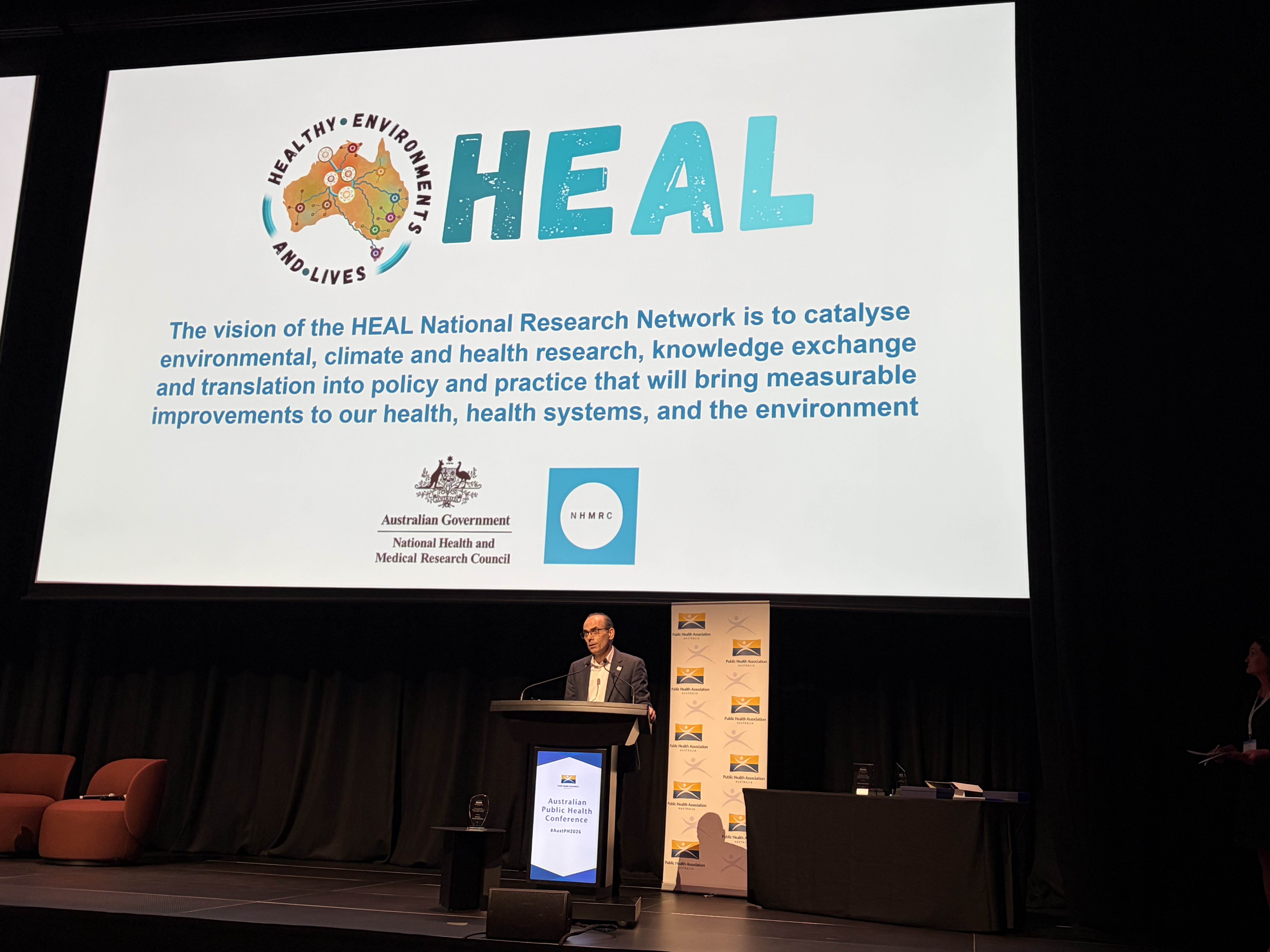
Today at the Australian Public Health Conference in Geelong, he was recognised for his decades of leadership and research, receiving the Tony McMichael Public Health Ecology and Environment Award for 2026, presented by the Public Health Association of Australia.
The award honours the legacy of the late Professor Tony McMichael who was a world leader in research and advocacy when it came to incorporating ecological and environmental factors into the field of public health.
Professor Vardoulakis said it was an honour to receive the prestigious award but stressed that it was not an accolade won in isolation.
“I am collecting this award on behalf of the entire HEAL network,” he said.
“This has been a collective effort, and it is recognition of the work that many people from my team and our network have contributed to.”
Over his career, Professor Vardoulakis has led research into the health effects of climate change, air pollution, extreme events, infectious diseases, and the benefits of sustainable development. He has undertaken this work as a Professor of Environmental and Public Health and, over the last five years, as Director of HEAL, and more recently as Director of the Health Research Institute at the University of Canberra.

Since founding HEAL in 2021, he has led many projects, including an Australian-first study assessing how community centres can provide shelter from extreme heat and air pollution, as well as contributing to the National Health and Climate Strategy and the landmark Global Environmental report of the United Nations Environment Programme.
“We are proud of the work we have done on bushfires, characterising the risks of bushfire smoke and extreme heat for communities. As well as developing practical solutions and communication tools as responses to wildfires and other extreme events and outbreaks in Australia, Asia and the Pacific,” he said.
“Also, the work we have done on community health in relation to air pollution from wood heaters in the ACT and promoting clean energy, not only in Canberra, but across Australia and internationally.”
What stands out to Professor Vardoulakis is the way the research has been conducted by HEAL.
“We have respectfully woven together Indigenous knowledge with Western science and technology to bring a diverse program of research and many organisations together – I think that is what has been groundbreaking,” he said.
“Another key achievement has been nurturing the next generation of environmental and public health researchers and providing career development opportunities for health scientists working on a wide range of climate-related topics, from health services to biosecurity to science communication.”
The University of Canberra-led HEAL National Research Network has been supported since 2022 by a five-year, $10 million grant from the National Health and Medical Research Council (NHMRC) Special Initiative in Human Health and Environmental Change.
For Professor Vardoulakis and the HEAL team, the award is both recognition of past achievements and encouragement for the work ahead.
“It gives us a lot of energy for the next five years, whatever that will look like, and is a huge boost for our network.”


