


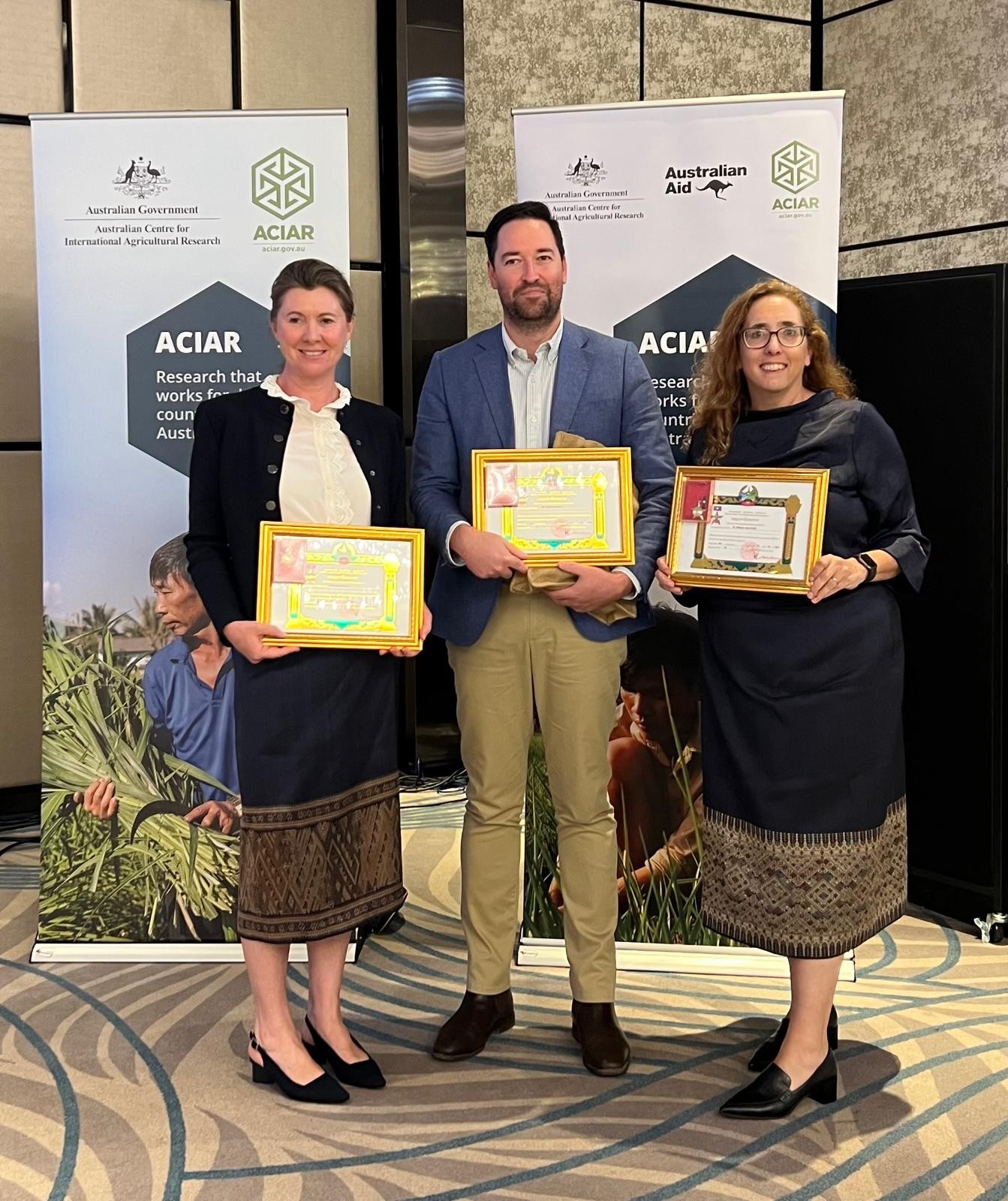
17 March 2026: Associate Professor Leonie Pearson and Professor Lain Dare, from the University’s Centre for Environmental Governance, have received the highest national honour from the Lao People’s Democratic Republic (Laos), for their work on the Pathways for Future Farmers in Southeast Asia (Future Farmers) project.
On the 5 March ceremony, the pair were honoured with the Lao PDR government’s Cross of Friendship in recognition of their outstanding contributions to the country’s agricultural development.
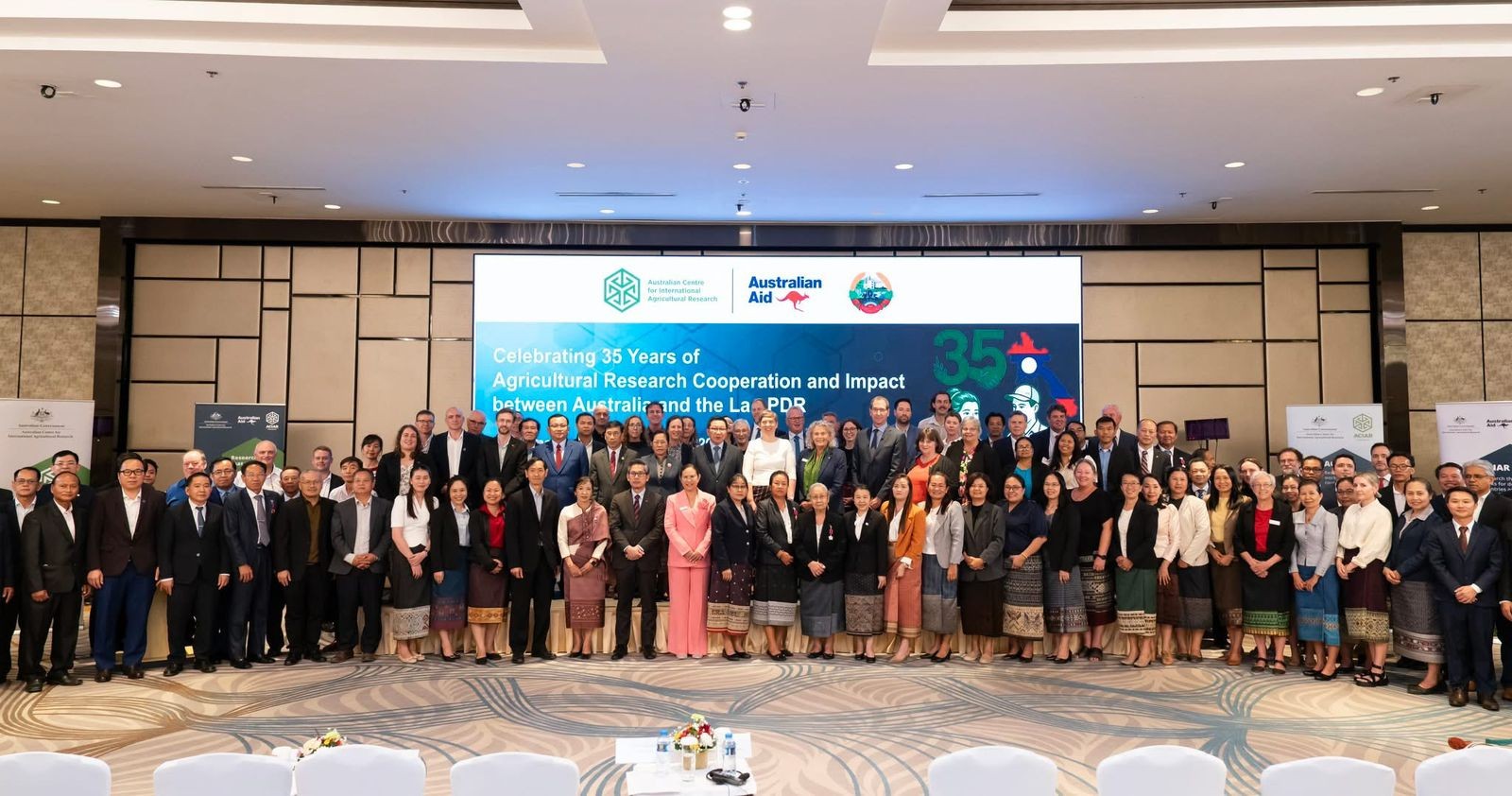
They were recognised alongside 60 other Australian scientists, representatives from the Australian Centre for International Agricultural Research (ACIAR) and nearly 100 Laotian partners and collaborators.
The Future Farmers project centres around small holder farms, which are small scale agricultural operations – typically managed by families – and play a crucial role in food production and local economies. In Laos, around 60 per cent of the population is involved in small holder farming, and they produce around 85 per cent of the country’s food, making them essential for food security and local economies.
The project, funded through an ACIAR grant, uses data to model the potential of policy changes to increase resilience, enhance livelihoods and reduce poverty in both Laos and Vietnam.
The Future Famers project has found success thanks to its unique focus on centring local voices in the research and policy design process. Associate Professor Pearson highlights how existing frameworks for agricultural development often fail to account for the lived experience of farmers themselves.
“Many assume that commercialisation is the only viable pathway for farmers out of poverty, however, emerging evidence challenges this narrative,” Associate Professor Pearson said.
“Many small holder farmers across the region demonstrate remarkable success on small land holdings, making significant income on highly productive plots through intensive, diversified systems.”
The project represents a major collaborative undertaking between researchers, policymakers, and farmers, with a focus on strong local ownership alongside research design and delivery with local communities’ interests at the centre.
It includes in-country partners — Lao PDR’s National Agriculture and Forestry Research Institute (NAFRI) and the National University of Laos, and Vietnam’s Institute of Strategy and Policy for Agriculture and Environment (ISPAE) — working in collaboration with the University of Canberra.
“Our role as Australian social scientists, is to co-design with our in-country collaborators, who are the next generation of leaders, so that they can conduct social science that provides relevant local insights to inform new policy positions and a build a more viable future,” Associate Professor Pearson said.
“In the short term, there are policy mechanisms that could lead to immediate benefits, like rebates to help women get access to credit, or improvements to road infrastructure so farmers can get to markets more easily.
“In the long term, it’s about building the capacity of policymakers at local and provincial level, from the Women’s Union and village chiefs to the national government.”
Through the results of the modelling, four plausible scenarios emerged for each country, ranging from rural decline under weak institutions and severe climate stress, through uneven growth benefiting only well-positioned farmers, to an aspirational but achievable pathway of inclusive, climate-smart transformation. Expert assessments suggest current trajectories in both countries point toward uneven outcomes without strengthened policy commitment.
Professor Dare said their work was set to impact generations of farmers in the region.
“By addressing the impacts of climate change, urbanisation, and shifting markets on Southeast Asia's agricultural landscape, we can transform the future of food production in the region, ensuring sustainable farming practices and food security for generations to come.”
They don’t do it for accolades, but for these researchers, recognition on the national stage is an affirming sign that their work is heading in the right direction. Reflecting on her award, Associate Professor Pearson notes how the learning has always gone both ways.
“Over almost a decade, my work in Laos has been wonderfully diverse — from water governance and transboundary resource management, to building research capacity and academic professionalism. Each strand has taught me something different about this endlessly complex, quietly remarkable country.”


