


By Fleta Page
7 August 2026: At what age do you stop coping with the heat and become more susceptible to illness in a heat wave? It turns out it’s not a phenomenon confined to the elderly.
Researchers from the University of Canberra’s Research Institute for Sport and Exercise (UCRISE) have found there is a linear decline in heat tolerance as we age – and while cardiovascular fitness is linked to greater tolerance to heat stress, you can’t completely out-train the effects of ageing when it comes to heat.
The research, recently published in the Journal of Applied Physiology, measured the impact of age, cardiorespiratory fitness, and regular physical activity on physiological strain and cognitive performance during six hours in a chamber replicating heat wave conditions of 43°C and 25 per cent humidity.
UCRISE Director Professor Julien Périard, one of the paper’s authors, said the research is important as heat waves are becoming more frequent and more severe.
“At the same time, people are living longer, but not necessarily healthier, and are exercising less,” he said.
“So we wanted to test if we are more vulnerable to the heat as we get older. And if physical activity, exercise, or aerobic fitness mitigate the impact of ageing on the ability to lose heat?”
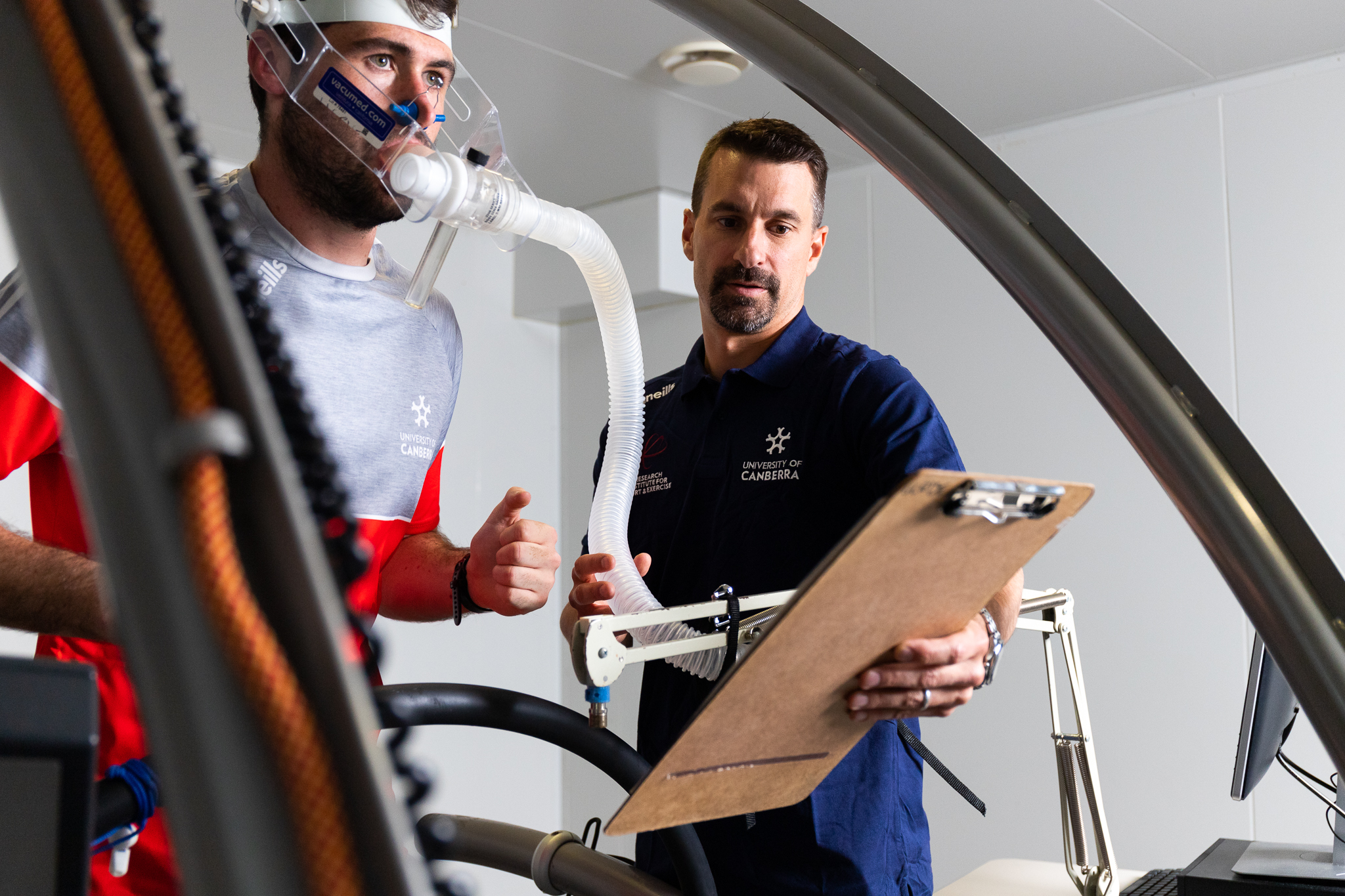
Participants in the study, aged from 18 to 79, were given an actigraphy watch for a week to measure their level of physical activity, and put through a VO2max test (for maximum oxygen consumption) to measure their baseline cardiorespiratory fitness. Their core and skin temperatures were measured through the heat exposure, as was their sweat rate.
“We wanted to see if the level of physical activity someone undertakes on a regular basis is a mediating factor in their ability to cope with a heat wave – or is that ability more closely aligned with cardiorespiratory fitness?” Professor Périard said.
What they found came as somewhat of a surprise.
“We know that as people get older, thermoregulatory function is compromised. But it was relatively unknown as to when and if it happens around a particular age,” he said.
“Usually we think of those in their 40s or 50s as the time when thermoregulatory function starts deteriorating. But what we saw was a relatively linear relationship – as we get older, our thermoregulation is more compromised.
“People’s sweat rate – which is very important under heat stress because sweating is primarily how we lose heat – decreased with age. This decrease also aligned with a greater increase in core temperature. For example, if someone started the heat wave simulation at a resting core temperature of 36.5°C and finished at 38°C, they’ve experienced an increase of 1.5°C. Well, that change in core temperature was greater with ageing, and occurred in line with the reduction in sweat rate.”
They also found cardiovascular fitness can mitigate the heat effects to a certain degree, but not completely.
“What we saw was that those who are fitter can sweat more and experience less of an increase in core temperature. But fitness doesn't fully compensate for the reduction in sweat rate or compromise in thermoregulatory capacity that accompanies ageing,” he said.
The research also looked at cognitive function of participants before and after the heat exposure, with the results raising the question of whether older individuals might also become less perceptive of the need to cool themselves.
“We saw that there was no difference in cognitive function between before and after the heat wave simulation, across the age spectrum. But what we did note was that cognitive function was generally lower in older individuals,” Professor Périard said.
“There is this notion that if your cognitive function is somehow compromised, you might have a reduced ability or capacity to recognise when you should be drinking more or where you should be using mitigation strategies.”
While the body has autonomic thermoregulation strategies – including sweating –Professor Périard explains behavioural thermoregulation is also very important.
“For example, if it's hot someone might seek shade, drink cold water, take a layer off, start the AC, or start the fan – which are thermoregulatory behaviours. However, if cognitive function is compromised and there is an impaired capacity to recognise that it's getting hot and something should be done about, then it may place certain people at risk,” he said.
“It's something that needs to be explored further in older individuals.”
The recently published findings are the first from the study to be released, with more still to come.


