


Suzanne Lazaroo
8 September 2026: Pitching his innovative intervention to address myopia (short-sightedness) with visual noise scored PhD candidate Michael Tran the top spot at the University of Canberra’s Three Minute Thesis (3MT) finals last week, held in front of a full-house audience at the Ann Harding Conference Centre.
Held annually, 3MT is an international research communication competition, which sees participants distil their (on average, 80,000-word) theses into a concise three-minute pitch, to win funding towards their research.
“Being able to effectively communicate your research, to both academics and a general audience, is an invaluable skill for any researcher – and the 3MT competition provides an important opportunity to build this ability,” said the University’s Deputy Vice-Chancellor Professor Michelle Lincoln.
“Each of the eight finalists who took the stage impressed the judges and the audience alike – you could tell from the crowd’s very enthusiastic reactions!
“I want to congratulate all the participants – not just for doing such a great job presenting their work, but also for stepping up and out of their comfort zones, which is so important to both personal and professional growth.”
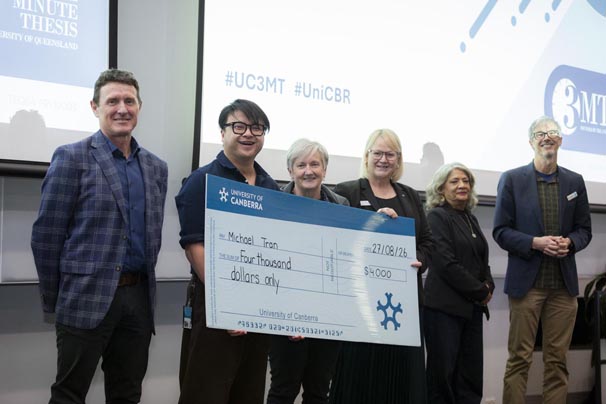
Pursuing his PhD at the Faculty of Health, Mr Tran’s research focuses on using an Augmented Reality (AR) headset to address myopia – a condition projected to affect 50 per cent of the global population by 2050. The Canberra optometrist is hoping his intervention may help shrink that number.
“Time spent outdoors is actually protective against myopia, which is one of the leading causes of visual impairment and blindness in the world,” he said.
“Due to urbanisation and modernisation, our visual world is changing. This impacts the random visual information that our eyes and brain receive, which plays a crucial role in the growth and development of our eyes. I believe that an AR headset can be used to offset that, and help prevent the development of myopia.”
Winning $4,000 for his research, Mr Tran was thrilled to take top spot – but said his real takeaway from the night was getting to hear about some of the other innovative, impactful and community-centric research happening at UC.
“I’ve been on the research communications journey since I started my PhD in 2024 – making complicated topics tangible for an audience is really valuable, not just to build your own skillset, but also your collaborative networks, and expand your research.”
"One of the great strengths of the UC research community is its grassroots research, that solves real world problems that our local community is experiencing,” he said.
“And at UC – as you heard at the finals – there are amazing teams of expert clinicians and scientists that work cohesively together to accomplish these goals. I'm grateful to be part of all of this!
Mr Tran will now go on to compete in the Asia-Pacific Three Minute Thesis Semi-Finals, to be held as a virtual event on Wednesday 14 October.
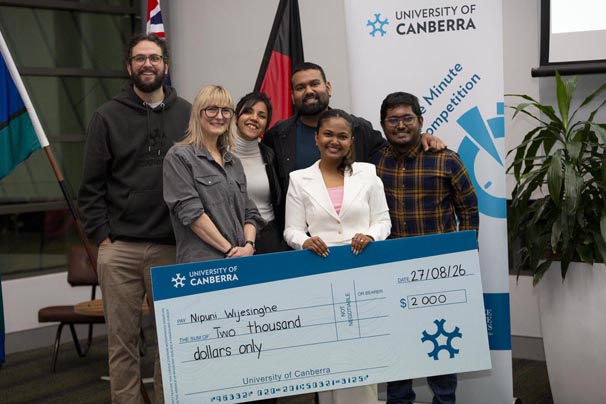
Nipuni Wijesinghe from the Faculty of Science and Technology won $2,000 as runner-up, engaging judges and audience alike with her pitch on how to improve human-robot interaction, when robots execute tasks without being able to read context clues as a human can.
“By 2025, it’s expected that one in 10 people will have regular interactions with robots, so getting this framework right now really matters,” she said.
“Making our research accessible to a general audience is so important – at the end of the day, research is about making people’s lives better and the knowledge should be shared with everyone. Plus, this accessibility allows others to build on our research.”
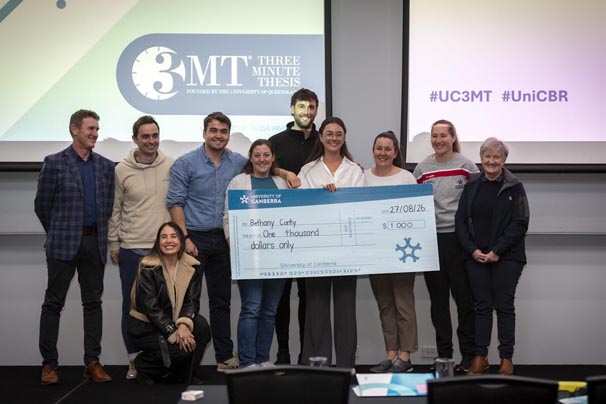
Bethany Canty from the Faculty of Health won the People’s Choice award – and $1,000 to go towards her work in the under-researched area of breast impacts in sport, as she evaluates the causes and complications of these impacts.
Ms Canty’s work combines research into women’s health with the field of biomechanics.
“I think there is still a stigma surrounding female health research, and it remains an undervalued and under-researched field that needs further attention – however, it is also a rapidly growing and fast-moving area, making it a great field to be part of,” she said.
“Being named the People’s Choice award winner was incredibly meaningful and rewarding. Feeling that people understood the importance of the research – particularly given that it focuses on an area that is often overlooked – was really special.”
While there were only three top spots, every competitor onstage that night held the audience captive, with their impactful research and impassioned delivery.
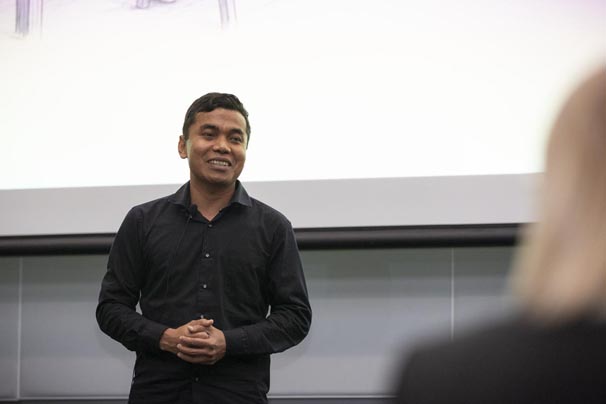
From the Faculty of Education, Adi Husnawadi expounded on his research into how the learner-centred pedagogy of flip classrooms (a model in which students learn new content at home, then put it into practice in class) affect the writing performance, engagement and perceptions of people learning second languages, while Gerelma Altangerel shared her research into how culture shapes self-regulated learning, which grew from observing children from nomadic Mongolian families.
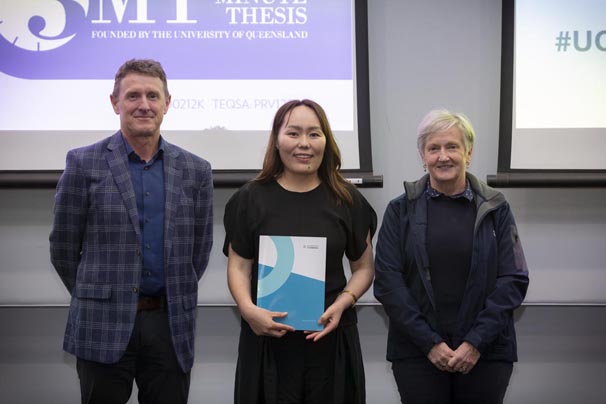
Lucy Walton from the Faculty of Health spoke about her work on lifestyle-based secondary prevention for people with transient ischemic attack (TIA) and mild stroke – her work emphasises practical, real-world approaches like cardiac rehabilitation that can be translated into clinical care, and improved health outcomes.
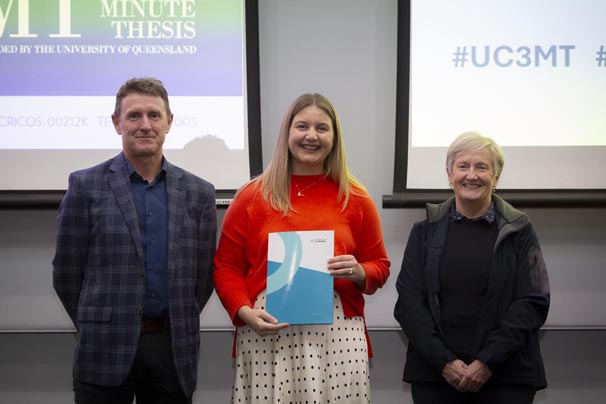
Zobaida Knanam from the Faculty of Business, Government and Law talked about her work assessing the quality of sustainability assurance with a comprehensive, multi-dimensional framework – which can shine a light on the truth of sustainability claims from a company, and help inform consumers.
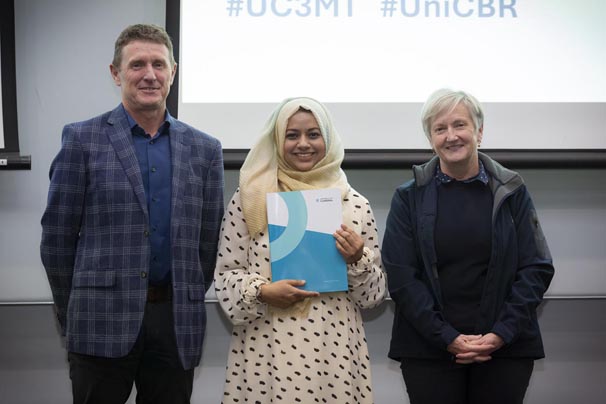
And Chloe Kim from the Faculty of Arts and Design shared her researchinto how consumption of Korean movies and drama series, as well as K-pop, influence cultural identity formation among Korean-Australians – and how they build belonging and connection for those who spend their lives moving between two cultural worlds.
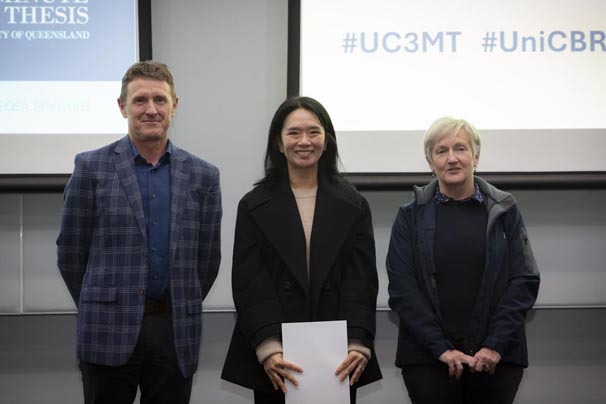
Judges for the night – The University’s Pro-Vice Chancellor Indigenous Professor Annette Gainsford, CSIRO’s Program Manager: Industry PhD Duncan Byrne and Sunita Kotnala, Founder and CEO of Women’s Shed Canberra – had their work cut out for them, with such strong competition in the mix.
“We certainly discussed at length, there were so many good pitches – it’s clear that UC is really punching above its weight in the research world,” said Professor Gainsford.
“What also really stood out for me was the sense of support and camaraderie among the participants – how they cheered each other on, and how happy they were for each other. That kind of community spirit is invaluable.”
Access all finalists’ pitch videos here: UC 3MT 2026 finalists.


