


9 July 2026: FreshEd with Will Brehm is now ranked in the top 1.5 per cent of podcasts globally – a major milestone for Dr Brehm, an Associate Professor at the University of Canberra’s Faculty of Education.
An educator and researcher specialising in comparative and international education, Dr Brehm has racked up over 400 interviews over the past decade, with guests ranging from Nobel Prize winners to PhD students, guided by his philosophy of putting ideas ahead of titles.
“I think it's really valuable to try to deeply engage with different perspectives. That’s what can help us better understand our own perspective,” Dr Brehm said.
And while FreshEd is an education-focused podcast, it’s not just teachers tuning in every episode. Given Dr Brehm’s focus on comparative and international education – a field that examines education systems and policies across different national and cultural contexts, often situating education within broader social and political-economic structures – the podcast attracts a broad audience spanning professions and countries.
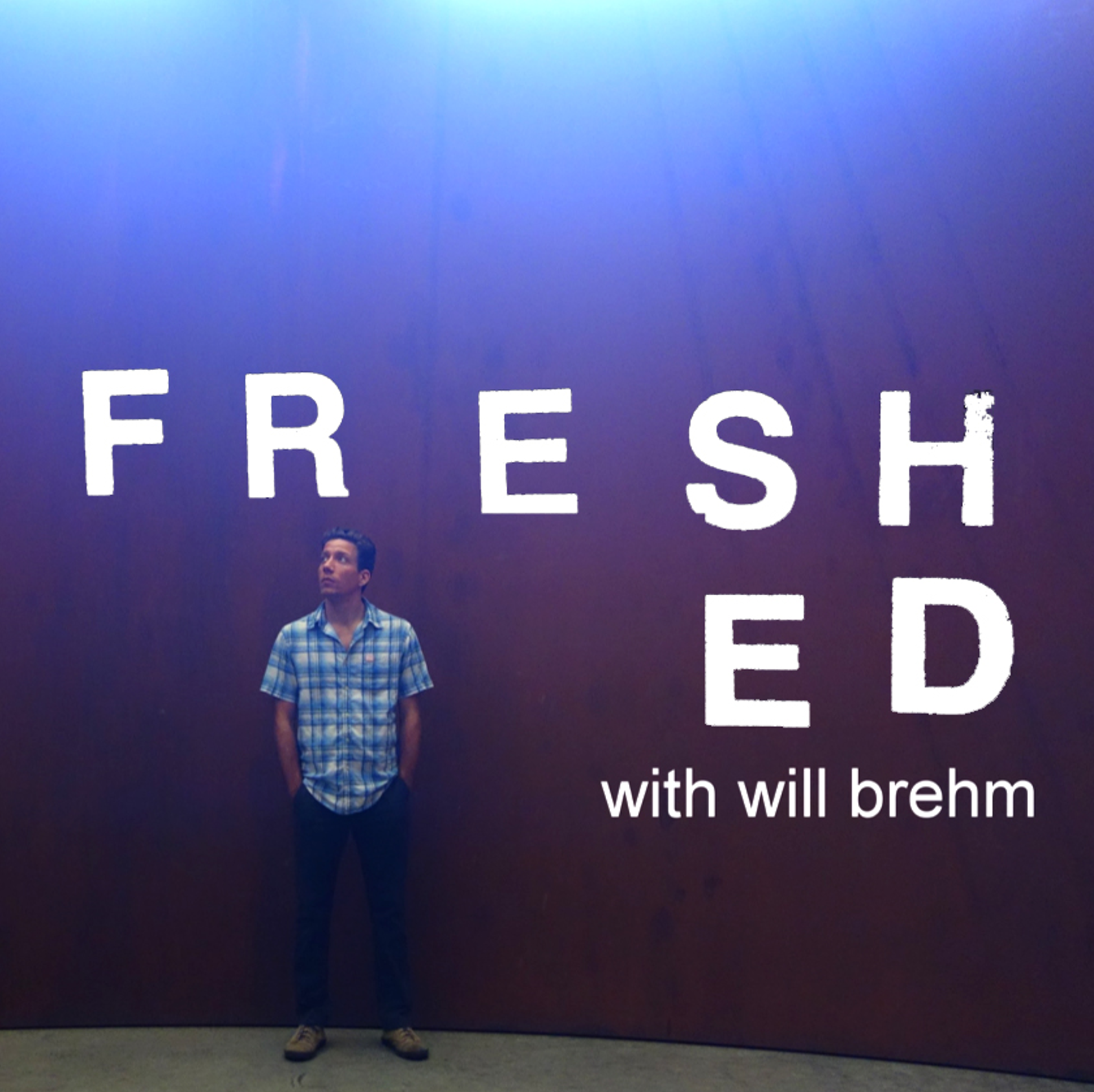
Dr Brehm never set out with the intention of becoming a professional podcaster. From humble beginnings, the podcast started as a personal project over ten years ago, sparked by his move to Japan to undertake a postdoctoral fellowship.
“It was my wife’s idea actually! She suggested that I could start a podcast as a way to stay in touch with people – this was in 2015 when podcasting really took off – I started it without any idea of what I was doing,” he said.
But what started as a project to connect personal networks soon grew into something more. Now, after a decade on the airwaves, Dr Brehm’s podcast has amassed a global following and a team of staff based both in Australia and across the world. The podcast has also been broadcast in Spanish and Portuguese and even inspired a spinoff.
“It really blows my mind, as someone who consumes a lot of podcasts, to realise that I'm creating something that is being recognised around the world. It's a dream come true,” Brehm said.
“There's always ups and downs in these projects, and you just have to keep going – it pays off. To know that ten years on, we're one of the top podcasts, not just among education podcasts, but across all categories, it’s amazing.
“I get excited every time I get to talk to someone new. I think it’s that love that’s going to keep me doing this indefinitely. Interviewing is like an art form – I’ve learned to love the challenge.”
Perhaps no surprise, it’s his penchant for asking questions that led Dr Brehm to the field of comparative and international education in the first place.
Following his experience working on the ground in different education systems abroad, first in his role as an English teacher in Taiwan, and then in an education development capacity in rural Cambodia, he started questioning the larger systems and philosophies that influence the delivery of education.
“All sorts of questions came up in my mind: why is English the main language that people are learning in Taiwan? Why does Cambodia need international donations from Australia or the US to fund their education system and what sort of power relations does that lead to? And who gets to decide what is the right approach to structuring an education system?” Dr Brehm said.
“I found the field of comparative and international education helped me answer those questions – there's a lot you can learn about your own school system by looking at other school systems abroad.”
Through the podcast, Dr Brehm is able to share his love of the field with others, connecting academics, educators and policymakers across disciplines and borders.
Dr Brehm is ever the fan of audio as a means of learning and sharing, and with his podcast, he can ask, answer and ponder the big questions that affect education globally, while bringing us all along for the ride.
“Audio as a medium can revolutionise what academics do,” Dr Brehm said.
“A really simple example is the power of silence. People who teach in a classroom understand that if you ask a question and then you pause, the class sits in silence, something happens in that room. It’s something that can’t be created in a written format.
“And the podcast is more than just translating research, because through this dialogic exchange, the guest is contributing new ideas, and I’m contributing new ideas, it’s not recreating what they wrote in a paper, it’s creating something new, a new form of research output.”
Listen now: FreshEd with Will Brehm * FreshEd


