


Eagle-eyed student wins photo prize
Sarina Talip
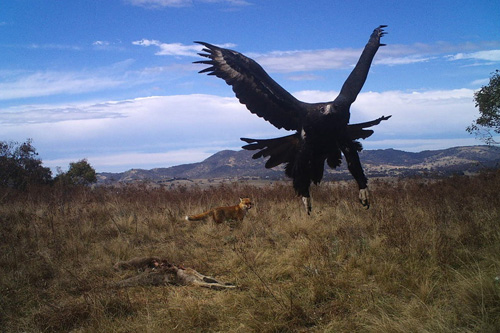
3 April 2014: When Felicity Hatton’s award-winning photograph was taken of a wedge-tailed eagle scaring a feral fox away from a kangaroo carcass, she was not behind the camera.
In fact, the University of Canberra graduate was not even there on the day.
That’s because wedge-tailed eagles are very wary of humans and if the birds of prey had spied Ms Hatton, she would have had to find new sites to conduct her field research.
And that’s why she spent 16 hours a day, for 20 days, over a period of four months, holed up in a one-man tent covered with hessian designed to blend into the bush, in order to avoid being seen by the wedge-tailed eagles she was trying to study.
Ms Hatton’s photograph, which was taken as part of her honours research in 2012, took out the top prize in the 2013 Invasive Animals Cooperative Research Centre’s annual photography competition from among almost 400 entries from across Australia.
 |
|
Felicity Hatton’s award-winning image of the wedge-tailed eagle |
Her image, which was taken with a motion senor camera, also won the people’s choice award.
In the photograph, the last in a series of six shots, the eagle had just swooped in and chased the fox away.
“Eagles are definitely at the top of the food chain,” Ms Hatton said.
Ms Hatton was awarded first class honours in a Bachelor of Environmental Science (Honours) for her research which broke new ground in understanding wedge-tailed eagles’ behaviour, which were once considered pests and as recently as 1974 had bounties offered for their capture.For six months, Ms Hatton dragged 64 kangaroo carcasses to six carefully chosen spots on private properties and in national parks in the ACT to lure wedge-tailed eagles.
Her original aim was to trap and catch an adult eagle to attach a satellite tracking device to it, something that had never been done before with this species, in order to better understand the wedge-tailed eagle’s home range size, habitat use and flight behaviour.
But Ms Hatton admits that it was “really tricky” to trap and catch such a powerful bird. She also ran into difficulty at the six trap sites, as foxes would “annoyingly” drag the kangaroo carcasses away at night, which meant she had to stake the carcasses down.
When Ms Hatton managed to catch a juvenile eagle and attach a satellite tracking device to the female bird in November 2012, she was ecstatic, and changed her research to focus on the post-fledging behaviour of juveniles.
She managed to collect six weeks’ worth of data and was able to monitor the juvenile female wedge-tailed eagle’s flight behaviour, how often she was perching or flying, and she could also see that the young bird was reaching higher altitudes over time.
“That’s important because she was getting more confident. She was getting up higher over time and was also using thermals to get up higher,” Ms Hatton said.
“The distance she travelled per day also increased over time. We were able to see trends like that.”
Ms Hatton was also able to track the eagle’s movements.
“She was moving around different habitats. She started off by using a really open area, eventually moving into more dense, thicker areas, which are more difficult to hunt in. That’s all about learning to be independent,” Ms Hatton said.
She discovered that it took about 121 days for the juvenile eagle to “disperse” – or leave her parents’ territory.
“Once they’re gone, they generally don’t come back. And I don’t know where she is now, she’s just flown away with $2,500 worth of equipment,” Ms Hatton said, laughing.
But the custom-designed backpack-style harness to which the satellite tracking device was attached is designed to break away anyway at around the six-month mark.
Ms Hatton hopes that the pilot study using a satellite tracking device on wedge-tailed eagles will pave the way for research to be carried out on little eagles, which are listed as vulnerable in the ACT and NSW.
“If we know more about an eagle’s home range, then we can reduce our impacts on their patch of land, for instance, avoid poisoning rabbits in areas where we know they are feeding,” Ms Hatton said.
Ms Hatton, who now works as a ranger, said she loves to watch eagles.
“They’re incredibly beautiful to watch up close, and at the same time they’re incredibly powerful,” Ms Hatton said.
“Their aeronautic displays are amazing as well – you’ll see two eagles coming together, tussling with their talons and spiralling out of the sky. Their freedom is a real symbol to me as well.
“Most of all, I love being out in the bush and being able to switch off from everything and just focus on being part of nature.
“And finding an eagle nest, something that’s so hidden to most people, is amazing.”


