Outside the research centres, academics within the Faculty of Arts and Design also undertake research in the disciplines of architecture, design, building and construction, communication, website design and more.
Research Centres, Institutes and Groups
Research centres and institutes
University of Canberra research is focused on shaping our region and working towards a better future. Strategically funded research institutes and centres undertake the majority of research at the University and are currently renewed on a three- to five-year cycle. Faculty-based research groups and teams also undertake valuable research, and collaborative networks promote a common focus and cross-university networking.
Jump to research centres and institutes in a category:
Centre for Applied Water Science
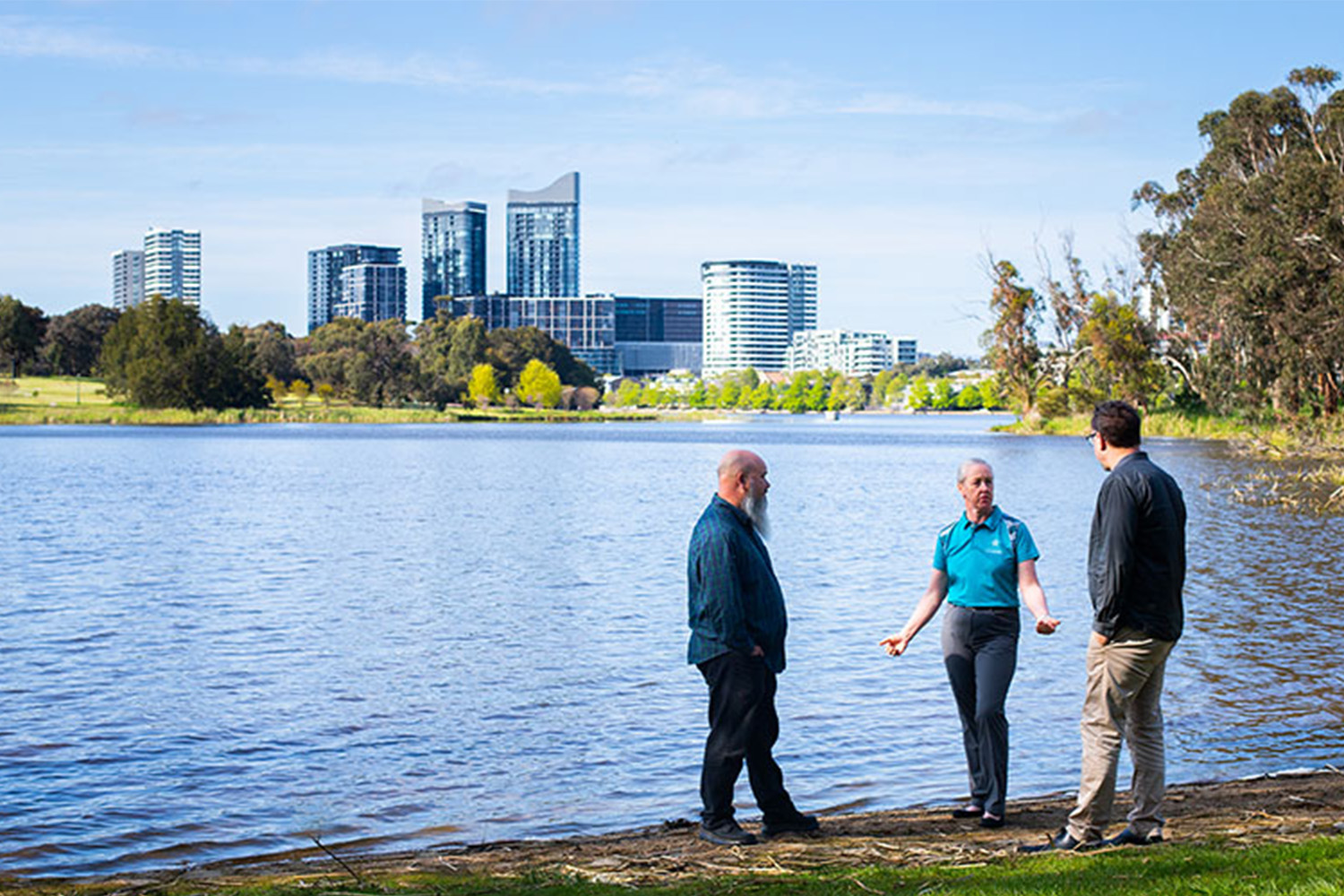
UC’s Centre for Applied Water Science (CAWS) is a multidisciplinary centre dedicated to bridging the gap between ecological theory and practical application in freshwater management. CAWS brings together hydro-ecological theory and practical application to address the management of complex environmental problems. Through research excellence, education, and long-term relationships with funding partners, the Centre informs policy and management, inspire the next generation of researchers and decision makers, and strive to ensure the long-term health and resilience of freshwater-dependent systems. CAWS’s research themes are:
- Environmental water;
- Water in urban environments; and
- Alpine and Antarctic environmental change.
Centre for Conservation Ecology and Genomics
The Centre for Conservation Ecology and Genomics (CCEG), within the Faculty of Science and Technology, combines ecological insights with genomic advances to generate fundamental knowledge and practical solutions for emerging environmental challenges. Building upon the University’s research excellence in environmental science and genetics, CCEG focuses on applications in conservation and biosecurity, which include on-campus captive breeding programs for critically endangered species and hosting the National eDNA Reference Centre. The Centre’s research themes are:
- Enhancing biodiversity and biosecurity using environmental DNA;
- Integrating ecology and genomics to improve conservation management;
- Investigating species’ responses to environmental changes; and
- Developing innovative tools for processing and analysing genomic data.
Centre for Environmental Governance
UC’s Centre for Environmental Governance (CEG) is an interdisciplinary centre focused on investigating and solving complex environmental problems such as water management, natural disasters and climate change through applied policy approaches. CEG is based within the Faculty of Business, Government and Law but brings together a range of researchers from fields including political science, public policy, public administration, environmental regulation and governance, natural resource management, democratic participation, political communication, online engagement and political participation, and big data analysis. The Centre’s two research themes are:
- Natural resource management and water governance; and
- Climate change, disaster recovery and resilience, and wellbeing.
Health Research Institute
The Health Research Institute (HRI), within the Faculty of Health, is UC’s largest research institute and focuses on disease prevention and creating healthy, sustainable environments. Its research aligns with the United Nations Sustainable Development Goal (SDG) 3 Good Health and Wellbeing, SDG13 Climate Action, and SDG 10 Reduced Inequalities. The Institute’s public health themes include:
- Environmental health and climate change;
- Mental health and wellbeing;
- Prevention of chronic disease; and
- One Health and infectious disease control.
HRI is supported by state-of-the art infrastructure including the GeoSpatial Health Lab, Visual and Decision Analytics (VIDEA) Lab, and HEAL (Healthy Environments And Lives) Observatory.
HEAL Global Research Centre
The Healthy Environments and Lives (HEAL) Global Research Centre takes a global approach to address the health risks of climate change, extreme events, air pollution, heat and cold, environmental degradation, and climate-sensitive infectious diseases. Situated within the Faculty of Health and the Health Research Institute, HEAL’s research themes are:
- Environment, climate change and health risks;
- Climate change mitigation and adaptation solutions; and
- Policy and practice implementation.
The Centre coordinates the HEAL National Research Network, which connects Australian researchers, policymakers, peak bodies, industry, and community organisations to improve public health, our health system, and the environment.
Centre for Ageing Research and Translation
The Centre for Ageing Research and Translation (CARAT) is a multidisciplinary research centre drawing on allied health, nursing, health and social sciences. CARAT’s work targets the practices, programs and policies that affect the health and wellbeing of older people living in their own homes, with family, in residential care, or elsewhere. Sitting within the Faculty of Health, CARAT’s research is focused across three themes:
- Dementia and cognition;
- Innovative care models; and
- Workforce for aged care and health services.
Research Institute for Sport and Exercise
The University of Canberra Research Institute for Sport and Exercise (UCRISE) is dedicated to advancing the science of sport, exercise, and movement through applied interdisciplinary research. Its work enhances athletic performance, supports lifelong health, builds occupational resilience, and promotes inclusive participation. Through innovation and cross sector collaboration, UCRISE transforms scientific discovery into practical solutions that improve human performance and wellbeing. Operating in the Faculty of Health, UCRISE undertakes research across four interconnected domains:
- Sport – human performance and resilience
- Health – lifelong wellbeing
- Occupation – tactical and environmental adaptation
- Community – inclusive participation and engagement
News and Media Research Centre
The News & Media Research Centre (N&MRC) at the University of Canberra is Australia’s leading research group focused on the critical issues facing news, media and communication industries. It brings together diverse academic and practitioner expertise to empower people, inform policy, and strengthen sustainable media and communication practice. The Centre is nationally recognised for its research areas of expertise, which include:
- News audiences and trust;
- Newsroom innovation;
- Media representation and diversity;
- Media and information literacy;
- Misinformation and online safety; and
- Civic capacity building.
Centre for Deliberative Democracy
Our Centre for Deliberative Democracy (CDD) is a world-leading centre for scholarly and applied research in deliberative governance and democratic innovations. It is home to internationally renowned political scientists who produce impactful research on complex societal challenges, shaping democratic practice from local to global levels. Based within the Faculty of Business, Government and Law, CDD’s work spans three interconnected research areas:
- Democratic inclusion;
- Democratic resilience; and
- Democratic reason.
Centre for Advanced Studies in Education (CASE)
The Centre for Advanced Studies in Education (CASE) pioneers groundbreaking research by integrating cognitive processes with sociocultural contexts to address complex 21st century educational challenges. Operating within the Faculty of Education, CASE brings together leading researchers to deliver transformative solutions from individual learning to community development. Through strategic partnerships with government agencies, schools, and communities, CASE conducts deeply embedded research that ensures relevance, real-world impact, and sustainable change across diverse formal, informal, nonformal learning environments.
CASE's impact areas include:
- Optimise student learning;
- Strengthen schools and systems;
- Empower families; and
- Partner with communities.
Centre for Intelligent Computing and Systems
The Research Centre for Intelligent Computing and Systems (CICS) leads research in intelligent systems and the computing that underpins them, employing multisensory perception, data analysis for decision making, robot control and cyber-physical artificial intelligence, intertwining the digital and AI transformation. CICS aims to design and integrate AI solutions that address societal challenges, building on its strength in the following areas:
- Artificial intelligence and machine learning;
- Cyber security and sensing systems;
- Robotics and embodied AI; and
- Smart digital transformation.
Explore more of our research undertaken within UC’s five faculties.
Faculty of Business, Government and Law
Our academics also undertake research in politics, public administration, law, business, gender equality, economy, crisis management, customer vulnerability, responsible business technology and more, with a strong focus on responsible and ethical practices across different industries.
Faculty of Education
Other research undertaken at UC within the Faculty of Education spans early childhood and schools to tertiary, workplace, and community learning in teaching, learning and policy contexts.
Faculty of Health
UC also undertakes valuable research in the Faculty Health across the disciplines of midwifery, psychology, physiotherapy, nursing, pharmacy, dietetics, pharmacy, speech pathology, and optometry, with its three areas of strength being Brighter Beginning, Clinical Research Rehab and Translation, and Mental health harm Prevention (MhhP).
Faculty of Science and Technology
Our academics also undertake research in artificial intelligence (AI) and robotics, network engineering, cybersecurity, information systems, software engineering, data sciences, virology, molecular and biochemical therapeutics, conservation and systems ecology.
Explore more of our research undertaken within UC’s five faculties.
Faculty of Arts and Design
Outside the research centres, academics within the Faculty of Arts and Design also undertake research in the disciplines of architecture, design, building and construction, communication, website design and more.
Faculty of Business, Government and Law
Our academics also undertake research in politics, public administration, law, business, gender equality, economy, crisis management, customer vulnerability, responsible business technology and more, with a strong focus on responsible and ethical practices across different industries.
Faculty of Education
Other research undertaken at UC within the Faculty of Education spans early childhood and schools to tertiary, workplace, and community learning in teaching, learning and policy contexts.
Faculty of Health
UC also undertakes valuable research in the Faculty Health across the disciplines of midwifery, psychology, physiotherapy, nursing, pharmacy, dietetics, pharmacy, speech pathology, and optometry, with its three areas of strength being Brighter Beginning, Clinical Research Rehab and Translation, and Mental health harm Prevention (MhhP).
Faculty of Science and Technology
Our academics also undertake research in artificial intelligence (AI) and robotics, network engineering, cybersecurity, information systems, software engineering, data sciences, virology, molecular and biochemical therapeutics, conservation and systems ecology.
Get in touch with the the University to begin or continue your journey in research, explore opportunities for collaboration, draw on our research expertise, or establish a relationship with UC.