


Fleta Page
26 February 2026: Tackling Indigenous Smoking (TIS) is widely regarded as one of Australia’s most successful health interventions.
Now in its 16th year, the program born from former University of Canberra Chancellor Emeritus Professor Tom Calma’s seminal Social Justice Report (2005) has launched an archive of its resources, which is hoped will serve as a blueprint for future health promotion programs.
The Tackling Indigenous Smoking digital repository – a living archive of all the community-based health promotion program’s resources – was launched on Tuesday, with a keynote presentation from Professor Calma, the National Coordinator of the program.
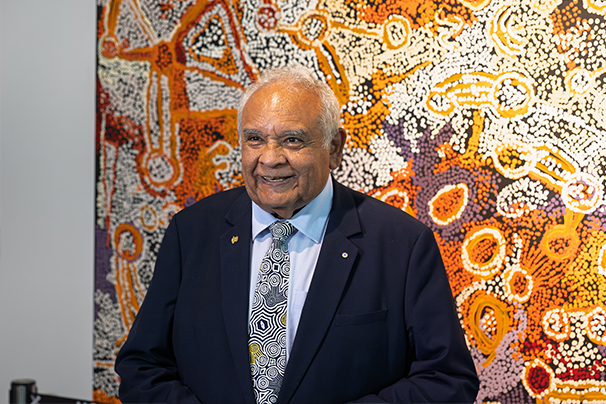
“Tackling Indigenous Smoking is recognised anecdotally as one of the most successful, if not the most successful health intervention program in the nation, for both Indigenous and non-Indigenous people,” Professor Calma said. “That’s based on mortality data, the number of lives that have been saved because people have given up – or not taken up – smoking.”
The keys to the program’s success have been recognising the different history of addiction in Indigenous communities – historically paid in rations of flour, sugar and cigarettes – and empowering local communities to create campaigns that cut through with mob, and counteract the tobacco industry’s targeting of First Nations people.
The Faculty of Health ’s Associate Professor Dr Penney Upton, led a review of the program in 2014, and is now the research and evidence lead with the program’s National Best Practice Unit (NBPU). She said that Indigenous smoking rates had dropped – from over 50 per cent when the program started in 2010, to 29 per cent as of the end of 2024. Evaluations indicate the TIS program has been central to that decline.
“The external evaluation team at the Australian National University, which assessed the program implementation, analysed communities where there were TIS teams working and compared them to communities without TIS presence, and they found a real difference in terms of people's attitude and knowledge,” Dr Upton said.
Smoking causes more than a third of Aboriginal and Torres Strait Islander deaths at any age, and Professor Calma noted the problem of smoking has wider impacts, including on food security and education, which become unaffordable if families spend their money on cigarettes. This compounds the value of the anti-smoking program.
“[The program is] very good value for money, when you look at the cost of smoking to the general population in both health terms and in loss of productivity, it is phenomenal. We're talking [saving] billions a year,” he said.
Professor Calma noted that lowering smoking rates is one of only four of the Commonwealth’s Closing the Gap targets – developed on the back of his 2005 Social Justice Report on Indigenous Health Equality – that are on track for achievement.
“I argue that’s because the way the other programs are being delivered needs to change – they need to really focus on self-determination and to empower the community to come up with the strategies, rather than for bureaucrats or agencies to try to determine what’s best for the community.”
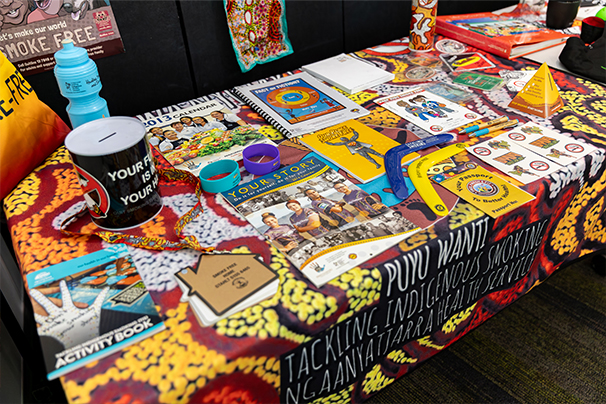
He said other areas need to learn from the Tackling Indigenous Smoking program and hopes the digital repository, which allows universal access to the history and resources of the program, will be used as a blueprint for other First Nations community programs.
Inspired by the University of Canberra’s Australian National Museum of Education (ANME), which was founded to promote an historical understanding of Australian education, Professor Calma hopesthe digital repository “will become a very prominent centre for UC into the future”.
The NBPU TIS is led by Indigenous-owned company Ninti One, working in a consortium with Edith Cowan University’s Australian Aboriginal HealthInfoNet and the University of Canberra’s Health Research Institute (HRI), which is housing the digital repository.
To complete the archive, 19 boxes of physical resources were digitised and catalogued by University of Canberra student Remy Morris, a Kamilaroi woman who joined the program in 2024 whilestudying a Bachelor of Health Science, and who has devoted hundreds of hours to the project over the last 18 months.
“I was in Sydney before this, working at an Aboriginal community health centre as a dental assistant, so I could see first-hand what smoking did to mobs’ teeth,” she said.
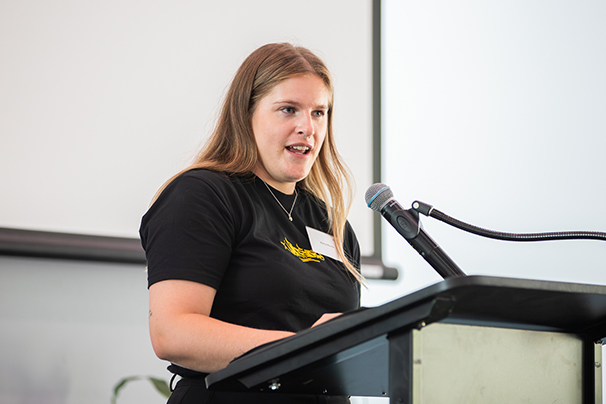
Ms Morris, who is now studying a Master of Public Health, said the launch, attended by people involved in TIS across the country, “showcased the success of the program since its beginnings, to inspire other initiatives to create successful long-running programs”.
She said the program is evolving to educate on new nicotine addictions, resulting from alternatives pitched by tobacco companies as ‘harm minimisation’.
“The tobacco industry is always finding new ways to get in with people which can result in new addictions,” Ms Morris said. “They've got vaping, which they claim is harm reduction because it's not tobacco. And now we've got nicotine pouches, and they say they’re smoke-free, so they must be better for you.”
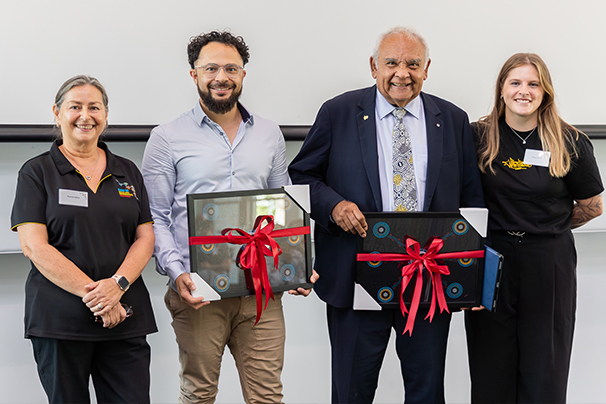
Ms Morris was recognised at the launch as a future leader in the Indigenous public health space, and awarded the inaugural Calma Family Endowment Scholarship, which will assist in her studies.
Dr Upton said aside from being led from the ground up, a major element to the program’s success is continuous bipartisan government funding.
Health Minister The Honourable Mark Butler, who addressed the launch via video message, acknowledged Professor Calma’s leadership and explained why the government continues to invest in the program.
“Tackling Indigenous smoking remains one of the most critical aspects of First Nations health. We all know that the largest contributor to the health and mortality gap between First Nations people and other Australians is smoking,” he said. “The program has contributed to significant public health gains, backed by national evaluations and peer-reviewed evidence.”
Dr Upton credits Professor Calma as the driving force at government and community level, alongside Dr Raglan Maddox, who was at the Department of Health at the time of the TIS program’s development, and later did his PhD at the University of Canberra.
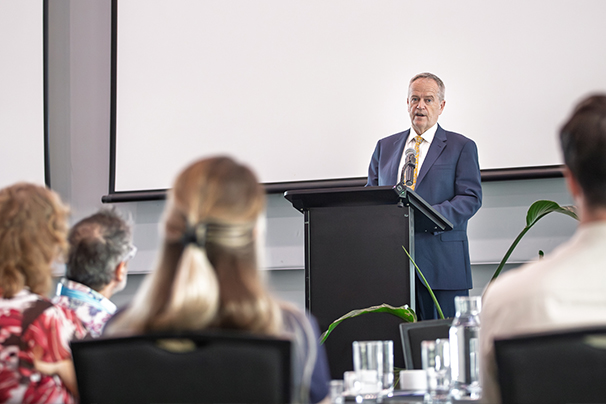
UC’s Vice-Chancellor, Professor The Honourable Bill Shorten, said the digital repository would be integral to guiding future action in public health, and the University was proud to be part of the initiative.
“The significance of ‘keeping knowledge alive’ cannot be understated,” he said.
“Having access to information about innovative strategies, community-driven initiatives and what worked – and equally important, what didn’t – allows us to learn from the past to better navigate a path to the future.”


