


Suzanne Lazaroo
22 December 2025: Driven by a vision to create and drive equal opportunity and inclusion within the design, property and construction industries, the 2025 Built Environment Diversity and Inclusion Scholarships (BEDI) at the University of Canberra went to three Bachelor of the Built Environment students who embody its ideals.
In 2017, University Council member Medy Hassan OAM initiated and founded the BEDI Scholarship, working in partnership with the University to establish and activate the program. The Scholarship celebrates students in their penultimate year of pursuing a degree at the Faculty of Arts and Design’s School of the Built Environment and Design.
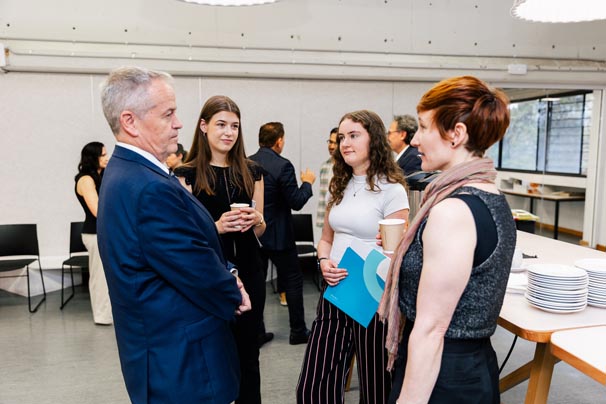
Bachelor of the Built Environment (Interior Architecture) student Grace Careless received the award in Semester One of this year. In Semester Two, Natalie Millerd and Sarah Brown, both studying for a Bachelor of the Built Environment (Architecture), were named recipients.
“The Scholarship aims to ensure equal opportunity for students studying within the built environment disciplines, to provide financial support, industry engagement and mentoring to help students build a strong foundation in their careers and to drive positive generational change, increase diversity and design, property and construction sectors,” Mr Hassan said.
University of Canberra Vice-Chancellor Professor The Honourable Bill Shorten reflected on how the built environment is a direct reflection of what we value as a society – and how the scholarship reflects the excellence the University itself holds dear.
“The way I see a diversity scholarship, it’s a merit radar,” he said. “It looks beyond the traditional, often superficial definitions of merit – beyond where you went to school, or who your family is – to find merit wherever it exists.
“Our built environment is one of the things that makes our values as a society clear. How we design things for people, who we include – or not. It is one of the things each successive generation looks to as an indicator of who the previous generation is. Heritage is not bricks and mortar, it is memory. And what Grace, Natalie and Sarah design will be part of the collective memory of today's society.”
Ms Careless has always been fascinated with building and creating – she found her calling when she fell in love with a design technology unit in high school.
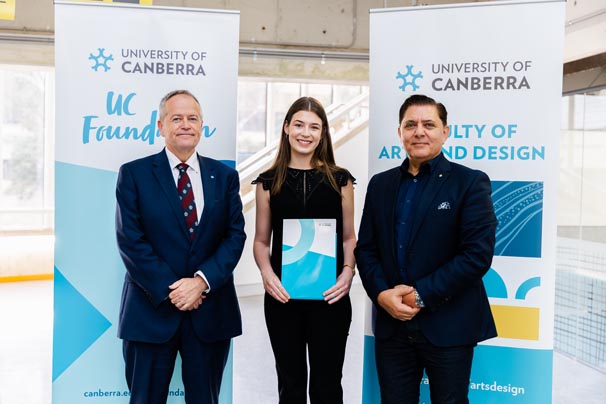
“For my major project, I designed an aged care facility for people who had dementia, and were suffering from loneliness,” she said.
“I became really interested in the way design can impact mental and emotional health – how the right spaces can facilitate relationships, provide comfort and support people's daily activities in meaningful ways. That project opened my eyes to how powerful design can be as a tool for care and connection, and I wanted to be part of the change in how we design spaces and make them more user-centred, rather than just aesthetically pleasing.”
Her focus is on interior architecture, because of how it can impact mood and emotion in a space.
“Architecture also shapes identity because the spaces we spend time in profoundly influence how we see ourselves and how we interact with others. If you grow up in environments that feel unwelcoming, that affects your sense of belonging. But when we design with inclusion, diversity and empathy in mind, we're making a statement that everyone deserves to feel they belong, that everyone's experience matters,” she said.
The award will allow Ms Careless to devote more time and energy to study, and to access additional specialised resources to support her learning. But the scholarship means much more than financial support – it’s an acknowledgement of her perseverance, as she embarks on her university journey while navigating dyslexia and other learning disabilities.
“Receiving this scholarship has inspired confidence in my abilities and affirmed that students with learning disabilities can thrive in higher education, with the right supports,” she said.
Ms Careless has community care as her cornerstone – she volunteers as a lifeguard, and assists at childrens’ triathlons.
“I am currently working as a disability support worker, which I absolutely love and which has deepened my understanding of the importance of accessibility and inclusion in all aspects of life."
Ms Millerd combines student life with full-time para-athletic training at the Australian Institute of Sport (AIS) – it’s a role in which she promotes and champions disability inclusion, and encourages others to understand that those with disability have unlimited potential when receiving the right support.
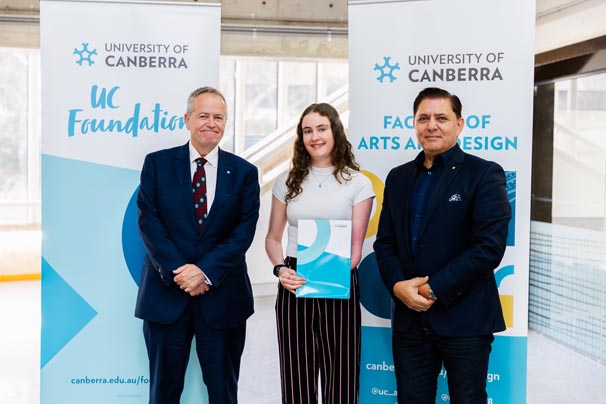
“Balancing elite-level training with university studies requires immense dedication and time management – by helping to alleviate financial stress, the scholarship will enable me to better maintain this balance, and significantly enhance my ability to pursue both my academic and athletic goals,” she said.
Ms Millerd has always had an innate curiosity spanning many different subject fields – and was drawn to architecture as a broad and interdisciplinary industry in which many areas of knowledge intersect.
“I love seeing how architectural projects evolve from theoretical ideas on a page into physical, tangible structures,” she said.
“I also value the history and culture embedded in buildings, and how contemporary design can bring innovation that enhances liveability.”
For Ms Brown, the scholarship represents a degree of financial freedom to pursue her creative ideas.
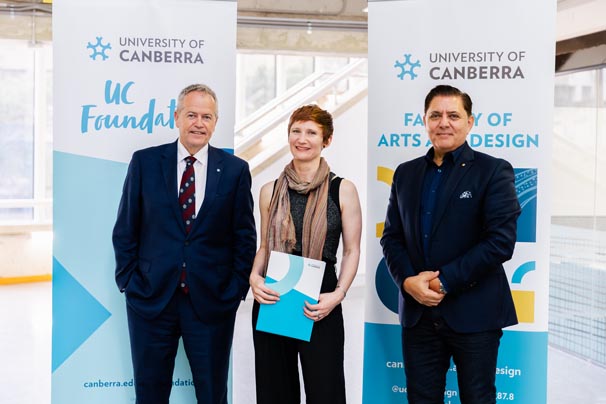
“I have always been interested in Architecture – when my friends who run an architecture firm were looking to hire a draftsperson at the same time that I got my permanent residency in Australia, I took that as a sign and joined their firm,” she said.
“It became clear quite quickly that I wanted to design as well as draft, so I did the Diploma of Building Design at CIT and then moved on to the UC for my Architecture degree.”
As the student representative for the ACT Chapter Council of the Institute of Architects, Ms Brown represents the needs of students within the profession. She’s also a member of the University of Canberra Architecture Society (UCAS).
“We organise the architecture portion of [annual design exhibition] FADx, the Arch Ball, put on student events, and organise the desks and lockers in the architecture studio. Outside the architecture world, I am involved in the Canberra Potters Society, and volunteer my time there.
Ms Brown sees the built environment as being simultaneously “wildly public and extremely personal”.
“We’re all having different experiences of our buildings all the time, and as designers we try to anticipate and curate that,” she said. “In some ways this is a lot of responsibility, but I prefer to think of it as a huge privilege.
“We’re very lucky in Canberra to have some incredible built environment professionals advocating very hard for positive outcomes. At its best, the built environment also reflects the best of our values and gives us safe, enjoyable places to be – and when we feel safe and nurtured, we have more freedom to build identity and live happily.”
Ms Brown has an ADHD diagnosis, and has received support throughout her degree from the Inclusion and Wellbeing team. She’s a member of the Neuro-Atypical Architects Network, which works to provide support and raise awareness of neurodiversity in the industry.
“It may not come as a surprise that neuro-atypical people often find themselves in creative industries – particularly industries where creative problem solving skills are prized,” she said.
“Despite this, our industry is not always friendly to neurodiverse people. I am very passionate about making architecture a safe and inclusive place to work. Diversity of ideas is one of the most valuable things in the design industry.
“It is also important to think about designing for neurodivergence – we know that adaptations for accessibility often benefit able-bodied people as well, and adaptations for neurodivergence are no different. People deserve buildings that are comfortable and safe to be in, and as built environment practitioners, we have a responsibility to provide that to as many people as possible.”
The scholarship will also help Ms Brown navigate some of the personal challenges she has faced this year, including helping with care for her mother who lives in Scotland, and is undergoing cancer treatment.
Professor Shorten also extended his gratitude – and that of the University – to the donors who make the Scholarship possible, including Mr Hassan and Haus Holdings, as well as TSA Riley, Manteena Commercial, Canberra Town Planning, the Harry Triguboff Foundation, National Association of Women in Construction (NAWiC), Lendlease, ACT and Light House Architecture and Science.


