
| Available teaching periods | Delivery mode | Location |
|---|---|---|
| View teaching periods | On-campus |
Bruce, Canberra |
| EFTSL | Credit points | Faculty |
| 0.125 | 3 | Faculty Of Education |
| Discipline | Study level | HECS Bands |
| School Of Teacher Education | Level 4 - Undergraduate Advanced Unit | Band 1 2021 (Commenced After 1 Jan 2021) Band 1 2021 (Commenced Before 1 Jan 2021) |
Learning outcomes
On successful completion of this unit, students will be able to:1. Demonstrate knowledge and understanding of appropriate pedagogical practices in relation to the learning area of Technologies;
2. Demonstrate familiarity with the purpose and content of the Technologies Australian Curriculum, and critically analyse its practical application in classrooms; and
3. Appreciate interrelations between pedagogical knowledge, content knowledge and technological knowledge.
Graduate attributes
1. UC graduates are professional - employ up-to-date and relevant knowledge and skills1. UC graduates are professional - communicate effectively
1. UC graduates are professional - use creativity, critical thinking, analysis and research skills to solve theoretical and real-world problems
1. UC graduates are professional - display initiative and drive, and use their organisation skills to plan and manage their workload
2. UC graduates are global citizens - communicate effectively in diverse cultural and social settings
2. UC graduates are global citizens - make creative use of technology in their learning and professional lives
2. UC graduates are global citizens - behave ethically and sustainably in their professional and personal lives
3. UC graduates are lifelong learners - reflect on their own practice, updating and adapting their knowledge and skills for continual professional and academic development
3. UC graduates are lifelong learners - be self-aware
3. UC graduates are lifelong learners - adapt to complexity, ambiguity and change by being flexible and keen to engage with new ideas
3. UC graduates are lifelong learners - evaluate and adopt new technology
Prerequisites
Students must have completed 24 credit points.This unit is only available to students enrolled in an undergraduate Initial Teacher Education (ITE) course.
Corequisites
None.Incompatible units
None.Equivalent units
None.Assumed knowledge
11765 Foundations of Pedagogy (for students of the following courses):- 321JA Bachelor of Primary Education
- 322JA Bachelor of Primary Education (STeM)
- 323JA Bachelor of Primary Education (Creative Arts)
- 324JA Bachelor of Primary Education (H&PE)
| Year | Location | Teaching period | Teaching start date | Delivery mode | Unit convener |
|---|---|---|---|---|---|
| 2026 | Bruce, Canberra | Winter Term | 08 June 2026 | On-campus | Mr Ryan Elwell |
| 2026 | Bruce, Canberra | Semester 2 | 10 August 2026 | On-campus | Mrs Lucy Bennett |
| 2027 | Bruce, Canberra | Winter Term | 07 June 2027 | On-campus | Mr Ryan Elwell |
| 2027 | Bruce, Canberra | Semester 2 | 09 August 2027 | On-campus | Mrs Lucy Bennett |
Required texts
The following textbooks will be referred to throughout the respective workshops. Please refer to Canvas for the entire reading list.
1) Fleer, M. (2023). Technologies for children (3rd ed.). Cambridge University Press.
2) Albion, P. et, al. (2022). Technologies Education for the Primary Years (2nd ed.). Cengage Learning Australia.
(Available for purchase from Cengage, The Nile Australia, Booktopia, Angus & Roberston online)
3) user e-book access from the UC Library.
Please access via the link below:
https://library.canberra.edu.au/permalink/61ARL_CNB/esmov/alma991005004815803996
Submission of assessment items
Extensions & Late submissions
Approval of extenuating circumstances will be dependent upon the production of supporting documentation and at the discretion of the unit convener.
All assessment items required to be submitted online must be submitted via the appropriate Canvas drop box. It is the student's responsibility to upload the correct and corresponding draft or assessment item to the right submission section. Assignments must be submitted in a format accessible to the assessor(s), as stated on the relevant canvas site. If the unit convener and/or tutor are unable to access a submission, or if no submission has been made by the due date and time, a standard late penalty of 10% of the total marks possible for the task may be applied per day, for three days, after which the submission will receive a score of ‘0' in keeping with UC's Assessment Policy.
It is important to note that no part of an assignment submission has been submitted in any other unit in this or another Faculty, except where authorised by the unit convenor concerned.
Artificial Intelligence
Please see the Unit Outline for specific guidance on AI use for this course. Always refer to UC's AI use guidelines and ask for clarification if needed.
Special assessment requirements
An aggregate mark of 50% is required to pass the unit.
All assignments must be submitted to pass this unit, including 'Ungraded Pass' tasks due at the end of Week 7.
Provision of valid documentation
Please note that the University takes student conduct very seriously. All documentation provided to University staff must be valid and the provision of fraudulent documentation carries with it potentially serious consequences, including suspension and/or exclusion from the University. Note that all allegations of student misconduct will be referred to the Associate Dean for Education (ADE) as a prescribed authority for investigation.
Students must apply academic integrity in their learning and research activities at UC. This includes submitting authentic and original work for assessments and properly acknowledging any sources used.
Academic integrity involves the ethical, honest and responsible use, creation and sharing of information. It is critical to the quality of higher education. Our academic integrity values are honesty, trust, fairness, respect, responsibility and courage.
UC students have to complete the Academic Integrity Module annually to learn about academic integrity and to understand the consequences of academic integrity breaches (or academic misconduct).
UC uses various strategies and systems, including detection software, to identify potential breaches of academic integrity. Suspected breaches may be investigated, and action can be taken when misconduct is found to have occurred.
Information is provided in the Academic Integrity Policy, Academic Integrity Procedure, and University of Canberra (Student Conduct) Rules 2023. For further advice, visit Study Skills.
Learner engagement
| 150 hours for this 3 credit point subject are comprised of the following: Reading and private study 50 hours Tutorial and online participation: 50 hours Assessment tasks: 50 hours Please note, these are approximations. |
Participation requirements
Active engagement across the unit enhances your learning and is strongly advised.
Required IT skills
Word processing skills.
During this unit, Pre-Service Teachers will be exposed to online coding and will need to develop their skills and understanding in this area.
Artificial intelligence services will be leveraged as indicated on each assessment task. Students are responsible for asking for clarification when there is a question around a particular task, AI tool, or AI use that is uncertain. Refer to the GenAI and Assessment at UC webpage here for more information, or visit the UC Libhub home for GenAI for Students at UC here. The graphic below is provided for clarity of safe and responsible AI use at UC.
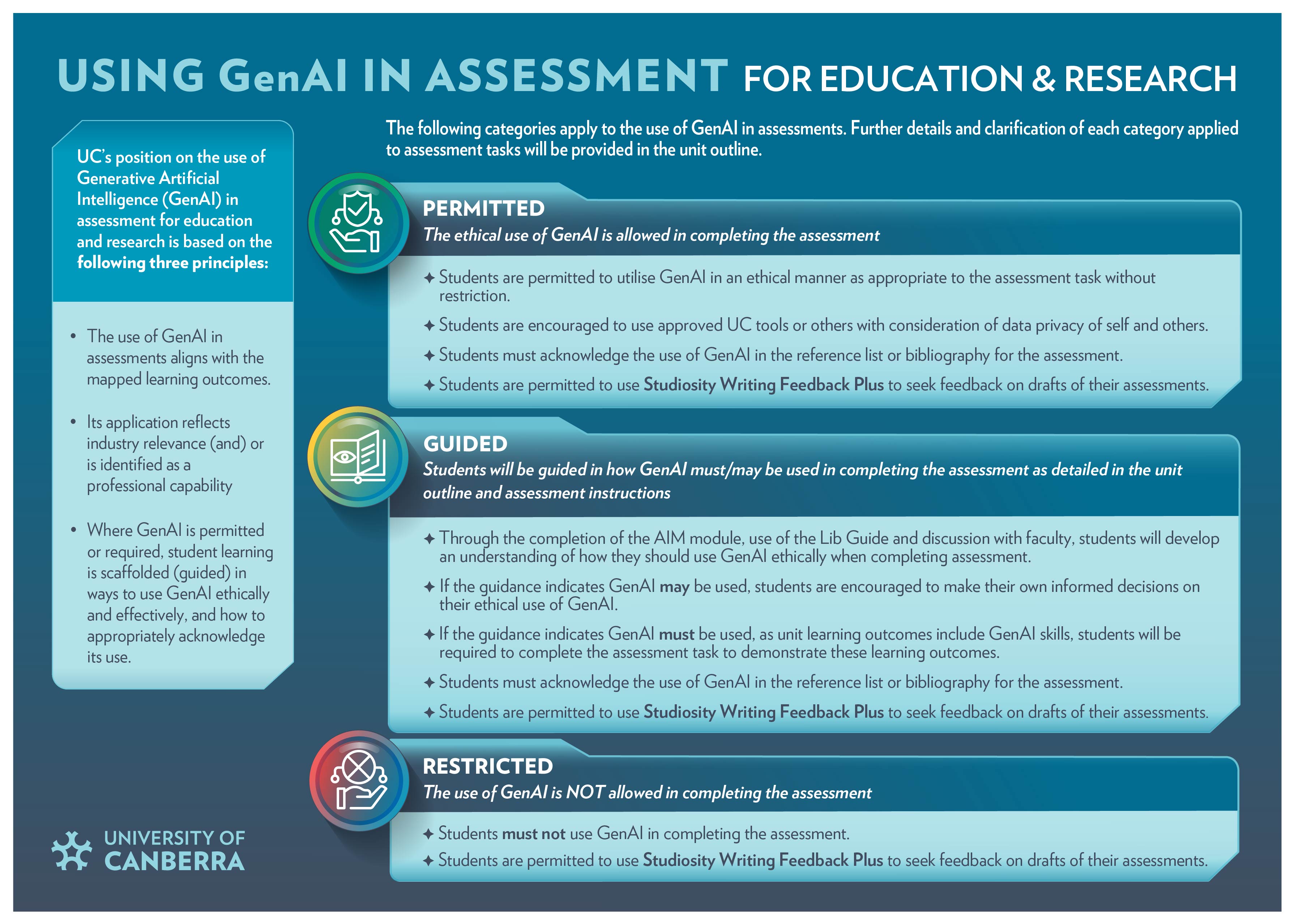
In all cases of AI use, students are responsible for and verifying the following:
- its use is authorised by the unit convener as part of a specified assessment task, and
- it is used in the way allowed in the assessment instructions and/or unit outline, and
- its use is appropriately referenced, meaning that students must reference the use of AI in their assessment in the same way as they reference other source material.
In-unit costs
Basic modelmaking materials may be required (e.g. cardboard, scissors, tape, etc). For assignment 1, students are encouraged to reuse and recycle materials rather than purchase new. Students are not required or encouraged to purchase materials for their Community Design Project; however, they can if they choose to do so.
Work placement, internships or practicums
None
Additional information
This unit encourages Pre-Service teachers' practical development of key pedagogical and attitudinal skills essential for teaching within the 21st-century classroom. This unit supports students to develop key pedagogical knowledge, content knowledge and knowledge of students and how they learn in relation to the Australian Curriculum: Technologies. Furthermore, students will practice and develop important technical skills to prepare them for future work within the education profession. Additionally, this unit will explore essential learning theories specific to the teaching of the Australian Curriculum: Technologies. These theories, including Design Thinking and TPACK, will underpin students' developing pedagogical approaches to instructing Design Technologies and Digital Technologies.
Provision of information to the group
Notifications through the Canvas Announcements Forum or the Canvas Discussion Forums are deemed to be made to the whole class. It is the responsibility of the student to ensure that they check for announcements on the Unit's Canvas website (forum messages are also emailed to student email addresses only). Students should ensure they check their student email regularly. The Canvas discussion forums will be checked by staff regularly, and students should use unit convenor UC email address to contact them.
Use of student email account
The University Email policy states that "students wishing to contact the University via email regarding administrative or academic matters need to send the email from the University account for identity verification purposes". Therefore, all unit enquiries should be sent by email using a student university email account. Students should contact the Service Desk ( servicedesk@canberra.edu.au ) if they have any issues accessing their university email account.
Email Etiquette Protocol:
- Subject line: Include your unit number and tutorial time (for example, "9890 Tuesday 4pm").
- Greeting: Start with "Hello [Tutor's Name],"
- Body: Clearly state the purpose of your email in a professional tone.
- Sign off: End with "Regards," followed by your full name.
- Semester 2, 2026, On-campus, UC - Canberra, Bruce (233447)
- Winter Term, 2026, On-campus, UC - Canberra, Bruce (230945)
- Semester 2, 2025, On-campus, UC - Canberra, Bruce (226964)
- Winter Term, 2025, On-campus, UC - Canberra, Bruce (225406)
- Semester 2, 2024, On-campus, UC - Canberra, Bruce (218070)
- Winter Term, 2024, On-campus, UC - Canberra, Bruce (216393)
- Semester 2, 2023, On-campus, UC - Canberra, Bruce (214470)
- Winter Term, 2023, On-campus, UC - Canberra, Bruce (215455)
- Semester 2, 2022, On-campus, UC - Canberra, Bruce (207866)
- Winter Term, 2022, On-campus, UC - Canberra, Bruce (209893)
- Semester 2, 2021, On-campus, UC - Canberra, Bruce (201948)
- Semester 2, 2020, On-campus, UC - Canberra, Bruce (195892)
- Semester 2, 2019, On-campus, UC - Canberra, Bruce (186926)
- Semester 2, 2018, On-campus, UC - Canberra, Bruce (182648)


