Policy Development, Leadership and Organisational Practice PG (12018.1)
| Available teaching periods | Delivery mode | Location |
|---|---|---|
| View teaching periods | Online real-time |
UC - Canberra, Online |
| EFTSL | Credit points | Faculty |
| 0.125 | 3 | Faculty Of Health |
| Discipline | Study level | HECS Bands |
| Social Work | Post Graduate Level | Band 2 2021 (Commenced Before 1 Jan 2021) Band 2 2021 (Prof Pathway Social Work- After 1 Jan 2021) Band 4 2021 (Commenced After 1 Jan 2021) |
Learning outcomes
Upon successful completion of this unit, students will be able to:1. Critically evaluate the organisational construction of social work practice, including the central role of information and digital technologies;
2. Reflect and distil the contemporary developments within policy that shapes human service delivery nationally and internationally; and
3. Demonstrate specialised skills in an applied policy development and implementation.
Graduate attributes
1. UC graduates are professional - employ up-to-date and relevant knowledge and skills1. UC graduates are professional - communicate effectively
1. UC graduates are professional - use creativity, critical thinking, analysis and research skills to solve theoretical and real-world problems
1. UC graduates are professional - display initiative and drive, and use their organisation skills to plan and manage their workload
2. UC graduates are global citizens - think globally about issues in their profession
2. UC graduates are global citizens - understand issues in their profession from the perspective of other cultures
2. UC graduates are global citizens - make creative use of technology in their learning and professional lives
3. UC graduates are lifelong learners - adapt to complexity, ambiguity and change by being flexible and keen to engage with new ideas
3. UC graduates are lifelong learners - evaluate and adopt new technology
4. UC graduates are able to demonstrate Aboriginal and Torres Strait Islander ways of knowing, being and doing - apply their knowledge to working with Indigenous Australians in socially just ways
4. UC graduates are able to demonstrate Aboriginal and Torres Strait Islander ways of knowing, being and doing - use Indigenous histories and traditional ecological knowledge to develop and augment understanding of their discipline
Skills development
Social Workers work within a framework of social policies, so this unit explores policy analysis, development, and change. It also explores the role of a Social Worker in a range or organisations with students developing skills in areas such as organisational analysis and change. Emphasis is on the significance of digital technologies in structuring contemporary social service work. Additionally, students examine the leadership potential of Social Workers and reflect on Aboriginal and Torres Strait Islander ways of being and doing in context of leadership.
Prerequisites
None.Corequisites
None.Incompatible units
None.Equivalent units
None.Assumed knowledge
None.| Year | Location | Teaching period | Teaching start date | Delivery mode | Unit convener |
|---|---|---|---|---|---|
| 2026 | UC - Canberra, Online | Study Block 1 | 19 January 2026 | Online real-time | Miss Stevie Wright |
| 2026 | UC - Canberra, Online | Study Block 4 | 06 July 2026 | Online real-time | Miss Stevie Wright |
| 2027 | UC - Canberra, Online | Study Block 1 | 18 January 2027 | Online real-time | Miss Stevie Wright |
| 2027 | UC - Canberra, Online | Study Block 4 | 05 July 2027 | Online real-time | Prof Lynne Keevers |
Required texts
Required:
Bacchi, C., & Goodwin, S. (2016). Poststructural policy analysis (pp. 13–26). In Poststructural policy analysis: A guide to practice. Palgrave Macmillan.
Erik Olin Wright. (2010). Envisioning Real Utopias. Verso Books.
Kingdon, J. (2014). Agendas, Alternatives, and Public Policies. https://questanbridge.com/wp-content/uploads/2024/11/Agendas-Alternatives-and-Public-Policies.pdf. Chapter 8 .
Useful For Assessments:
Bennett, B., Baines, D., Terare, M., & Howard, A. (2025). Emancipatory decoloniality as leadership in social service organizations: Insights from Indigenous and anti-oppressive yarnings. The British Journal of Social Work, bcaf104.
Erik Olin Wright. (2019). How to be an anticapitalist in the twenty-first century. Verso.
Foote, W. L., Conley Wright, A., Mason, J., & McEwan, T. (2023). Collaboration between Australian peak bodies and governments in the context of the COVID¿19 pandemic: New ways of interacting. Australian Journal of Social Issues, 58(4). https://doi.org/10.1002/ajs4.260
Venning, A., Morley, C., & Newcomb, M. (2025). Reimagining leadership in social work: A call for a distinctive activist approach to social work leadershipLinks to an external site.. The British Journal of Social Work, https://doi.org/10.1093/bjsw/bcaf144
Zufferey, C. (2024). Radicalising hope to resist the neoliberalisation of social work. Critical and Radical Social Work, 1–17. https://doi.org/10.1332/20498608y2024d000000064
Submission of assessment items
Extensions & Late submissions
Where possible, all assessment items will be submitted online via the teaching site in UCLearn. The first page of each assessment item should include the following information:
- Student ID number:
- Assessment Name:
- Word Count (if applicable):
Students' names are not to be included on any assessment tasks/submission. Only Student ID numbers should be included (as per the Assessment Policy and Assessment Procedures).
Assessment items must be submitted to the assignment area in the UCLearn teaching site, relating to that piece of assessment. It is the student's responsibility to upload the correct and corresponding draft or assessment item, to the right submission section.
Late submissions will only be accepted for a limited period. If more than one late submission is made within that period, only the first late submission will be accepted for marking and may be subject to penalties as detailed in the Assessment Procedures.
Extensions
Students can apply for an extension to the submission due date for an assessment item due to extenuating, evidenced circumstances (specific details are found in the Assessment Procedures). An extension must be applied for before the due date. Documentary evidence (e.g. medical certificate) will be expected for an extension to be granted, however this will not guarantee that the application will be successful. The Unit Convener or relevant Program Director/Course Convener will decide whether to grant an extension and the length of the extension.
An Assignment Extension form is available from the Student Forms page.
Late Submission
The following late submission period and penalty is applicable to any teaching period commencing after 1 April 2024.
To support the provision of timely feedback to students within the unit, late penalties will apply for summative assessments where late submission is permitted. Late submissions without an approved extension or reasonable adjustment will result in a penalty of a mark reduction of 10% of the maximum available marks for the assessment item per day (or part thereof) up to and including three calendar days. If a student submits more than three calendar days late without an approved extension or reasonable adjustment, the student will be allocated a mark of zero for that assessment, with no feedback provided.
Approval of extensions based on extenuating circumstances will be dependent upon the production of supporting documentation and at the discretion of the unit convener.
For teaching periods commencing prior to 1 April 2024, a late penalty of 5 % of the maximum available marks for the assessment item per day (or part thereof) was applied up to and including seven calendar days. An assignment submitted over 7 days late will not be accepted.
Assessment 3 requires students to upload a video recording of a 15-minute Peer Supervision session. Please see the detailed instructions on the Unit Canvas site for how to record and upload a video-related assessment.
University of Canberra GenAI and Assessment at UC Policy (2026)
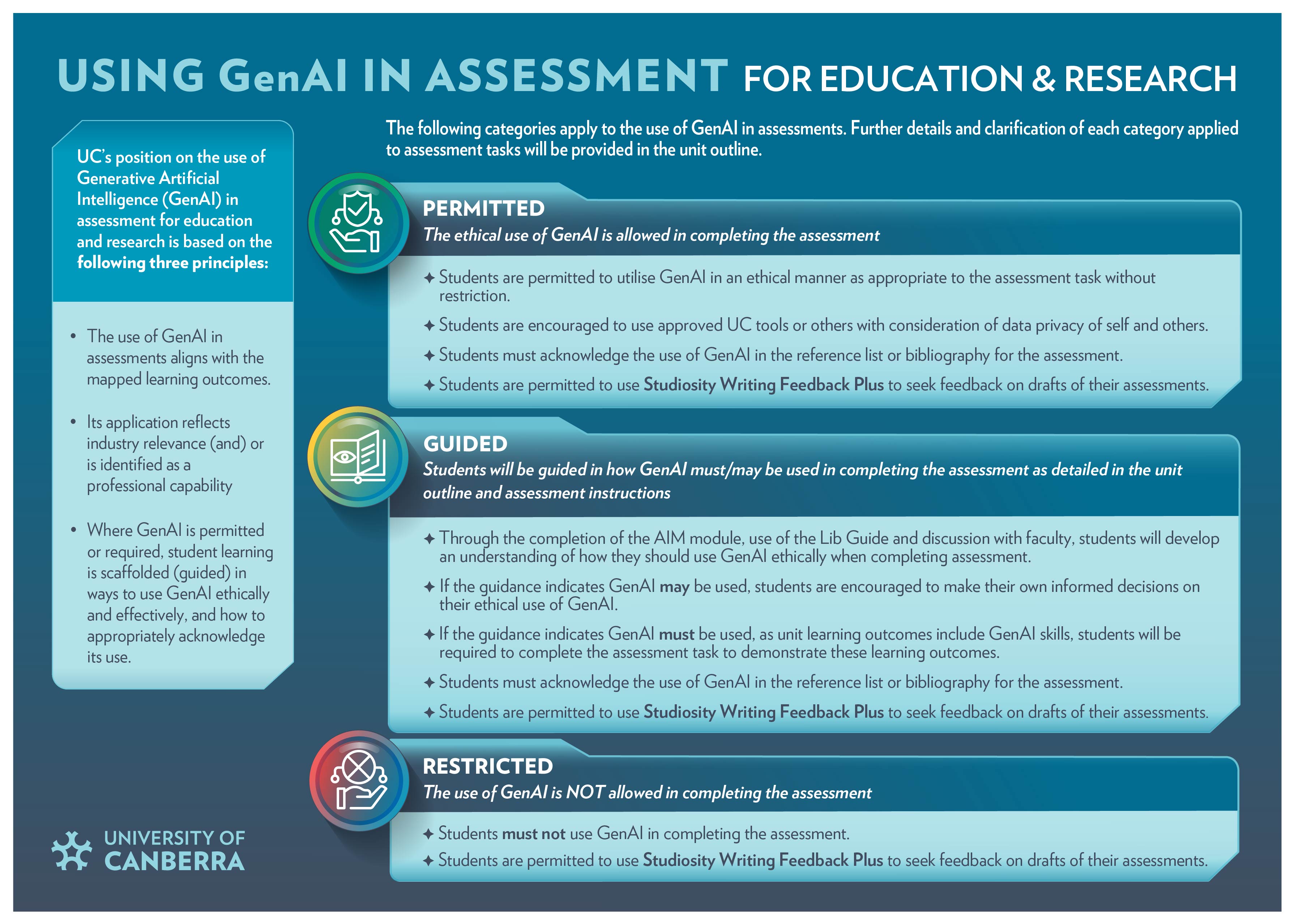
The University of Canberra has recently updated its requirements and guidelines surrounding the use of generative artificial intelligence in assessments. Each assessment task in this unit has been assigned a GenAI category in accordance with the new policy, with specific guidance included under the relevant assessment to support transparency and clarify how GenAI may or may not be used.
Students should review both the assessment-specific instructions and the University’s current GenAI assessment guidance before commencing each task. More info can be found on this University of Canberra Gen AI and Assessment at UC website page.
Resources for further information below:
Download the Infographic of the GenAI Assessment Guide
Download the GenAI Assessment Guide Categories
For more information refer to the University's GenAI for Students LibGuide.
Students must apply academic integrity in their learning and research activities at UC. This includes submitting authentic and original work for assessments and properly acknowledging any sources used.
Academic integrity involves the ethical, honest and responsible use, creation and sharing of information. It is critical to the quality of higher education. Our academic integrity values are honesty, trust, fairness, respect, responsibility and courage.
UC students have to complete the Academic Integrity Module annually to learn about academic integrity and to understand the consequences of academic integrity breaches (or academic misconduct).
UC uses various strategies and systems, including detection software, to identify potential breaches of academic integrity. Suspected breaches may be investigated, and action can be taken when misconduct is found to have occurred.
Information is provided in the Academic Integrity Policy, Academic Integrity Procedure, and University of Canberra (Student Conduct) Rules 2023. For further advice, visit Study Skills.
Participation requirements
Attendance at weekly Zoom tutorials is highly recommended. The unit is grounded in participatory, relational and critically reflective pedagogy, and students are expected to engage actively with the learning community through either live tutorial participation or asynchronous engagement.
Tutorial recordings will be uploaded to a dedicated discussion board. Students who access a recording are expected to engage with the accompanying discussion prompts so that they contribute their own reflections, questions and insights to the collective learning process.
Students are also expected to engage with the online learning materials, required readings and tutorial preparation activities. Policy concepts can be complex and unfamiliar, and consistent participation is important for developing the knowledge and skills required to complete the assessment tasks successfully. Students who experience barriers to participation or begin falling behind should contact the teaching team as early as possible to discuss available support.
Required IT skills
In order to engage in this unit, you are expected to have a reliable computer with the latest operating system. You will also need reliable internet connections and the latest version of Google Chrome (preferred browser) to access UCLearn. You are expected to have access to Microsoft Office applications: including Word, Excel and PowerPoint equivalent. In some units, you will be required to download specific software applications to complete the unit content and assessment successfully.
This unit involves online meetings in real time using Zoom in your UCLearn teaching site. Zoom allows you to communicate in real time with your lecturer and other students. To participate verbally, rather than just typing, you will need a microphone. For best audio quality we recommend a microphone and speaker headset.
In order to complete research, you will need to be able to search the library databases for relevant academic resources. It is the individual student's responsibility to access appropriate help from the University IT services or the library if needed.
Please see the Social Work Hub on Canvas for orientation to key software and applications.
Work placement, internships or practicums
None
Additional information
Detailed information governing teaching and learning in this unit is provided on the unit's UCLearn site. This includes requirements and guidance relating to:
-
APA 7th edition referencing and academic writing;
-
guidelines around ethical and transparent use of generative artificial intelligence;
-
assessment preparation, submission and academic integrity; and
-
the voluntary research project associated with the delivery of the unit.
Students enrolled in the unit are required to read and comply with the relevant information and instructions provided on UCLearn. Students should contact the Unit Convenor or their Student Success Adviser if they require clarification or support in meeting these expectations.