


Fleta Page
26 May 2026: A national University of Canberra-led program aimed at recruiting more students into gerontological nursing has won the Ageing Australia innovation award for capacity building.
Clinical Placements with Older People (CPOP) won the prestigious award at the peak body’s Innovation Transforming Aged Care 2026 Conference, in recognition of how the program, run in partnership with seven other Australian universities, is fighting ageism and transforming nursing students’ experiences caring for older people.
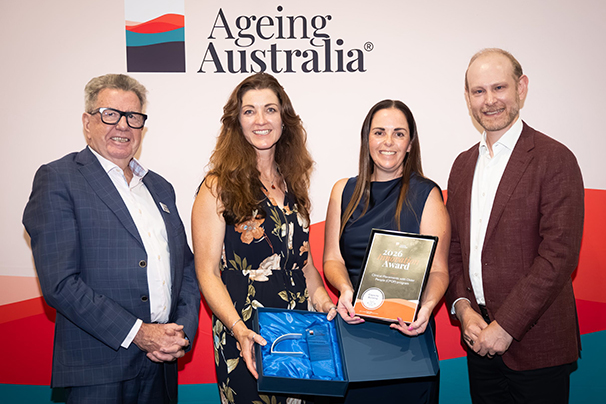
Ageing Australia Chairman Michael Reid AM, CPOP Lead Professor Kasia Bail, CPOP Data Manager Dr Kelly Marriott-Statham and Ageing Australia CEO Tom Symondson.
Historically, nursing students have undertaken an aged care placement only in their first year of study, often working with an assistant in nursing (AIN) rather than a registered nurse (RN), and not seeing the complexity of gerontological nursing as a specialty or the rewards it offers.
Stephanie Munk, a registered nurse and the CPOP program manager says that first-year work experience didn’t convince students of the field’s merits, and unintentionally reinforced negative views of aged care.
“You can't be what you can't see, and what they saw was not the work that they wanted to do as a registered nurse,” she said.
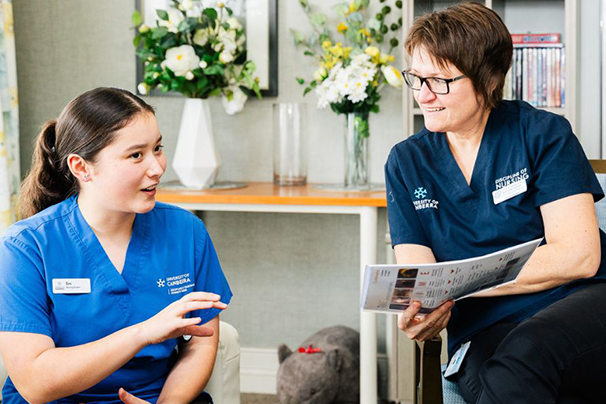
Stephanie Munk, CPOP Program Manager (right) with a UC student.
CPOP addresses this by creating high-quality placements for students in the second and third years of their degrees, in which they can work with older people alongside registered nurses (preceptors). Since 2023, the program has coordinated more than 2,000 placements in over 200 care settings.
Professor of Gerontological Nursing and CPOP program lead, Dr Kasia Bail, whose professional networks were instrumental in expanding the program after a pilot study received a $6.3m investment from the Australian Government Department of Health, Disability and Ageing, said there was a lot more richness to placements with older people in later years of study.
“You've got students who've got the anatomy and physiology and pharmacology and pharmacokinetics knowledge to understand the complexity of the older person, and to then expand their practice into that space,” Professor Bail said.
The CPOP program has seen a 940 per cent increase in final year placements with older people, and more graduates are entering the field having put aged care as their first-choice placement.
The feedback from participants shows the program is successfully changing attitudes within the future nursing workforce.
Ms Munk says working with older people offers the chance to become part of their community.
“You’re almost part of their family – it’s a different way of being. You are embedded in that location. You know these people. You have the ability to make such a huge difference in their lives and their families' lives,” she said.
Professor Bail says the specialty offers the rare opportunity for continuity of care that nurses value, and that improves outcomes for older people.
“Because they've got to know those people’s preferences and choices, they can input them when making life and death decisions,” she said.
“And for the clinical decision-making, they need all of the accumulated skill sets from all of the other specialties, so their cardiac nursing, renal nursing and surgical nursing to combine with their palliative care nursing, to interpret, decide and help find a pathway of the best decisions for the best outcomes for those individuals.”
Ageing Australia’s award for capacity building recognised that the CPOP program works to improve the quality of the nursing within the sector – the CPOP team trains educators to supervise the students in the field as clinical facilitators and has upskilled over 200 industry and university-employed nurse educators in gerontological nursing.
The program also provides positive feedback to outstanding gerontological nurses through a preceptor award program, which recipients report helps with motivation and retention.
Professor Bail said recruiting and retaining highly skilled RNs in the gerontological field was vital for improving outcomes for the older population, with strong evidence of the benefits of an increased registered nurse ratio.
“The minimum staffing requirements that are currently legislated for residential aged care are 10 per cent lower than the evidence suggests we need,” she said.
“The evidence base suggests about 20 to 30 per cent ratio of registered nurse to assistants in nursing, and we're currently only aiming for about 10 to 20 per cent,” Professor Bail said.
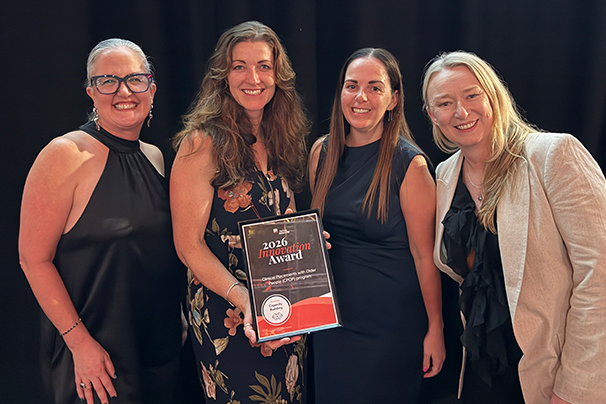
CPOP's Professor Kasia Bail and Dr Kelly Marriot-Statham with Kath Faulkner (left) and Tanya Davison (right) of Silverchain, one of the program's WA partners that adopted CPOP in 2023.
She said receiving the award provided a fantastic opportunity to engage with hundreds of Ageing Australia member organisations about the benefits of hosting later-year students, and promote the program as a recruitment strategy.
“The sector is crying out and they're all worried about the nursing workforce shortage, but they haven't seen students as their pipeline,” Professor Bail said.
“This program helps increase the visibility of the gerontological registered nurse career pathway for nursing students, and the award helps increase the visibility of RN workforce development for the sector.”
Photos supplied, video by Liam Budge


