


Georgie Burgess
12 March 2026: A safe place to have intellectual debate around hard issues, where respect of diverse views can be restored - that’s how Professor the Honourable Bill Shorten, Vice-Chancellor and President of the University of Canberra described his Centre of Public Ideas (COPI) when he launched the new think tank on Wednesday night, during a rousing address for the 2026 UC Aitkin Lecture.
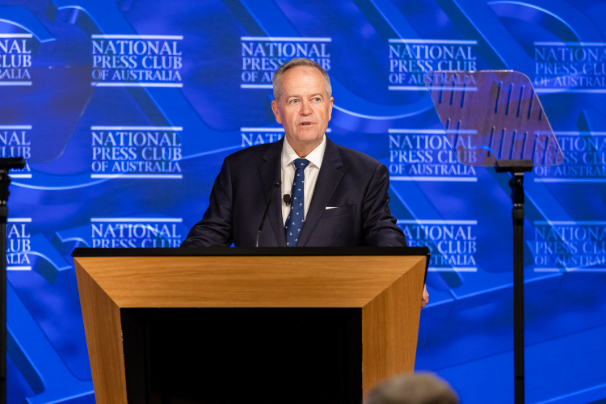
“I believe [COPI] has the potential to position UC as a leading authority on Australian politics, history and society, contributing to and influencing national policymaking and debate,” he said.
“Australia has never needed such intellectual, political and policy firepower as we do right now. We have a tremendous opportunity to reap the rewards of being an effective, even more prosperous country – if we move first.”
Helming the ship is inaugural Centre Director, Professor Frank Bongiorno, who has taken up the Donald Horne Professorship, named in honour of the late Professor Donald Horne AO, a former University Chancellor.
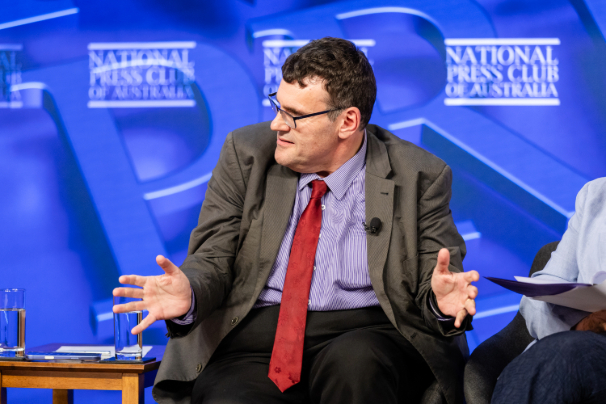
“Donald Horne was so much more than author of The Lucky Country. He helped Australians see this country and themselves in a new light – and we need to see things in a new light right now,” Professor Shorten said.
“That is what Donald Horne did.
“We are fortunate now to have Frank’s vision, aspirations and understanding of the times past and present and how they influence the future.”
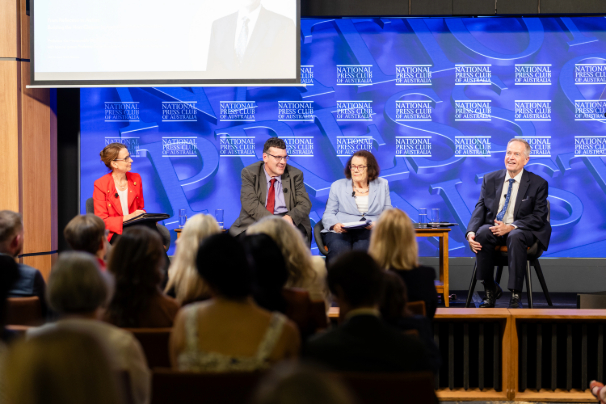
The annual lecture, held in memory of the University of Canberra’s longest serving Vice-Chancellor, Professor Don Aitkin, who led the University from 1991 to 2002, serves as an opportunity to spark debate from shared insights into major contemporary social, cultural and scientific issues.
“I have felt the weight of expectation as I have taken on the role Professor Aitkin carried out with such wisdom, intellect and compassion,” Professor Shorten said to the large crowd, which included three members of the Aitkin family – Susan and Lesley Aitkin and Jesse Newton.
At the event, which brought together distinguished scholars, artists, critics, and the University community, the Vice-Chancellor presented his ideas on a new funding deal for the Australian higher education sector through a Sovereign Wealth Education Fund.
The proposed one per cent levy on the profits of big businesses, estimated to raise approximately $5.2 billion each year, would be administered jointly by government, industry and universities for agreed national priorities.
“A Sovereign Wealth Education Fund is about a country investing in some of its citizens, so that all of its citizens benefit from their skills and knowledge in a febrile, unpredictable world,” he said.
“We could do this here in Australia with one prerequisite – that the left and the right meet in the middle. Where we get big thinking from big thinkers who care about Australia, rather than partisanship.”
The call for unity was strongly present throughout the address, with Professor Shorten warning that universities’ social licence to operate is at risk if the sector does not rise to the challenges in front of it with a sense of urgency.
“The time is now to bring the sector together. To bring the left and right of politics together. To be future-focused on what Australia needs over the next 20, 30, 40 years – and how universities can partner on those priorities,” he said.
“We are in a period of upheaval in our higher education institutions, and it is up to us to emerge a better, stronger, more unified sector.”


