


Suzanne Lazaroo
11 June 2026: Always a significant and moving event, this year’s Ngunnawal Lecture took on added dimensions with a special focus on Indigenous women’s leadership and the importance of sport to Indigenous communities, as well as the addition of a cultural seminar.
Held at the start of National Reconciliation Week, the event was hosted by the University of Canberra’s Office of Indigenous Leadership and Strategy.
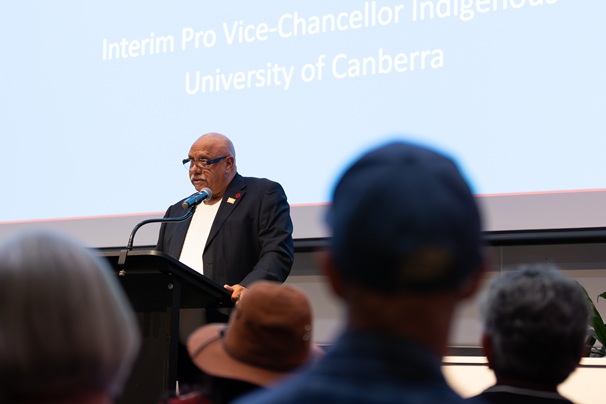
Interim Pro-Vice Chancellor Indigenous Professor Duncan – a proud Kamilaroi man and the University’s inaugural Galambany Professorial Fellow – said that the night reflected the University’s approach to Reconciliation.
“UC doesn’t just talk about Reconciliation – we live it,” he said. “Reconciliation is about walking together in this wonderful multicultural community that we get to be a part of, sharing both the load and the journey. It's about making every day better, by us being better together.
“Our cultural values are part of the very fabric of our institution. I see the embodiment of Galambany – a Ngunnawal word meaning ‘we are together as one’ – everywhere I go on campus.”
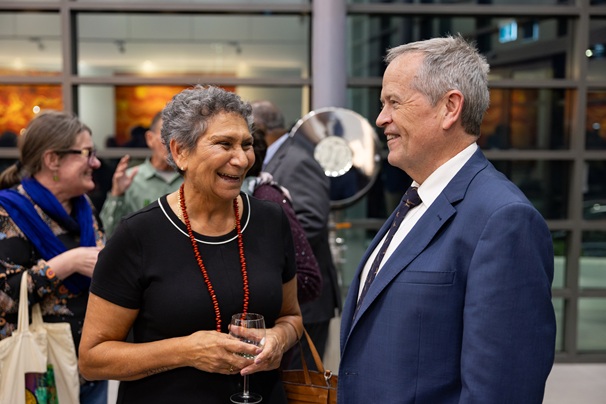
University of Canberra Vice-Chancellor and President Professor The Honourable Bill Shorten said that he was reminded every day of the University’s deep ties to the First Nations people of the ACT region.
“One of our main streets into UC is named ‘Kirinari’ – the Ngunnawal word for ‘place of learning’,” he said. “We have a reverence for Indigenous knowledge systems, because we know they are critical to UC’s future.
“The Ngunnawal Lecture event was a reminder of how crucial it is for every one of us to uplift, amplify and centre Indigenous voices, as well as to learn to truly listen and hear their messages – and a reflection of our desire to walk the path to Reconciliation together.”
From evening start to night-time finish, the event placed the leadership of Indigenous women in the spotlight.
Indigenous affairs leader and Indigenous Basketball Australia (IBA) co-founder Aunty Yvonne Mills emceed the night, Associate Professor Jodi Edwards from the University of Wollongong presented insight into the Unbroken Whispers – The Ripples Connecting Sea Kin project, and the Ngunnawal Lecture was delivered by Aunty Marcia Ella-Duncan OAM, the first Indigenous netball player to represent the Australian Diamonds.
The event was also built on deep and lasting ties, into which the audience was welcomed – for one, Professor Duncan is married to Aunty Marcia.
“My wife was the first woman to play netball for Australia, and the first Indigenous scholarship holder with the Australian Institute of Sport,” he said.
“Obviously I’m her biggest fan … but the reality is that she has accomplished so much and had to overcome so many trials and tribulations to do so.”
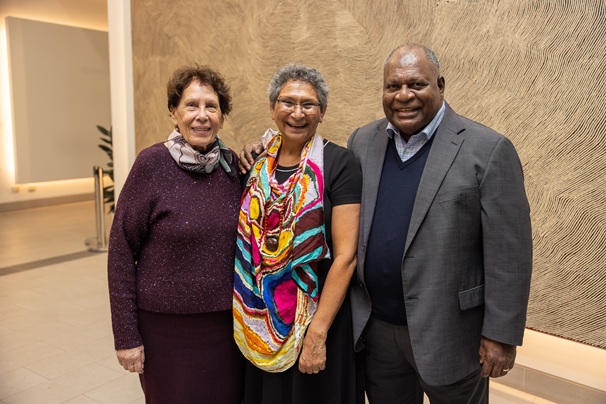
The couple also has a very special relationship with Aunty Yvonne, her husband Benny Mills and their son, five-time Olympic basketballer Patty Mills.
“When Marcia first came to Canberra, Uncle Benny and Aunty Yvonne took her under their wing and became her family away from home. These community ties are so precious, and that’s also what we’re celebrating,” Professor Duncan said.
He also took the opportunity to welcome incoming Pro Vice-Chancellor Professor Annette Gainsford – “another exemplary Indigenous woman leader” – who joined the University this month.
“Annette will take us to the next level of Indigenous leadership,” Professor Duncan said.
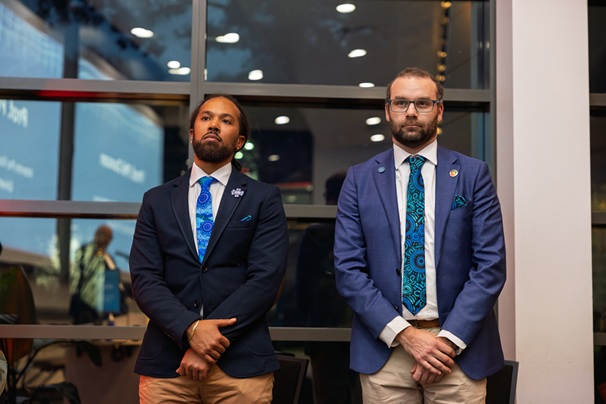
Academic Advisor Indigenous Leadership Stirling Sharpe said that sport has long been central to opportunities for Indigenous communities and individuals, making it a natural focus for the event.
“When we were brainstorming for this event, I thought of the Nelson Mandela quote: ‘Sport has the power to change the world. It has the power to inspire … to unite people in a way that little else does,” he said.
“For me, Reconciliation is all about uniting Indigenous and non-Indigenous people. We wanted a headliner who has seen and lived the struggles, and successes, of Indigenous people, who would speak from the heart – I could think of noone better than Aunty Marcia.”
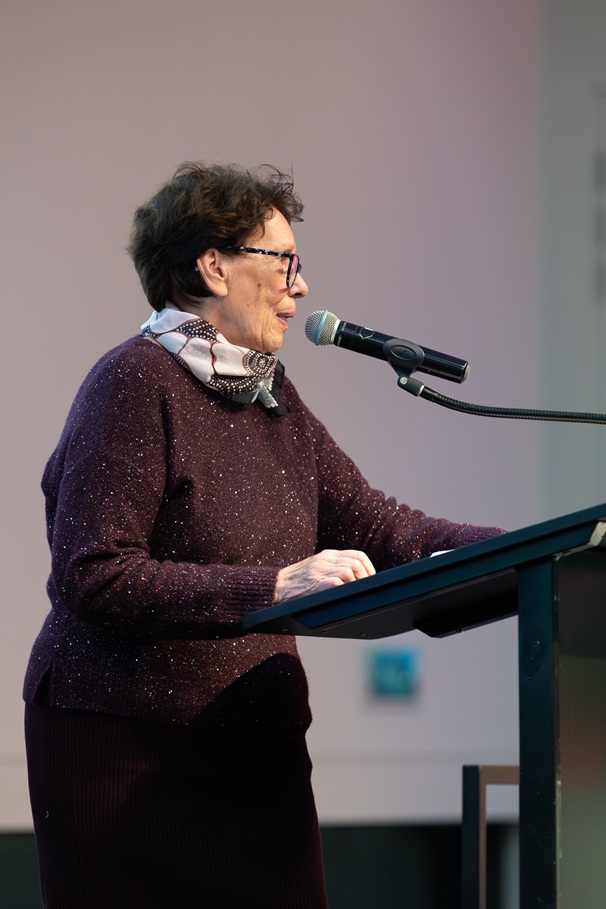
Aunty Yvonne, a proud Kokatha and Mirning woman and a survivor of the Stolen Generation, opened the evening with frank and fearless truth-telling.
“For 16 years of my life, I grew up in state care, disconnected from who I was meant to be and where I belonged. I was 25 months old when my four siblings and I were removed from our Aboriginal mother. When I was six years old, I was told my mother did not want me.
“I have lived with the impact of being forcibly removed, the memory of those words.”
Aunty Yvonne has spent over 40 years working in Indigenous affairs in state and federal government agencies, which saw her connecting with communities across Australia, including in the ACT, Northern Territory and the Torres Strait Islands.
“I understood the importance of cultures, identities, land and languages, because I immersed myself in the communities that I visited – and I found Aboriginal and Torres Strait Islander women leaders in communities and organisations with their strengths noticed, and their voices: heard,” she said.
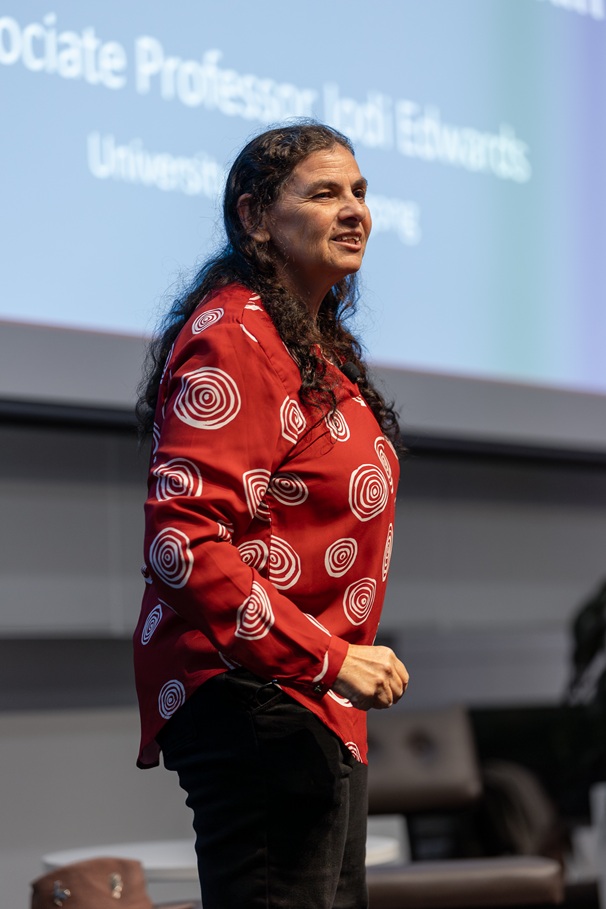
Associate Professor Edwards took the stage next – a researcher whose work bridges culture, community and science, she is a leader in Indigenous efforts to bring ecological knowledge, stories, songlines and kinship systems into conversations with contemporary environmental practice, particularly in relation to whales, dolphins and sea Country.
She introduced the audience to Unbroken Whispers – The Ripples Connecting Sea Kin, an Indigenous-led project which identifies and shares cultural knowledge of relationships with whales and dolphins – sacred and culturally significant – and connections between land, sea, and sky.
Ultimately, the project is looking to contribute to a better understanding of, and safeguard, the threatened species.
“I come from a long line of whale people, and a matriarchal place,” said the proud Walbanja woman from the Yuin Nation, who has Dharawalties.
“You always got to remember where you come from. You take only what you need, and you don't take too much [from Country]. And if you take something from Country, you always give back. That's the lore you've got to remember … there's a lot of remembering in the ripples. Ours is a living knowledge system, and intergenerational knowledge transfer can lead us to a better space.”
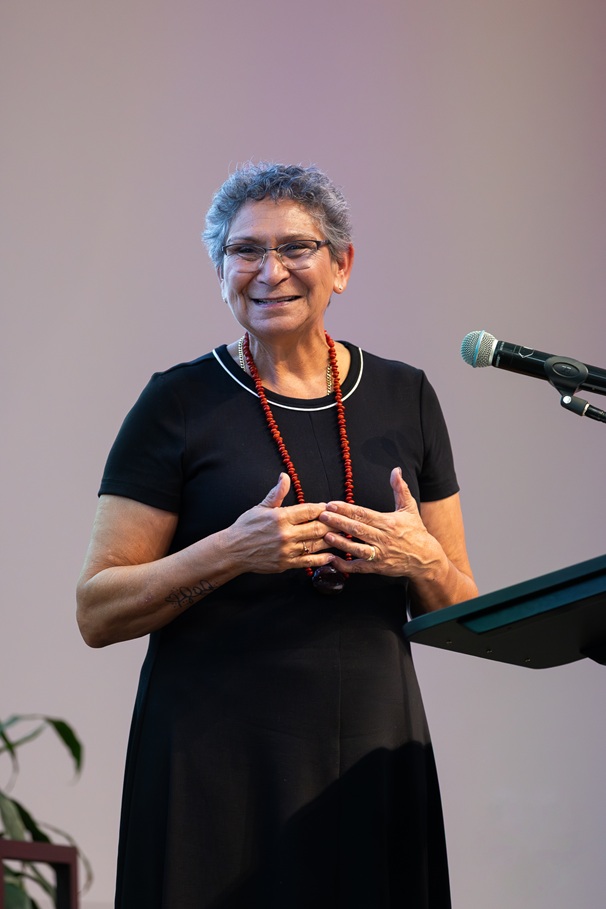
Finally, it was time for Aunty Marcia to deliver this year’s Ngunnawal Lecture – which she began in her typical understated style.
“I am Yuin, Bidjigal, and a Whale Woman, and just one of a group of women and girls who love sport,” she said.
“And I have been fortunate to have opportunities, and to create opportunities for others.”
The reality however, is that Aunty Marcia is a trailblazer on so many fronts. In addition to being a legend in the sporting world – receiving a Medal of the Order for Australia for service to netball in 1988, and being inducted in the Australian Netball Hall of Fame in 2015 – her work in criminal justice, child and family wellbeing, land management and education has had infinite ripples of community impact.
She told a story of growing up in a family of 12 (“I had four sisters, and was surrounded by brothers!”), recalling ocean harvests, seasons on the coast, a deep relationship with Country – and how growing industry caused once-bountiful ocean produce to dwindle.
“We grew up healthy and strong, played football on the beach – and I was tough … never let a brother tell me what to do!” Aunty Marcia says.
At 11, she represented Randwick in netball, later being selected for NSW 16 Schoolgirls and NSW U21 teams – wherever she went, she retained a strong connection to Country and place.
“We accumulate connection to places and people over time, kinship and cultural connections to all of my Country,” Aunty Marcia said, speaking of unity rather than division along cultural lines.
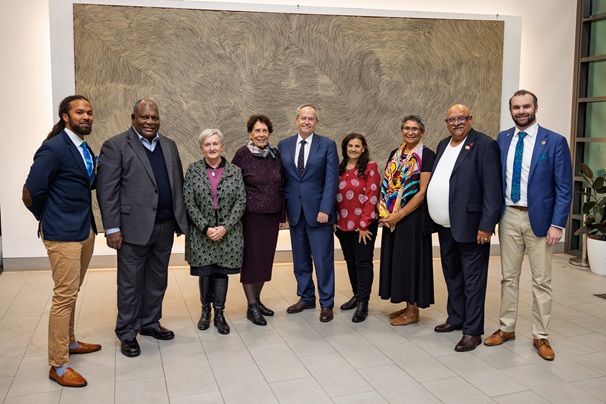
Racism in sport could be insidious, she said. It could take the form of ignorance of circumstances, as when she was judged absent from some team practices and games, but no one asked why – the reality was that she simply didn’t have a way to get there.
“Noone asked why I couldn’t get to the games,” she said. “Instead, there were jokes that I’d gone ‘walkabout’ – I had never even heard the word till then!”
The ‘odd one out’ when she received her AIS scholarship, Aunty Marcia gravitated to international athletes, people of colour – “But then I encountered a new kind of racism, because they still saw me as not ‘coloured’ enough,” she said. “Caught in an identity warp, I started to deepen my sense of self and become more aware of myself as an Aboriginal woman.”
This awareness drove her work to improve the circumstances of her community, working in the Aboriginal affairs sector.
“Every Aboriginal person I knew lived in poverty like we did, locked out of education, the health system, etc,” she said.
“The prevalence of child sexual abuse, poor response from agencies – it all got a fire burning in my belly … that was nearly extinguished after the [2023 Aboriginal and Torres Strait Islander Voice] Referendum. But still, it burns, after nearly 40 years spent working in Aboriginal affairs.”
And Aunty Marcia ended the extraordinary evening with a challenge that held traces of that fire.
“We have to elevate the voices of Indigenous women and children, and we have to keep speaking up, challenging. We’re not done until racism itself is in decline. I’m all in – are you?”


