Alumni Stories
Grads 2026: Tempa Tshering
When Tempa Tshering walked across the stage to collect his second degree – a Master of Teaching (Primary) from the University of Canberra – it was the culmination of a journey motivated by memories of his childhood and sacrifices of those close to him, and the start of a new chapter in which he intends to inspire the next generation to forge their own path.
To say that Tempa Tshering came from humble beginnings would be an understatement.
Tempa grew up in a small village in a remote area in eastern Bhutan. The village had a single farm road and little else. From the time he was in kindergarten, he would walk two hours to get to school, and another two hours to get back home. Every day.
His family didn’t have much. Like most of the villagers, his parents were farmers. They never went to school – they didn’t have access. But they always understood the value of education – and they worked hard so that they could send Tempa and his siblings to school.
“When I was six years old, my dad gave me and my older brother a choice that was common in rural communities at that time – be a lay monk or go to school,” Tempa recalls. A lay monk follows spiritual monastic practices but continues to live in the secular world.
“My brother chose school for both of us and to enable that, my family sacrificed everything – it’s because of all those sacrifices that I am where I am today,” Tempa says.
When Tempa was preparing to enter Year 9, continuing his education meant moving away to attend a different school. Although public education in Bhutan is free, his family had to find a way to cover his accommodation costs.
With three other siblings also pursuing their education, the family faced considerable financial demands. So, they decided to sell one of their valuable family possessions to allow Tempa to continue his schooling.
The sacrifice stayed with him, giving him an early appreciation of the lengths his family would go to for him to pursue his studies. It made him determined to make their efforts worthwhile.
“In the back of my mind, I always felt like I needed to repay them for everything they’ve done, so I studied really hard,” he says.
In Year 12, Tempa topped Bhutan’s Higher Secondary Education Certificate, the national board examination system taken by over 10,000 students from around 58 schools.
Thanks to his results, Tempa was offered a scholarship to study law – bringing him a step closer to fulfilling a childhood dream of becoming a lawyer. Growing up, he had loved the idea of upholding justice in society, and being a lawyer was considered one of the most prestigious professions in the country.
Then he turned it down.
A scholarship opportunity to study archaeology abroad came up, and growing up in a country that deeply values its cultural heritage, Tempa decided to take the chance and see if he could contribute more to a field that was still in its infancy in the country.
“I gave up my dream of becoming a lawyer and studied archaeology in India,” he says.
“When I graduated, I returned home and worked at the Ministry of Home Affairs for two years as an archaeologist – we made some really interesting discoveries, we once discovered a two-storey underground fortress, during my time there.”
It was meaningful work, but Tempa came to feel its limits. Bhutan's archaeological programs depended heavily on foreign partners who funded and staffed much of the country's excavation work, and he felt he couldn’t contribute to his full potential within that structure.
During that time, he started thinking about his childhood.
Growing up in a non-English-speaking household in rural Bhutan, Tempa initially found learning English at school challenging. But a science teacher in primary school saw his potential and went out of his way to stay back after classes to help him learn.
As Tempa’s confidence and proficiency in English grew, so did his love of reading, writing and literature in general. What began as a struggle with a new language gradually became a passion – one that would play a defining role in his educational and professional journey.
“As I got better with English, I started writing poems. I got my inspiration reading Shakespeare – at that time, I was still struggling to understand the meaning of what he wrote – but I enjoyed the style and I thought it was fun,” he says.
After completing Year 12, he compiled all his poems, and with some support from locals who loved literature, he published his first book. While he was studying in India, he wrote his first novel The Tentacles of Love; by the time he was working, he would write and publish his third book, a crime non-fiction titled Dream Dubai.
That core memory also sparked a desire to pursue teaching – his own way of paying it forward.
“I have a desire to make a positive impact in the lives of young people – similar to how my science teacher influenced me,” Tempa says.
“Unfortunately, at the time, Bhutan didn’t offer much in terms of doing a Master’s in Teaching, so I started to look at overseas universities, and the University of Canberra kept popping up.”
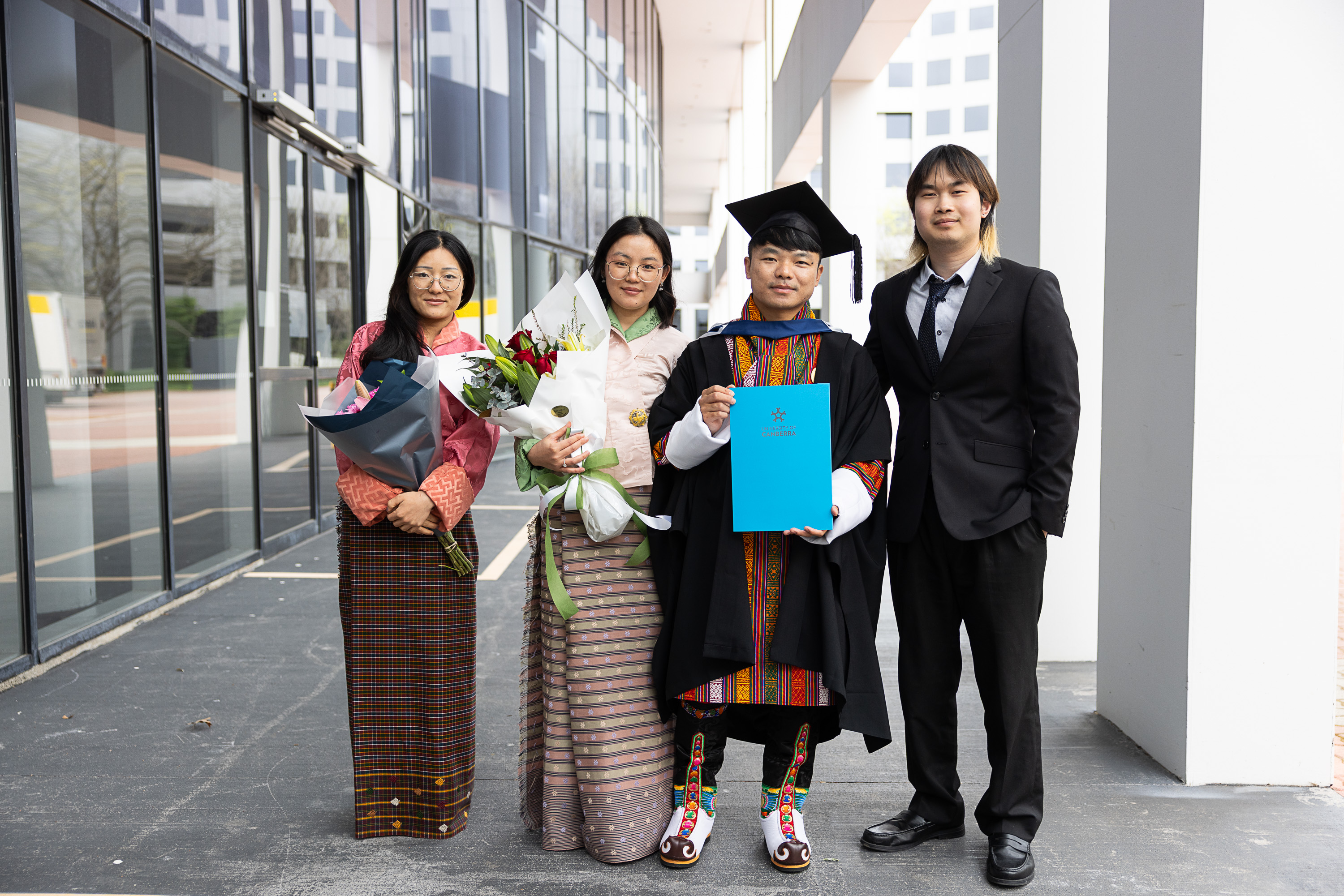
UC, he says, has a good reputation in Bhutan and was the alma mater of several respected leaders in the country, so he decided to give it a shot. He packed his bags and moved once again, bracing himself for a difficult adjustment to life in a developed country. But Canberra's natural landscape reminded him enough of home that the transition was easier than he expected.
“Canberra has such beautiful nature, and with hills everywhere, it gave me a sense of home away from home,” he says.
“As I settled here, I met a lot of new friends, and everyone has been so welcoming and supportive.”
Tempa’s UC experience has been an absolute highlight, and he says it has been the best decision of his life to study at the University. As in his childhood, he met lecturers who were always willing to go the extra mile to help and work with him even after hours, which allowed him to thrive.
“I was lucky enough to have met lecturers like Dr Sally Rule and Dr Kate Halcrow who really supported me. They made a huge difference, helping me with my projects and ensuring that I was on the right track in completing this course,” he says.
Tempa also credits his wife – they met while he was studying in India and she has since joined him in Canberra – for being a rock that has held things together by providing financial and emotional support as he focused on his studies.
With his degree completed, Tempa is currently in the process of obtaining all the necessary documents so he can teach here in Australia. But eventually, he wants to make it back home to Bhutan, where he hopes to help strengthen a developing education sector with what he's learned in Australia.
“Five years from now, I hope I am an experienced teacher, with a classroom full of students, helping kids fall in love with their passion, whether it be literature or something else,” he says.
When Tempa eventually finds himself leading that class, it would be a fitting scene for someone who has spent his life choosing new paths rather than resting on the ones already walked, inspiring the next generation along the way.
Words by Mike Verzosa. Images by Teagan Glenane.