Alumni Stories
Grads 2026: Thomas Bevitt
Nearly three decades after Thomas Bevitt started his tertiary studies at the University of Canberra – paradoxically after he didn’t get the marks to study Occupational Therapy (OT) – he’s finally a UC graduate.
The senior lecturer in Occupational Therapy – who had also been a key agitator for UC to offer an OT course – graduated last week from the University with his PhD in the field, having co-designed a world-first feedback system for OT education.
The doctorate journey took Thomas seven and a half years – a time that included the Black Summer bushfires, COVID-19 lockdowns, the birth of his two children, a harrowing jury duty experience, a brain injury from a bicycle crash, strokes for his father and father-in-law, and the deaths of his grandmother, his best friend and the auntie who helped care for his kids.
“It was a bit of a journey,” he says. “The PhD became a little bit of therapy, I guess, because it was something that you could immerse your brain into and you could think, and you were creating.
“I treated it as a hobby. And I did make a very conscious decision at the very beginning of the whole process that I would have fun with it, or I wasn't going to do it.”
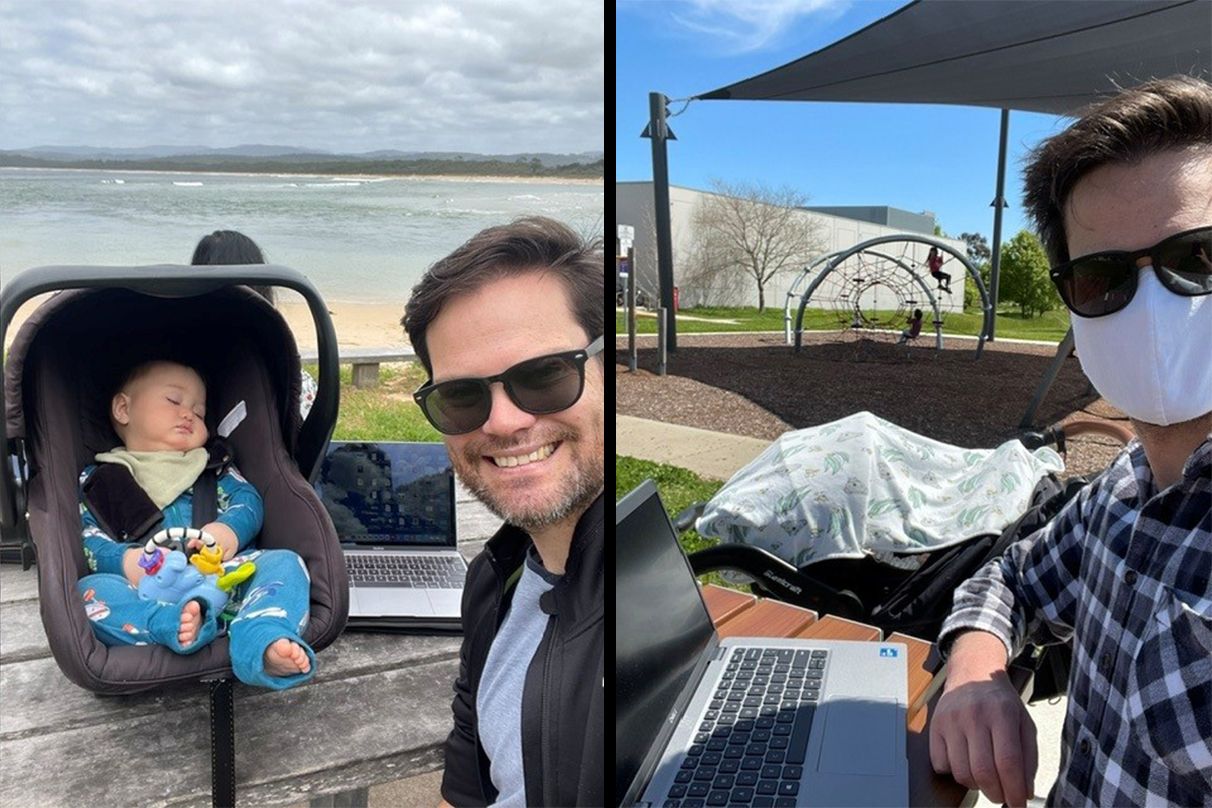
Thomas completing his PhD, sometimes in 10-minute chunks.
Thomas admits a PhD was not something he initially dreamed would be part of his pathway and he had to “confront many demons” along the way, thinking he was not smart enough or a good enough writer, or not really an academic.
A “country kid from the Bega Valley”, Thomas came to Canberra after high school to study human biology at UC, and after a year he had the marks to study OT at Charles Sturt University.
Having entered the field for the chance to experience a multitude of occupations through clients, his work took him into the world of disability, which he describes as “the most profound and wonderful community to be involved in”.
But he was soon “schooled” by user feedback, an experience that would shape his career pathway towards education and then his PhD.
“They taught me so much more about life than I've ever experienced in any other space: Advocacy, how much they needed to fight just to do everyday, regular things, and how me as a therapist could actually be a barrier,” he says.
“I kind of came in with a bit of a saviour complex, thinking I was coming in to help the people in need – but the people with disabilities were saying, actually, you're part of the systems and therefore part of the problem, and you need to be working to help me help myself get what I need.
“I listened deeply, and heard what they were saying and understood – I need to be an advocate and an ally to help break down systemic barriers.”
Planting the seed for a PhD
It during an attempt to do a movement ABC assessment – a standardised test to spot motor coordination difficulties – for a client with Down syndrome when the idea for Thomas’ PhD was seeded.
“This young man already had like 20 movement ABCs across his life and he said, ‘I'm not doing it’. So I said to him, ‘well, okay, what do you want to do?’ And he said ‘let's go and play basketball’. So we did. I took him out the back and we played basketball.
“And I saw exactly the same thing that I would have seen with his standardised assessment, I just didn’t get the number. I knew he had a fine motor disorder because that's part of the condition, but the system was saying he had to do the movement ABC because the last one was over 12 months old … really, it wasn't going to tell me anything new, and he just wanted to focus on basketball and tying his shoelaces.”
Thomas thought his interaction on the day was basic, quality therapy, but the boy’s mother informed him that other therapists would have insisted on completing the ABC.
“She said other therapists would have railroaded him and said ‘I need the number to prove that this is the condition, to then be able to do the therapy’.”
That feedback inspired Thomas to try to upskill the next generation of therapists. He went on to run the student-led clinics at Therapy ACT and joined the board of the Occupational Therapy Association, through which he became a driver for UC to start an OT course.
“We were so short-staffed in Canberra for occupational therapists, and with [UC Distinguished Professor] Diane Gibson and the Occupational Therapy Association, we worked collaboratively to get the program up and running.”
Professor Stephen Isbel – who would go on to be Thomas’ primary PhD supervisor – developed and founded UC’s OT program.
Through Thomas’ student-led clinics, which used students from across Australia to provide “light touch services”, the waitlist for OT services reduced from 200 participants to 50, and the wait time went from two years down to six months.
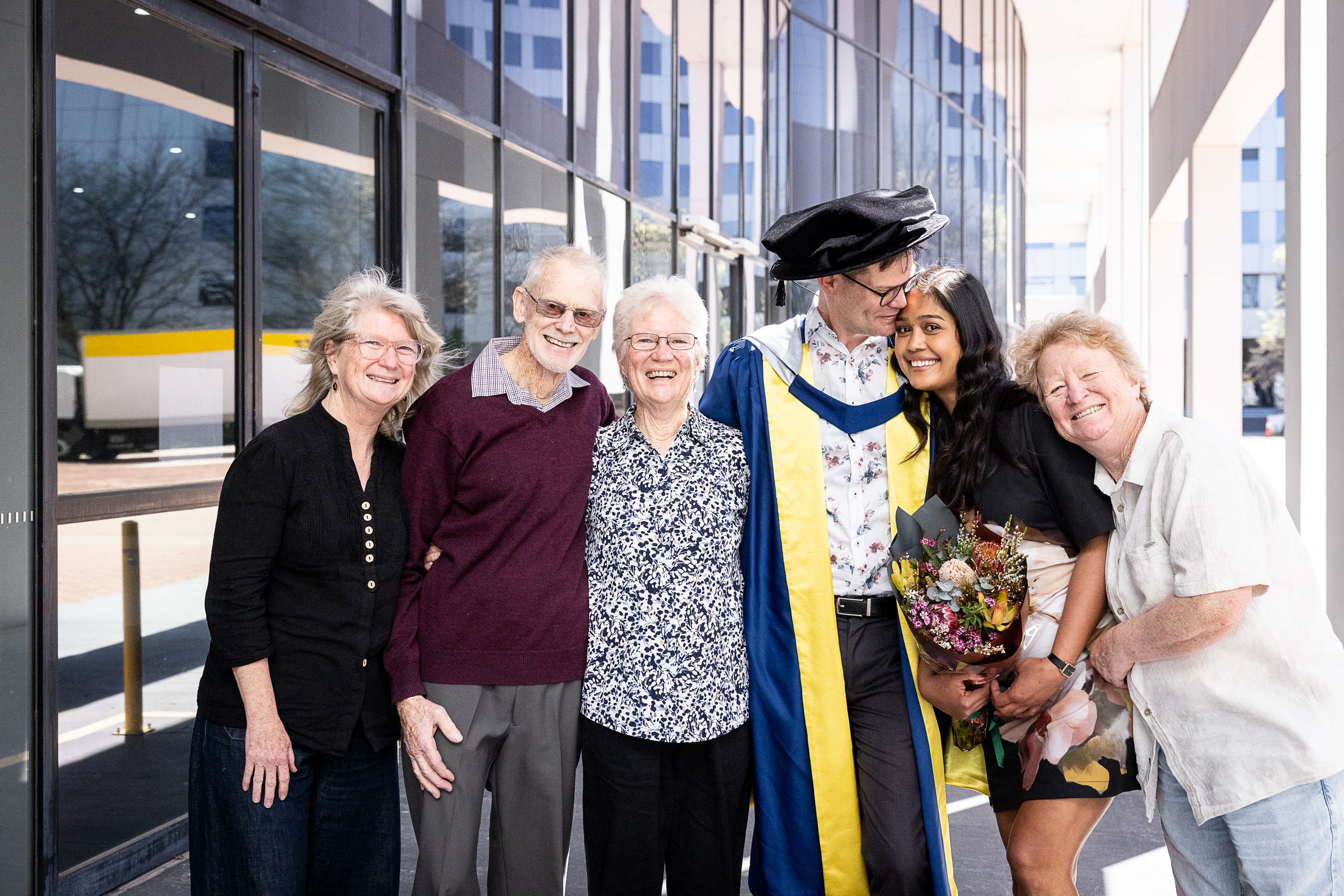
Thomas with his family at graduation.
He went on to join UC in 2014 as the OT Professional Practice Program Convener and a lecturer, and in 2019 started his PhD – which he affectionately named ‘Hank’.
Filling a gap in OT education
The topic was born from Thomas’ experience of learning from clients’ feedback about what kind of therapist they wanted and needed him to be, and the realisation that it took him three or four years of practise to learn that, because student-led clinics had no mechanism for consumer feedback.
“When we're on placement or on practice education, it's healthcare professionals assessing novice student healthcare professionals. We didn't have a system or a process in place within that student, consumer, practice educator and university quadrant to gather consumer feedback in a safe, supported way,” he says.
So through the next seven and a half years, Thomas completed four studies, the first a literature review to find out what other healthcare professions were doing. He found medicine and nursing were getting some consumer feedback in their placement programs, but there were challenges within each system.
For his second study, he reached out to OT professionals for their thoughts about gathering consumer feedback.
“That was a pretty confronting study for me because as an occupational therapist, we see ourselves as client-centred. We see ourselves as building these amazing relationships with people. But that paper and data basically communicated that our profession didn't have a lot of confidence in the consumer's capability to provide feedback,” he says.
“I found that a very powerful, very insightful paper because it put a mirror up to us as a profession and it made us ask some very serious, deep questions.”
The paper found beliefs that consumers wouldn’t provide constructive feedback, that they would need support, that collecting feedback was too risky, and extra training would be needed for feedback to be safe.
He also identified concerns that handing power to the consumer to give feedback could disempower healthcare professionals and their opinion of the student performance.
Thomas concluded that practitioners wanted a governance structure around any feedback process to ensure it could be implemented properly. So for his third paper, he gathered a consumer, a student, a practice educator and, filling the academic role himself, they co-designed the feedback structure. They called it PEPA – Prepare, Engage, Process and Action.
“We realised one process was not going to work and we needed to have a principle-based system to create a nuanced approach depending on the student, the consumer and the placement site. So it's more of a systems approach that we've designed,” he says.
The co-designed feedback system was a global first for occupational therapy education, and the first known system to be co-designed by all collaborators involved in student placement; consumer, student, the practice educator and academic.
He set about teaching the students and practice educators how to implement the PEPA system and ran a pilot study for his final paper.
“We asked the students about their learning experience and how they learnt through the consumer feedback using this new system, and the feedback was fantastic. I used this approach called phenomenography, which unpacks how people learn, and what they learn,” Thomas says.
“It was quite profound because the students went from this space where they were using the system as a kind of a regimented, structured process, and it was often connected to fear and worry about critical feedback.
“But as they went through the scaffold approach, they came back and went, wow, ‘I didn't think about asking consumers for feedback. I was a bit scared – but now that I've got feedback, it's amazing’.”
While PEPA has been rolled out within UC’s Occupational Therapy placements, Thomas would like to see it implemented in all the student-led clinics in the UC Health Hub.
“There are lots of disciplines in that space, so I'd love to be able to implement it in the bigger picture,” he says.
For others embarking on a PhD, Thomas says his secret to completing it through all sorts of turmoil, and while working full time, was to recognise that “every 10 minutes counts”.
“It was just about having these really small, quarantined chunks of time that just kept nibbling away and progressing the process.”
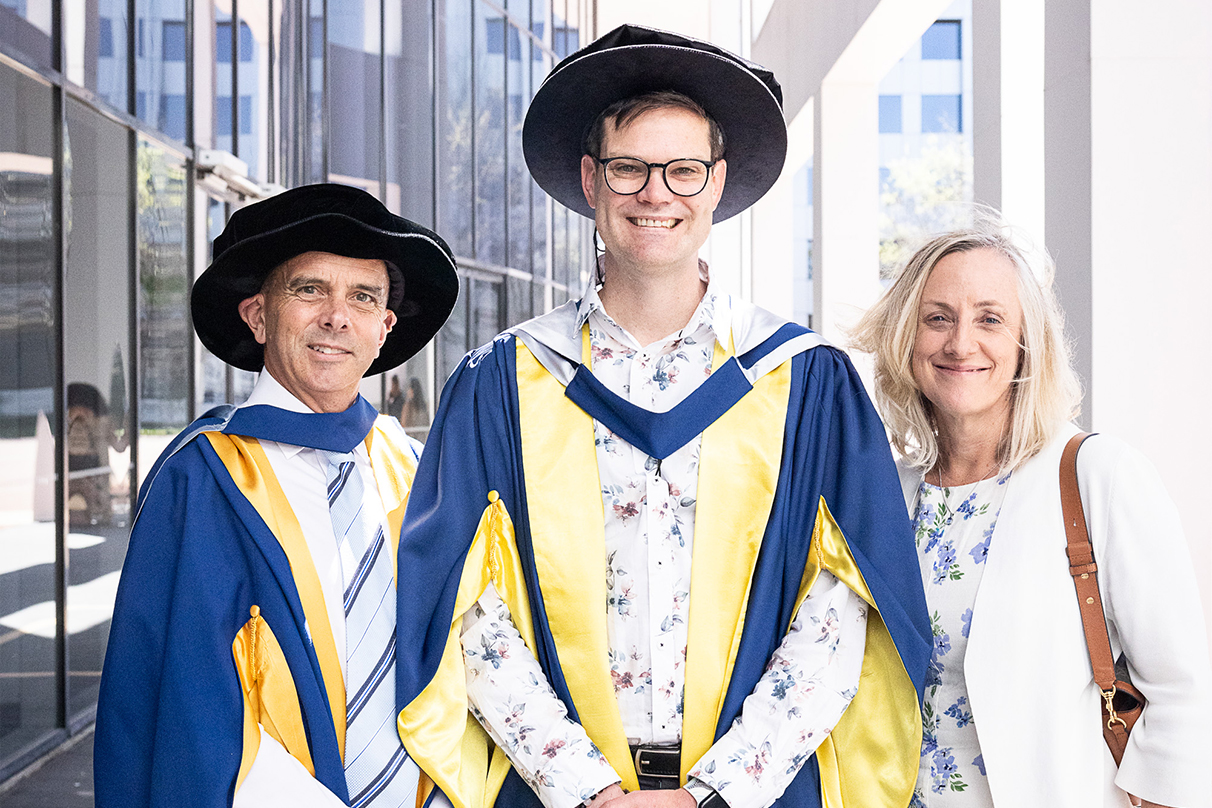
Thomas with two of his PhD Supervisors: Professor Stephen Isbel and Associate Professor Rachel Bacon
Thomas also credits having a fantastic supervisor in Professor Isbel, who took the time to understand him and work with him.
“There was a lot going on for me, but he managed me extraordinarily well and was able to just give me the right amount of coaching, and the right balance of push and leeway and support that actually kept me going,” he says. “Without him I would not have completed it.”
“I had some horrific ups and downs, and times where I didn't progress … but I would always come back to it and go, I'm doing this for a reason. My ‘why’ was very strong – I wanted to have an impact on the people that we work with, to have high-quality services for them.”
Words by Fleta Page. Photos by Teagan Glenane and supplied.