Alumni Stories
GRADS 2026: Megan Fluke
“I felt trapped in my life – and study freed me.”
The year she turned 40, Megan Fluke started her Bachelor of Science course at the University of Canberra’s Faculty of Science and Technology – the first time she would be attending uni. “I was terrified for the first couple of weeks,” she says.
Recently divorced and navigating life as a single parent, Megan was contemplating her next step – and realising that the last time she had studied, Britney-mania was in full swing.
“[That was] 1999, when I was in Year 12!” she says. Megan had always enjoyed studying, but says she lacked the confidence to apply to university after finishing school.
“When I joined uni, my classmates were generally so much younger than me. But everyone was very welcoming and accepting, so I soon started to feel more at home – and then I felt my whole world light up.”
That shine never dimmed, and Megan has gone from strength to strength, both personally and academically.
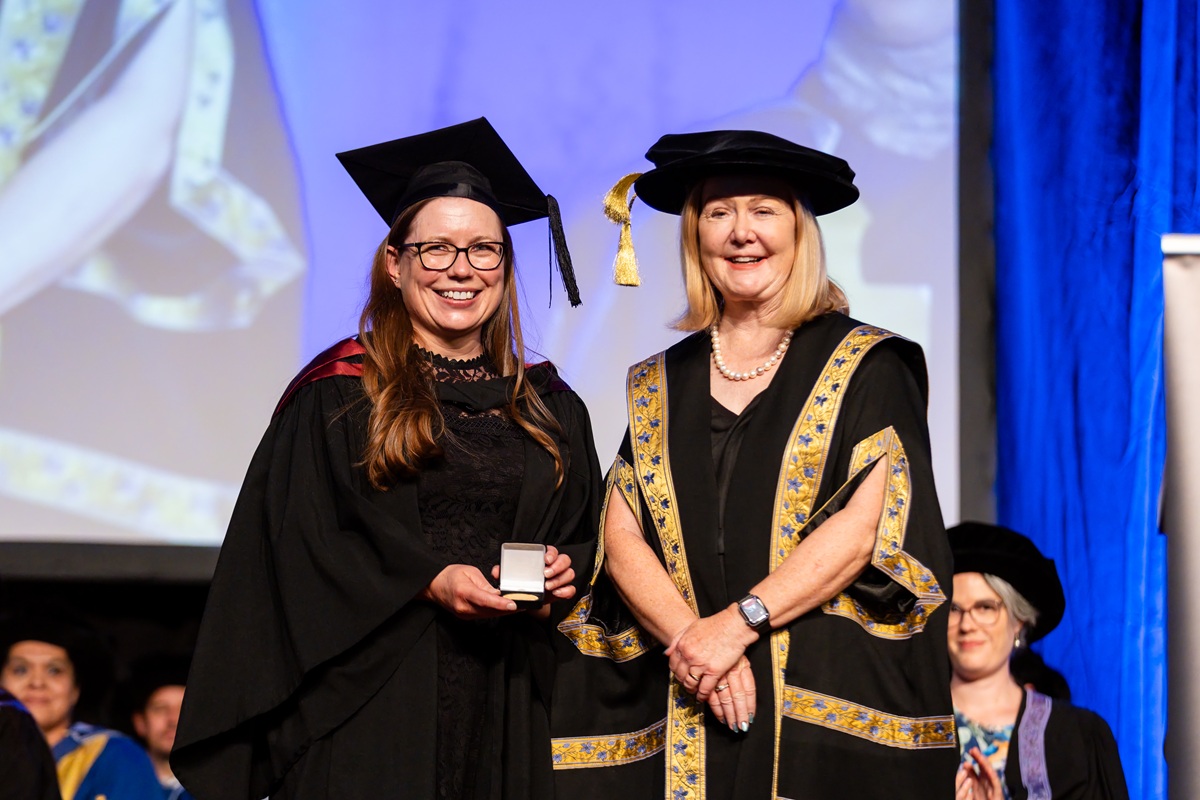
This week, her smile lit up the stage when she received not only her testamur for a Bachelor of Science (Honours) in Environmental Science – graduating First Class – but also a University Medal, awarded to graduates with the highest Grade Point Average (GPA) in each faculty.
“One of the greatest things about getting my degree has just been realising that I could – my younger self would be blown away,” she says.
Looking to the past to move forward
Megan grew up on a farm on NSW’s South Coast, and considered time outdoors vastly superior to being inside.
A “science-y, outdoorsy” child, she loved fishing, peering into puddles to see tiny worlds within, and adopting random bugs. Today, nothing has changed – although those bugs are now likely to become prized specimens in Megan’s expanding insect collection.
When Megan found herself at a crossroads, and thinking about where life would take her next, what she loved most as a child proved the inspiration.
“When I looked at the options to study science at UC, I initially chose biomedical science,” she says. “But then I realised that I like creatures more than people, so after the first semester, I switched to focus on ecology and water science.”
Contributing to the bigger picture
To get into the swing of studying again, Megan decided to do the UC Prep course.
“I’d just taken a 20-year ‘gap year’, so I’d forgotten how to study,” she says. “And because I had a lot going on in my life, I knew I would have to focus and work extra hard.”
It was also around then that Megan met her partner, whose encouragement and support helped her believe in herself and see her own potential.
“A lack of confidence was what held me back for so long, so having someone really backing me definitely helped,” she says.

Megan’s determination paid off in both opportunities and awards – including a summer internship with the Centre for Applied Water Science (CAWS) when she was a second-year student, and receiving the Sue Briggs Honours Scholarship, which is awarded to students at UC whose research focuses on conservation and the management of natural resources.
She also joined the CAWS team as a Research Assistant.
The internship and subsequent work with CAWS shaped and sharpened Megan’s ultimate research focus – finding better ways to manage and improve the health of Canberra’s urban water bodies.
“The internship gave me hands-on experience and a sense of contributing to the bigger picture,” she says. “I had the opportunity to work with Professor Fiona Dyer – who is brilliant, and has believed in me from the start – and the experience inspired my Honours project, because I wanted to understand the nutrient sources that drive algal blooms and complete a research project that focused on understanding and addressing a real-world problem.”
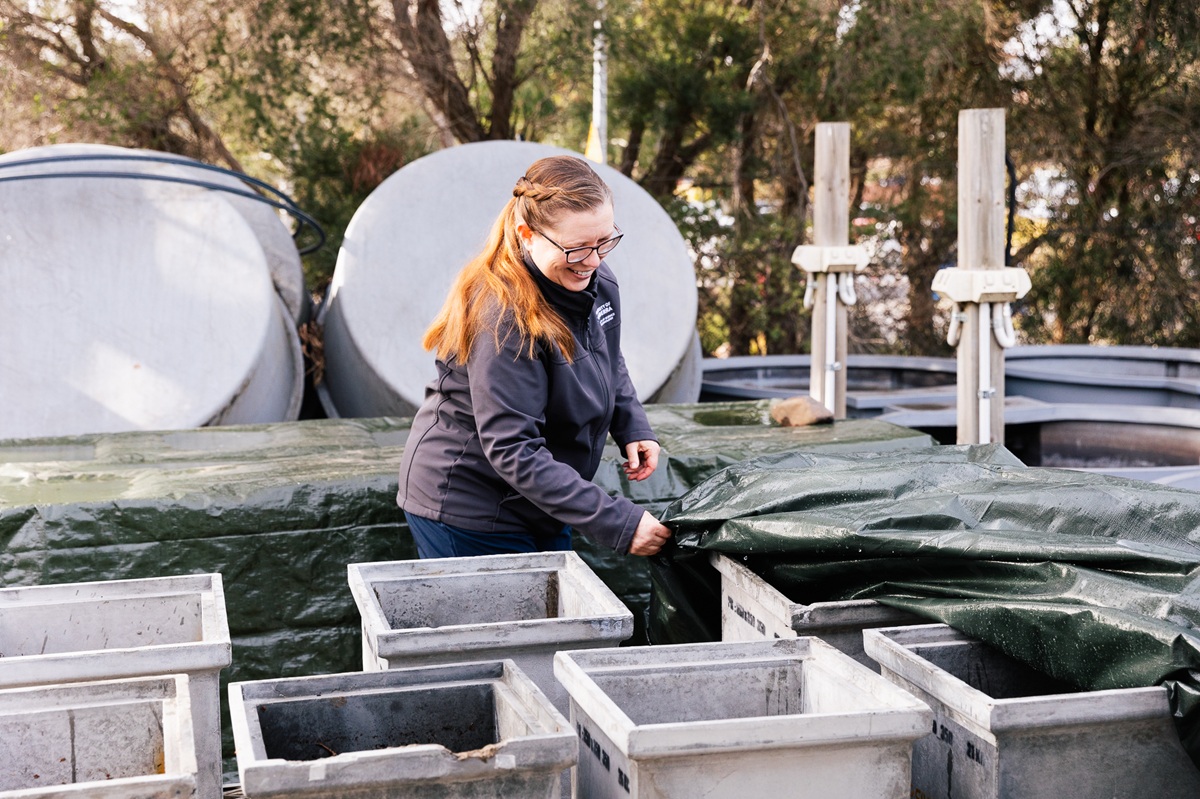
A major experiment in her Honours research saw Megan constructing a system of large concrete pits on campus, filled with “all of the filth out of the gutter – dead leaves, dirt, animal waste, and even the odd Pokemon card!”, to replicate the debris found within any regular street and stormwater drainage system in Canberra.
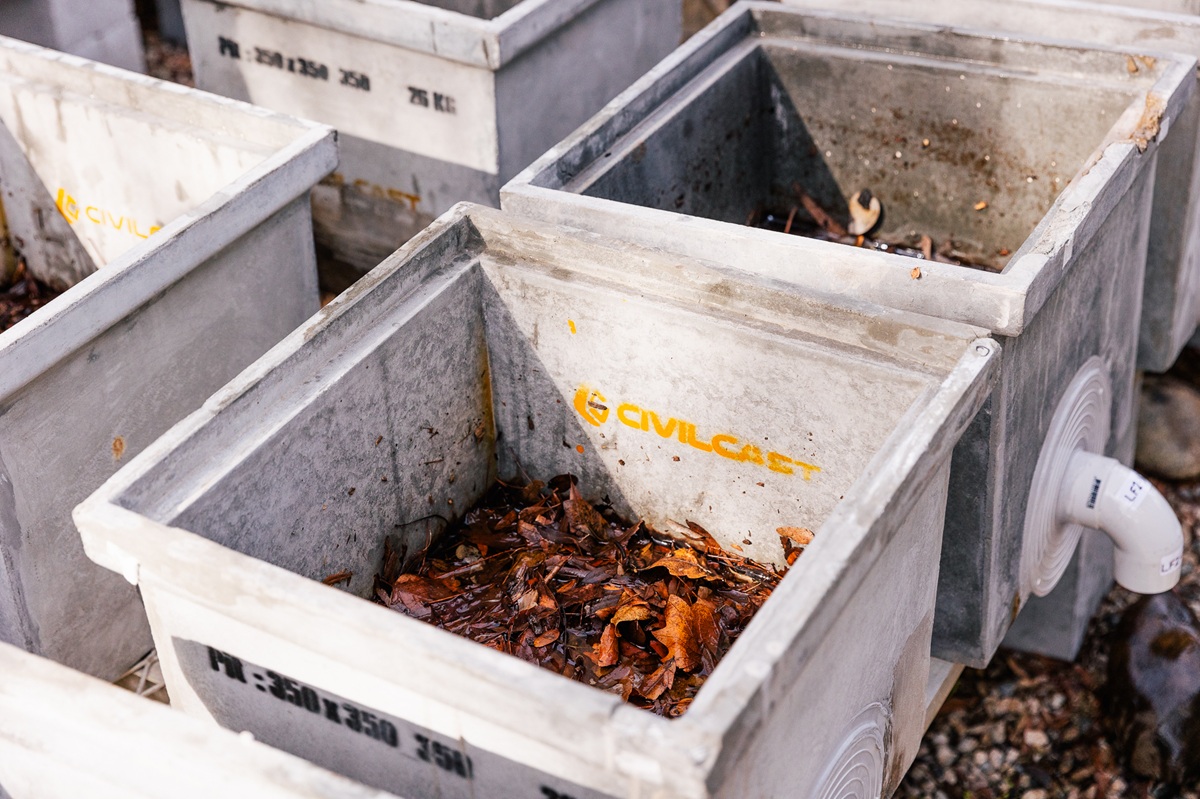
The aim was to investigate the nutrient contribution and leaching dynamics of urban detritus in concrete infrastructure, under realistic environmental conditions. Megan wondered: As fallen plant matter breaks down in gutters and drains, what is it putting into our urban water bodies? And are eucalypts or deciduous species having the greater impact?
“This understanding will help us find ways to reduce that nutrient load – to see if a measure like increasing the frequency of street sweeping can help – and contribute to real world improvements in urban storm water management,” Megan says.
“And the people who make some of these decisions even attended my final Honours seminar and asked these very questions. Having senior staff from the ACT Government Office of Water present at that seminar really drove home how my research could have real impact.”
In December last year, Megan also had the opportunity to present her research to the international water science community at the joint New Zealand and Australian Freshwater Sciences Society conference in Christchurch, New Zealand.
For someone who’d lacked the confidence to even speak in class, holding the stage in front of esteemed scientists is something that younger Megan never thought she would do.
'It’ll change your life’
“Uni has been both easier and harder than I thought it would be,” Megan says.
“It has been a steep, enjoyable and rewarding learning curve – not just the science, but seeing the reality of how science influences government policy and decision-making, and how all the pieces fit together into a whole.”
Megan credits her success to the UC small university environment, lecturers who have become colleagues and advocates, and hard work and dedication.
“I have always had the feeling that the people around me really want me to succeed and do my best. I am especially grateful to my Honours supervisors and CAWS colleagues – Fiona, Dr Rod Ubrihien and Dr Manuja Lekammudiyanse,” she says.
Megan’s uni chapter hasn’t come to a close with graduation. Her work with CAWS continues, and she may take the plunge and do a PhD.
“I just like learning new things, discovering how they work – it never gets old,” she says. “I’m looking forward to making a meaningful impact with my research, to helping improve the health of Canberra’s urban waterways.
“I can’t recommend the uni experience enough, especially to people who feel stuck – it’ll change your life, I promise.”
Words by Suzanne Lazaroo, photos by David Barber and Liam Budge.
Congratulations to all our graduates this March and welcome to the UC alumni community!
Behind each testamur lies a story of aspirations, inspiration, sacrifice and hard work – and our graduates have risen to meet every challenge with spirit, heart, creativity and courage.
We couldn’t be prouder of what they have achieved and the people they are today.
They now embark on a new chapter with the skills and knowledge gained, and the values embedded from their years of study and practice at UC.
Wherever they carve out their paths, we look forward to seeing what they’ll do next on a journey of lifelong learning.