Alumni Stories
GRADS 2026: LISA RUSS
When Lisa Russ moved to Australia with her husband, she left behind a career in teaching to pursue becoming an author. Her only plan: to write a historical non-fiction novel about a World War II bomber crew. Yet, through some small twists of fate, today, she is a textile conservator, who helps safeguard collection objects – and the people who care for them – for generations to come.
Packing up her life Canada and moving to Australia was Lisa’s biggest adventure yet, and while the land down under represented an exciting change of environment and career, it also meant leaving behind an established community, friends and routine.
To help settle into her new life, Lisa began volunteering at the Australian Army Military Intelligence Museum in Canungra in South-East Queensland. Researching for her book and volunteering in the museum sparked a passion that took her from Queensland to Canberra, and from the classroom, all the way across the stage at the University of Canberra’s September graduation ceremony, when she accepted her PhD testamur.

“I was sent by the museum to do a course and learn some basic conservation skills. That’s when I realised, I really enjoyed conservation, and I needed to go back to uni,” Lisa says.
“It became an obsession ... to be a conservator.”
After completing a Bachelor of Heritage, Museums and Conservation and a Bachelor of Arts and Design (Honours) at UC, Lisa wasn’t finished. She chose to undertake a PhD, so she could take her research a step further.
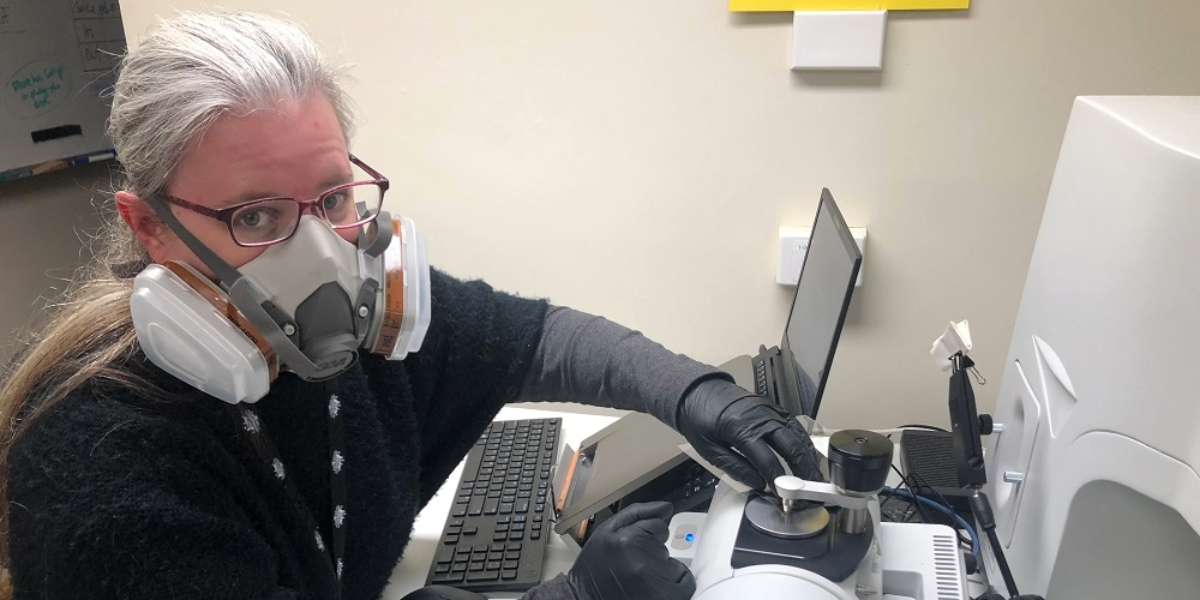
Lisa’s conservation obsession has now become reality. Six years on from starting her PhD, her research is increasing the awareness of hazards in the heritage sector. Her work raises questions about the identification and management of triphenyl phosphate, a hazardous chemical, and its potential impact on conservators like Lisa, who are entrusted with the care of collection objects.
Triphenyl phosphate – more commonly known as TPP – is widely used as a flame retardant, plasticiser and lubricant in plastics, including motion picture film, goggles and aircraft recognition models. As materials containing TPP deteriorate, TPP crystals can form on their surface. When disturbed, these crystals can be inhaled, ingested or absorbed through the skin, potentially interfering with hormonal function and contributing to a range of health concerns.
“I conducted a survey on what the industry was doing, what type of PPE they were using and whether they had identified TPP in their own collections,” she says.
“Between doing that and my own analysis of objects, I realised that not enough was being done to identify TPP in collections.”
A key challenge, she discovered, was the method they were using to detect the chemical compound. The traditional Fourier-transform infrared spectroscopy in attenuated total reflectance (FTIR-ATR) method – a surface-sampling technique that measures molecular vibrations and chemical bonds in solids, liquids, and pastes – was not producing the results she expected.
“I did the FTIR-ATR spectroscopy initially and couldn’t find TPP... I was just left thinking: ‘it has to be here, so why can’t I find it?’ It seemed strange that other people didn’t seem to be finding it either.”
In fact, only a very small group from the survey had identified TPP in their collections, and considering the likely widespread use of the chemical, the discrepancy got Lisa thinking ... what if the industry’s use of FTIR-ATR to detect TPP was missing the mark?
“I think sometimes we tend to focus our attention on what we know, which stops us from looking more broadly, and challenging our perspectives. When I started changing up how I did FTIR-ATR, that’s when I started to see what I needed.”
That change in part involved using multi-component search, which assisted in identifying TPP in materials before it became visible on the surface.
“When I started to use that technique, I realised that TPP is there, it is just hard to identify because it is dispersed throughout the plastic, resulting in a weak signal compared to the dominant polymer. Identifying weak but visible TPP peaks relevant to the identified polymer meant we could triage TPP- containing objects before TPP reached the surface,” she says.
Lisa has since used her research to create a guide for institutions on how to spot TPP in their collections – with real world impacts for the safety and health of conservators.
A standout feature of her PhD study was Lisa’s experience with the UC PhD Plus Program – giving her the opportunity to intern with the Australian War Memorial as she worked on her dissertation. The hands-on opportunity created connections that have lasted far longer than just her placement. It’s something she would recommend to other PhD students.
“The two supervisors I had at the Australian War Memorial, along with a few of the other people I worked with, came to my graduation. So, they were able to celebrate with me, which was fantastic,” she says.
“That intern experience is also how I ended up with the job I have now – so it all worked out very well.”
Today, working as a textile conservator, no two days are the same for Lisa.
“This morning for example, I was opening up boxes and looking at the items, working out how deteriorated they are, and spending a lot of time writing condition reports, but also thinking: how can we save these objects for the next generation?," she says.
“It’s exciting and interesting, and it really gets you thinking outside the box and working hard to make these important pieces of our history into things that will last.”
She also gives special mention to her professors at UC for their inspiration and guidance.
“They were the ones who suggested doing specific internships and working on certain objects over the years,” Lisa says.
“They made me who I am today.”
Having now completed four university degrees, Lisa is ready for a well-earned break, planning to focus purely on putting her learning into action – but as a lifelong learner working in a hands-on field, she knows the next research question is never far away.
“At work I do a lot of identification of different plastics used in textiles, and there is lots to investigate,” she says.
“It’s a massive area of research, so I’ll definitely be looking into a lot of those other potentially hazardous chemicals that become evident as textiles deteriorate.”
Words by Georgie Burgess. Photos by Teagan Glenane.