Alumni Stories
'Living the dream': Down syndrome no barrier to a degree for artist Rory O'Chee
Rory O’Chee was 12 when Santa brought him a digital camera. The gift – a Sony with an optical zoom – was quickly put to use on the streets of his home town.
“I started walking around the city, Brisbane city, Roma Street, Southbank – and we started from there,” he says .
He realised he had talent “on that very first expedition”, as did his family. Self-taught, Rory progressed to landscapes and started winning art prizes as a teenager, becoming one of the most awarded fine art photographers in the country.
Fifteen years after that fateful Christmas, Rory graduated this week with a Bachelor of Creative Industries (Visual Arts) from the University of Canberra via TAFE Queensland – thought to be among few handfuls of people with Down syndrome worldwide to receive a tertiary degree and only the second in Australia.
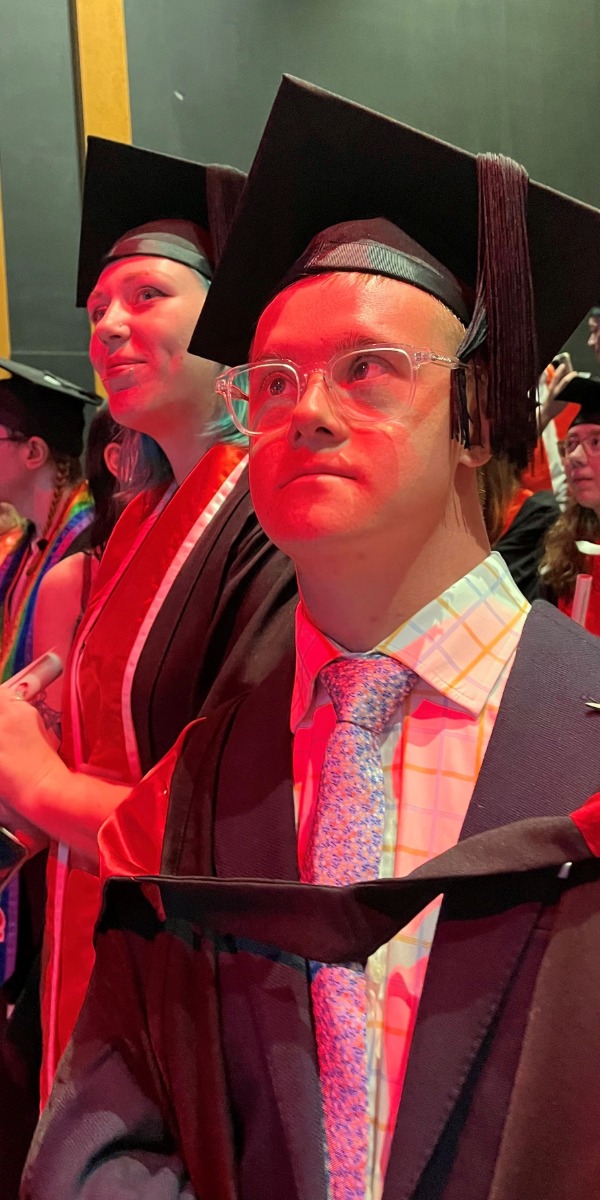
Rory beamed as he walked across the stage in his gown and mortarboard on Wednesday. He didn’t know what to expect from the day, but entered with a sense of achievement after seven years of study.
“All I can say is I have done it. My experience [of graduation] was mixed feelings of happiness and excitement. Overall a great day has happened, and my milestone is completed,” he says.
In the graduation crowd were his biggest supporters: his father Bill, his sister Ondine – who proofread his assignments – his photography mentor Michael Murchie, and his tutor, Irene Mengel.
Bill exudes pride in his son, who has been a finalist in the Stanthorpe Art Prize, one of the highest-value art prizes in Australia, a semi-finalist in the Moran Contemporary Photographic Prize, and a finalist, for multiple years running, in the Lethbridge Landscape Prize – among a slew of others.
“He's achieved in 27 years what many artists would be pleased to achieve by the time they're 40. And he's only getting better,” Bill says.
“We were so pleased for him to finish his degree, because he was spending five days a week at the library, just reading and looking at things!”
The degree experience “was nothing short of a challenge” Rory admits. He completed it part-time, sometimes just one subject at a time, sometimes faster. The pandemic threw a curve ball, forcing him into the virtual classroom, and he failed a few subjects along the way.
“There were a few catastrophic events, let’s say,” he says, joking about the ‘fails’. “There were a few times dad told me off about them!
“I almost felt like giving up sometimes, but I never did because I wanted to see how far I could go and push myself,” he said, crediting his mentors and teachers for their support.
“The university ensured I was surrounded by helpful people, pushing me to be my best. Sometimes I think I enjoyed it a little too much, because I grew a strong love for weekly study sessions and attending classes!”
While the university provided a tutor on campus, NDIS funding allowed him to also engage Irene as a private tutor. She had known him since he was a teenager, when one of his works was exhibited in her family’s Aspire Gallery.
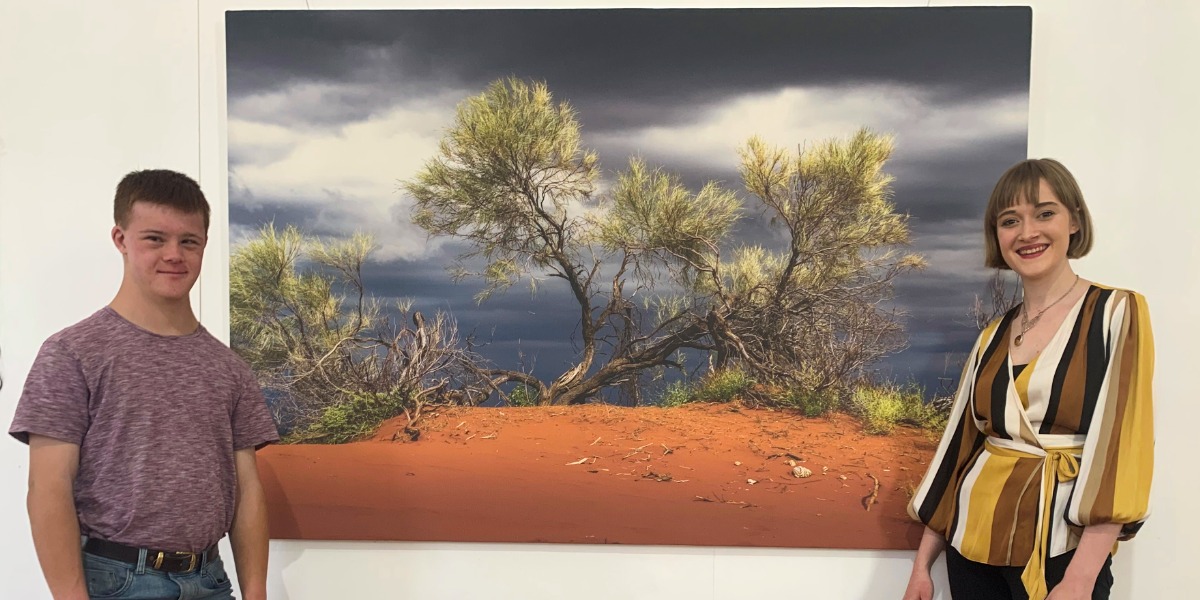
“Rory had the ideas. Every single assignment that he did at university, they were all his ideas, entirely his own,” Irene says, noting her task was to help him present the ideas and be understood.
“[Writing] full sentences is something he struggles with, and that's why a lot of his artist statements are written as poems, because it's actually easier for him to convey his thoughts without being constrained by what's typically considered good grammar.
“What I did like in his degree, was that he was not seen as any different, really – and he did fail a couple of subjects, so we knew that people weren't just letting him through.”
Rory names “handing assignments in on time” as his biggest challenge, partly because he would spend hours reading, studying and immersing himself in a subject, and partly because Down syndrome affects his fine motor skills, making the physical acts of writing or typing slow.
Irene, whose family’s gallery has Rory and a handful of other artists under management, admits they had reservations when they learned he was going to start a university degree. He had already completed a Certificate IV during Year 12, and then an Advanced Diploma in Digital Imaging through Southbank TAFE.
“We said ‘is [a bachelor’s degree] something he needs for his photography?’ You know, we were cautious of how Rory would find it,” Irene says. “But for both Bill and Rory, I think it was really to reinforce that aspect that he may have Down syndrome, but he is capable.”
Having watched his progression through the degree, Irene concluded it was a good choice for his photography career.
“You don't necessarily have to have an arts degree to pursue the arts, but I think it is a fantastic degree for people to do to broaden their understanding of the arts, and broaden how they explore things. And also, the way the University of Canberra really does focus on the practical side of it endures into the workplace,” she says.
“Photography is a very hard market here in Australia … and in the age of iPhones, anybody can take some nice photos, but Rory’s work has commercial appeal.
“I think the reason he has been successful, and why I see great success for him is – while he is a very traditional photographer – he is exploring alternative ways to elevate his work.”
Rory pointed to his heritage as the motivation for some of his latest artworks.
“I’m part Chinese, and have always been interested in Asian art – that plays a role in my composition and how I get it framed,” he says.
“I started doing research on the Chinese handscroll idea, on silk, and I do some of my photos on silk.”
His desire is to take his audience into his landscapes without a barrier, and Irene notes he doesn’t like his pieces displayed behind glass.
“He wants his photography to be the main star,” she says. His latest piece, printed on high quality archival paper, has 16 layers of varnish in lieu of glass.
Rory continues to shoot on a Sony camera – an A7 III – and captures his landscapes with his friend and mentor, Michael.
“I’ve been all around Western Queensland on many different road trips – it’s a yearly thing I’ve been doing with him,” Rory says.
Irene says Rory’s relationship with Michael – a successful photographer in his own right, albeit specialising in portraits – has provided him with confidence over the years, but it’s also a two-way street.
“Mick has said to me that he learns so much from Rory too, and seeing the way he views things has encouraged him to expand his own horizons, which is really lovely for a mentor to say,” she says.
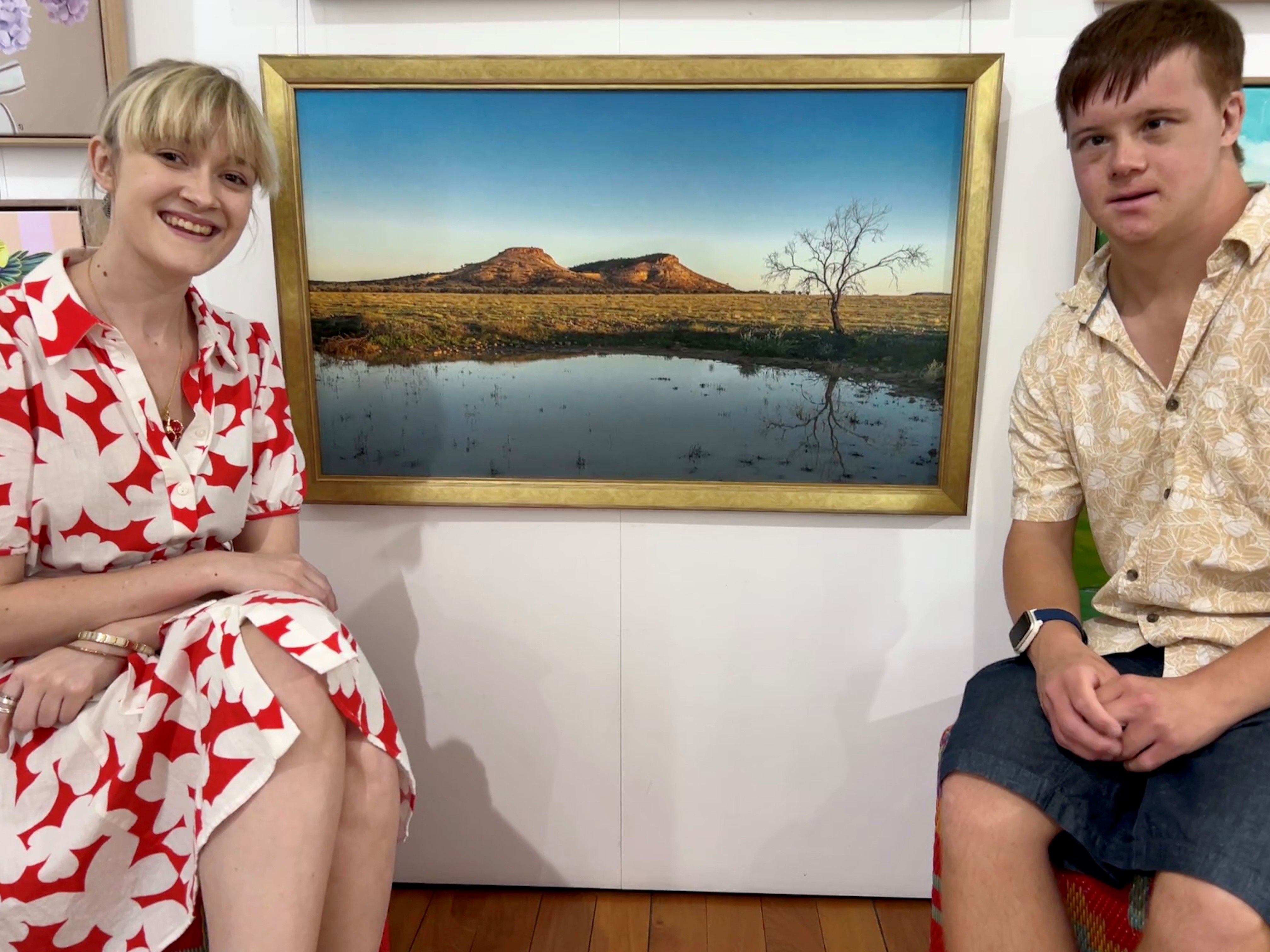
Sometimes the pair will drive hundreds of kilometres, only for Rory to sit and wait for his moment, taking just a few frames, confident he got the shot he wanted.
“While some people would fuss around with a shot, he sits down and gets the shot, and it will be fantastic,” Irene says. “Honestly, sometimes it is just one frame.”
From here, Rory hopes to make a career out of photography, stepping up his output now he is finished with his studies.
“Photography is my world. I am just living the dream,” he says.
Words by Fleta Page, photos supplied.