Ideas, Progress & the Future
'A pathway that made sense': Why Mary-Ellen is passionate about vocational education
In Year 10, Mary-Ellen Hooper was encouraged to consider whether completing her Higher School Certificate (HSC) was the right pathway for her.
School wasn't going particularly well – she could grasp complex ideas when a subject captured her interest, but struggled to stay focused and perform consistently when she couldn't see its relevance.
“I knew I could understand things, but I couldn't always translate that into results. I wanted to do well, but it was difficult to stay engaged when something didn't interest me or I couldn't see the purpose of learning it,” she says.
She persevered to complete Year 12 and get her HSC, after which she came across a NSW Health initiative that offered her the opportunity to study enrolled nursing through TAFE, while gaining practical experience in the workforce and earning an income.
For Mary-Ellen, vocational education offered a pathway into nursing when university seemed out of reach. Rather than returning to school or completing a bridging course, she was able to earn an income while studying towards a recognised qualification and experiencing the profession firsthand.
"TAFE gave me a pathway that made sense to me," she says. “I could earn money while studying something I was genuinely interested in, and I had the opportunity to experience nursing early on and discover whether it was something I really wanted to do."
For the first time, she could see how her interest in a subject, the knowledge she was developing, and her future career, all intersected.
"I could connect the theory to the care I was providing, and the nurse I was becoming. It gave me a sense of purpose and the confidence to recognise that I was capable of much more than my school results had suggested,” Mary-Ellen says.
It's funny to think I could have dropped out of school in Year 10. But in the end, the vocational path helped me find a profession I love and allowed me to go further with my education than I ever thought possible.
After completing her Certificate IV in Enrolled Nursing, Mary-Ellen continued to work as an Endorsed Enrolled Nurse while studying a Bachelor of Nursing at Charles Sturt University. She became a registered nurse, then completed a Master's degree in Mental Health Nursing through Newcastle University and went on to earn a PhD in Nursing, researching organisational culture and workforce retention in the profession.
It wasn’t until adulthood that Mary-Ellen was diagnosed with inattentive Attention Deficit and Hyperactivity Disorder (ADHD), providing a new perspective on her challenges with attention and organisation that had so significantly affected her education.
"Obviously not every student who struggles at school has ADHD, and vocational education is not necessarily the right choice for everyone,” she says. “The important thing is that everyone can find an educational pathway that works for their circumstances, motivations and aspirations.”
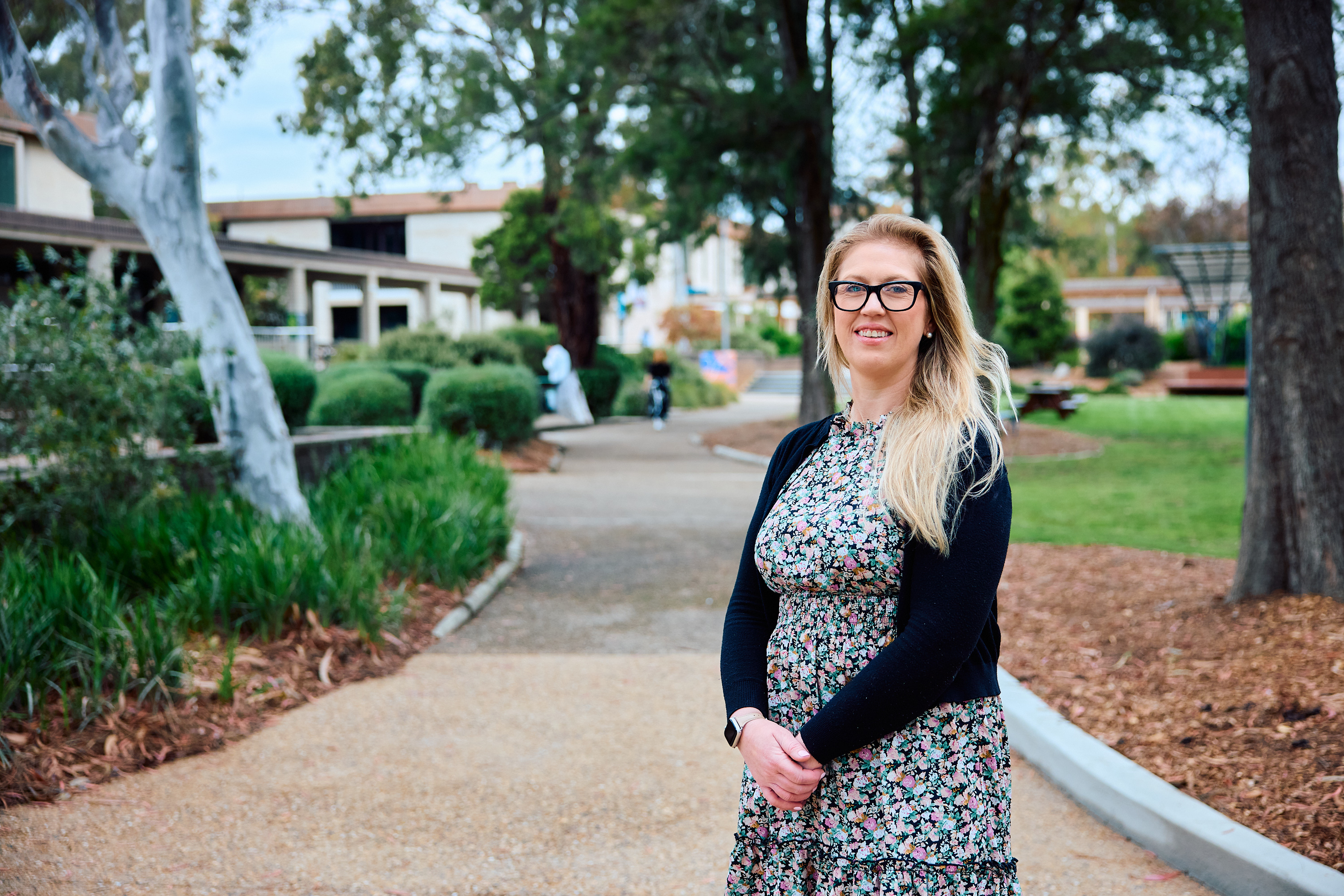
Today, Mary-Ellen is the Discipline Lead for Nursing at the University of Canberra and continues to practise part-time in mental health nursing with NSW Health.
She strongly believes in tertiary harmonisation – the strategic alignment of universities and vocational education – and as discipline lead, would love to work more closely with the Canberra Institute of Technology (CIT).
While she insists each program and institution needs to maintain distinct identities and educational focus, she thinks strengthened visibility and co-operation between UC and CIT could help students transition more seamlessly from one to the other, if they wish.
Eligible graduates of CIT's Diploma of Nursing can already receive up to 12 months' credit towards UC's Bachelor of Nursing, recognising their prior learning. However, Mary-Ellen believes the opportunity extends beyond credit recognition.
"We also need to understand what students have already learned, the capabilities they've developed and how we can best support them as they prepare for a different professional role," she says.
She notes the focus of a Diploma-qualified Enrolled Nurse is different from that of a Registered Nurse, particularly in terms of scope of practice, clinical responsibilities and accountability.
“The Bachelor of Nursing builds on the Diploma's foundations, developing broader capabilities in comprehensive assessment, clinical reasoning, decision-making and coordination of care,” Mary-Ellen says.
"It's about supporting Enrolled Nurses to transition into the broader responsibilities and accountability of a Registered Nurse, while recognising the knowledge, skills and professional experience Enrolled Nurses already have."
Mary-Ellen sees opportunities for CIT and UC to work more closely together – mapping curricula, understanding each other's learning outcomes and developing more coordinated support for students transitioning between qualifications.
We don't need two institutions delivering the same thing. We need to understand how our programs connect, so we can build on students' existing capabilities, while preserving the strengths of both educational pathways.
She believes closer collaboration could create clearer options for students whose circumstances or aspirations change – for instance, if they begin a Bachelor of Nursing, but wish to switch to an Enrolled Nursing qualification.
"Education doesn't always follow a straight line, and with every changing direction, we should look for ways to recognise what a student has already achieved," she says, noting UC’s Nursing discipline has many staff members who laid their career foundations with vocational training.
Whatever the pathway or qualification, Mary-Ellen says preparing nurses to deliver safe, high-quality care must be a shared priority for nursing educators, and one that could be strengthened through tertiary harmonisation.
"Ultimately, whether we're preparing Enrolled Nurses or Registered Nurses, we share the same goal of developing knowledgeable, capable nurses who can think critically, advocate for their patients and deliver safe, high-quality care," she says.
While she acknowledges some people will always want to start with a bachelor’s degree, Mary-Ellen fully believes the vocational educational pathway was the right one for her, and likely many others who, for whatever reason, don’t want to enter academia.
She admits she was “a very average student” for her bachelor and masters degrees, but flourished once she got to her PhD – her brain was better suited to the self-directed style, and she was deeply engaged with her research topic.
"I think I really found my feet during my PhD,” she says. “I had the freedom to explore questions, make connections and follow ideas in a way that suited how I think."
That way of thinking, and her struggles with education, made a lot more sense after her ADHD diagnosis.
"Like a lot of women, it was only when I started recognising similar traits in my children that I began to reflect on my own experiences,” she says.
“Looking back, my curiosity and love of learning were always strengths, and over time, with maturity and experience, I was able to develop strategies to help me make the most of those strengths.
"I gradually learned to break bigger goals into smaller, achievable steps and find motivation in the progress I was making."
She says her curiosity and genuine interest in nursing, along with that strategy, played the most important role in her success.
“I'm really glad I started in vocational education, because it sparked that interest,” she says.
"My experiences as an Enrolled Nurse shaped the Registered Nurse, academic and educator I became. I wouldn't change that.”
Words by Fleta Page. Photos by Chris Walsh.