Alumni Stories
GRADS 2026: Macey Barratt
University of Canberra graduate Macey Barratt has many stories that will make you cry. The introduction to her PhD thesis alone often brings people to tears.
In her years working as a paediatric nurse, Macey has helped families navigate their darkest times while helping their sick children to die as comfortably as possible.
The bubbly 35-year-old doesn’t shy away from the fact it can be distressing work.
“Unfortunately, a lot of the families I have had the privilege of caring for, their children are no longer with us. And sometimes it's done beautifully, palliative care for children – it can be beautiful, but it is still gut-wrenching,” she says.
“There's what I call the ‘collateral beauty’, which is that it's such an amazing, beautiful place to work, with so much richness and meaning behind everything you do. But there is obviously also that collateral of the fact that you are supporting people to pass away, who are not ready to pass away ... whose families are not ready to let them pass away,” she says.
“It has very much shaped me to be somebody who recognises how precious life is, how quickly everything can change, and that you have to live every single moment and make it count.
“That's what I've learned from all those families ... I’ve learned so much from those families.”
Macey spent 10 years nursing all over Australia, Europe, the United States and even the Saudi Arabian desert. She has travelled to 70 countries, and at one point took a career break to run a bar in Thailand. A polyglot, Macey learned Arabic in two months, and speaks Thai, Italian, Spanish and Bahasa Indonesian.
And on Monday, she graduated with a PhD.
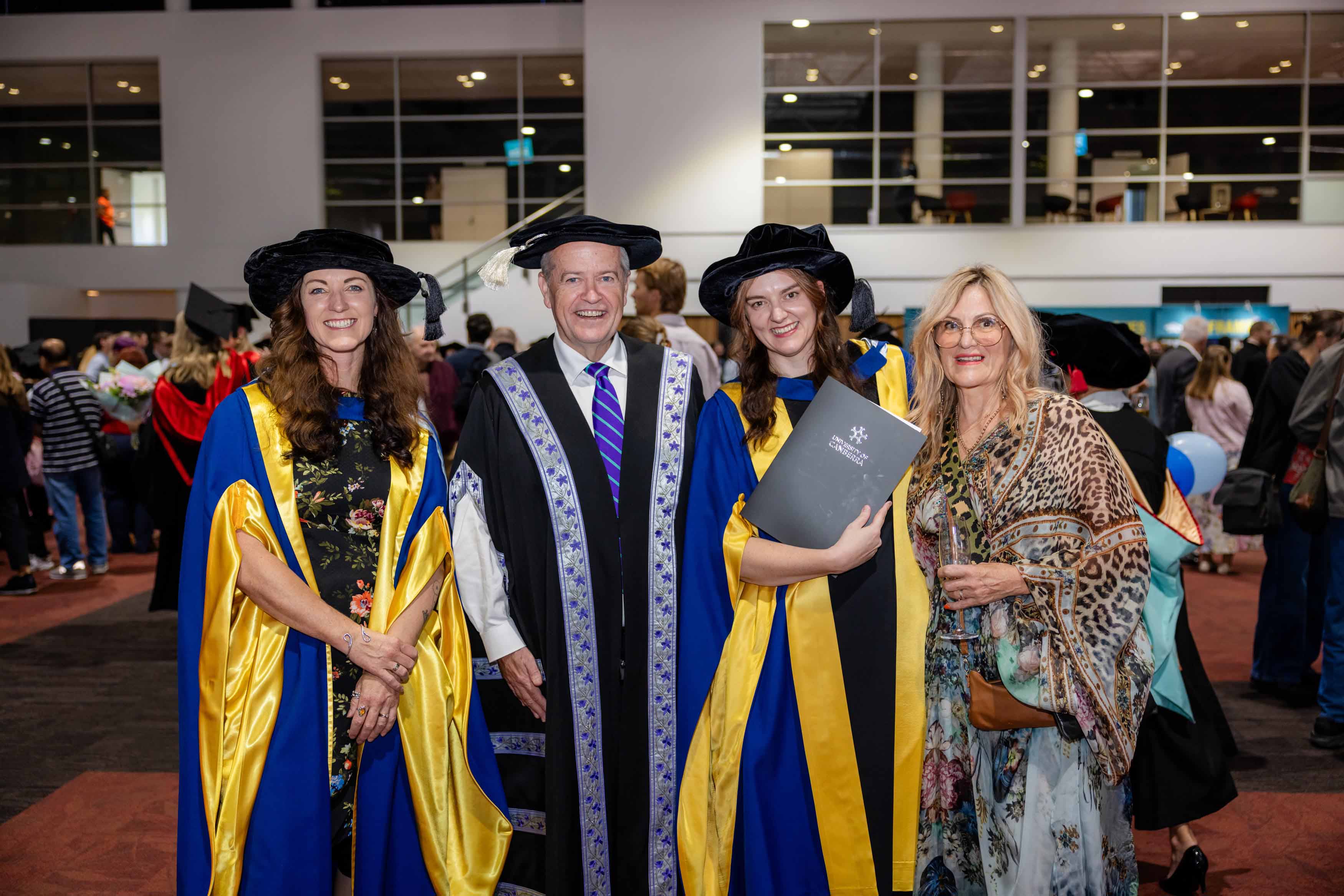
Professor Kasia Bail, her primary PhD supervisor and teaching colleague in the Faculty of Health describes Macey as “inexhaustible in her own pursuit of self-improvement”.
“She's one of those rare people who have kind of unending energy and enthusiasm for all people around them. Macey always finds a way to connect everybody and bring out their best,” Kasia says.
Her switch from frontline nursing to academia came during the COVID-19 pandemic. Macey was working in Europe in 2019 when word spread of a new respiratory virus. Having lived in Saudi Arabia through the initial outbreak of Middle East Respiratory Syndrome (MERS) – another coronavirus – Macey knew what was coming and chose Canberra as her escape destination.
“I moved here for my friend network … I picked a little bubble that I knew I'd be supported in. And I honestly have the best network of people in Canberra,” she says.
What started as a master’s degree at UC – while working as a community paediatrics nurse and pondering her future – soon morphed into a PhD after a conversation with one of her teachers, Professor Catherine Paterson.
'Triadic partnership nursing’: A new definition
Macey’s research topic was the partnership between nurses, parents and children with long-term conditions – a harmonisation she had witnessed at times and always tried to practise herself, but one that had not been previously documented.
As part of her research, Macey observed a paediatric unit renowned for its excellent nursing.
“I wanted to observe what they do really, really well and map out what that looks like, so it could be taken to other places,” she says.
Kasia said Macey’s research identified and established the definition of triadic partnership nursing.
“The old definition of partnership nursing was focused on either of the dyads – so either looking at the parent and child, or the child and the nurse, or perhaps the nurse and the parent – and not recognising that the three-way relationship is instrumental. It’s the constant negotiation and re-negotiation of that three-way relationship that makes nursing care work effectively,” Kasia says.
The need for re-negotiation comes from nurses changing shifts, multiple parents or grandparents involved as carers, and the child – the one constant in the triad – can have a changing preference or ability for their level of involvement in decision-making.
Macey says a key to the partnership is acknowledging the expertise of the family of a child with a long-term condition or disability that's complex or life-limiting.
“As a parent, you need to be seen as an expert, because you are the one at home with this child 24/7. You're the nurse and the doctor and the physio, you're everybody,” she says.
“But then you come into the hospital and sometimes you need to breathe – but you may not have that trust in the nurses and doctors yet.”
Kasia notes the exhaustive and groundbreaking work done in researching the child’s perspective in the triadic partnership.
“Macey used multi-method data collection approaches, using Lego or other games and ways of being able to interpret and listen to what the child is trying to say, whether by behaviours or verbally,” she says.
Macey explains that even if the child isn’t able to communicate, the partnership sees them as “somebody who should be able to be informed and make decisions”.
The feedback from the examiners – international ethicists and paediatric nursing experts – all noted the thesis was an exceptional piece of work.
“She was already extensively cited with more than 50 citations before she even finished her PhD,” Kasia says. “This is uncommon, particularly in nursing, and shows the need and relevance of her work across the globe.”
‘It takes a village’
Macey took a partnership approach to her PhD studies too – building a “village of women” to support each other through their doctorate journey, which Macey completed in just four years, part time.
“One of the highlights is the people I've met along the way. Honestly, you can't do it without them,” she says.
“So many people feel like they are alone in a PhD journey, because it’s so big and it's so personal that it's sometimes hard for people to share it. Being able to have that beautiful group of women and connect and just rely on each other for when we have those ups and we have those down days is so important.”
Bringing a curriculum of care to life
Macey completed her thesis while also working full-time – in research and as a lecturer, receiving a University citation in 2024 for outstanding contributions to student learning, having gamified the often-dry nursing topics of law and ethics.
Fun, she says, is important. It’s why she has always loved working with kids, be it as a nanny in her teens or as a nurse – which she pivoted to after a brief flirtation with physics, but was turned off by a class on weapons systems.
Kasia says UC is privileged to have Macey teaching the next generation of nurses.
“She has supported many children to die well, in complex places with complex diseases, and fought to advocate for their wellbeing and dignity sometimes in the midst of strong cultural biases and complex social and organisational hierarchies,” she says.
“She tells them clinical stories that make their eyes water and mouths drop.
“Obviously we've got our curriculum … but Macey brings that to life in the classroom including some worst case scenarios and the examples of the advocacy patients need. That's really inspiring for students. She makes the textbooks come to life.”
Taking advocacy skills to the disability sector
Post-PhD, Macey is now leading a national project to co-design psychotropic medicine information sheets for people with intellectual disabilities, for which she received a $1.87 million Commonwealth grant – incidentally, the first grant she’d ever applied for.
Her colleagues were unsurprised by the successful funding application, given Macey’s expertise in advocating for those who may not be able to speak easily for themselves.
Kasia says the research is in a complex area that “most people try to leave alone” – but Macey is still not shying away from trying to give people better quality of life.
“She has the drive and wisdom to make a change, not just to get a PhD, not just to teach in the classroom – this is about making the world a better place,” Kasia says.
“Macey is unafraid to lead in complex areas of healthcare that others may shy away from. She is not just making a difference with her work, but opening doors for so many others to contribute to positive change”.
While Macey once dreamed of chairing the United Nations Convention on the Human Rights of Children, she now sees endless opportunity in the disability sector.
“As I do this work, I recognise there are so many more new and emerging areas that could be targeted, where research and community could be integrated and strengthened to improve the health and wellbeing of people with disability,” she says.
Despite a heavy workload of teaching and conducting co-design workshops across the country and as a core member of the Centre for Ageing Research and Translation, Macey’s desire to work on the frontline with children is unwavering. In coming weeks, she will take on casual night shifts in a local paediatric ward.
“I just want to get the skills back up,” she says. “I'm sure it's like riding a bike.”
Words by Fleta Page, photos by David Barber.
Congratulations to all our graduates this March and welcome to the UC alumni community!
Behind each testamur lies a story of aspirations, inspiration, sacrifice and hard work – and our graduates have risen to meet every challenge with spirit, heart, creativity and courage.
We couldn’t be prouder of what they have achieved and the people they are today.
They now embark on a new chapter with the skills and knowledge gained, and the values embedded from their years of study and practice at UC.
Wherever they carve out their paths, we look forward to seeing what they’ll do next on a journey of lifelong learning.